The art of snow and script
Iranian-born artist connects wintry Manitoba, Persian creative tradition

Advertisement
Read this article for free:
or
Already have an account? Log in here »
To continue reading, please subscribe:

Digital Subscription
One year of digital access for only $205*
- Enjoy unlimited reading on winnipegfreepress.com
- Read the E-Edition, our digital replica newspaper
- Access News Break, our award-winning app
- Play interactive puzzles
*First annual payment billed as $205.00 + GST for one year. This annual subscription will automatically renew at $233.00 + GST every 52 weeks (10% off the regular annual price of $259.35). Offer available to new and qualified returning subscribers only. Cancel any time.
To continue reading, please subscribe:
Add Free Press access to your Brandon Sun subscription for only an additional
$1 for the first 4 weeks*
- Enjoy unlimited reading on winnipegfreepress.com
- Read the E-Edition, our digital replica newspaper
- Access News Break, our award-winning app
- Play interactive puzzles
*Your next Brandon Sun subscription payment will increase by $1.00 and you will be charged $17.95 plus GST for four weeks. After four weeks, your payment will increase to $24.95 plus GST every four weeks.
Read unlimited articles for free today:
or
Already have an account? Log in here »
Between the Two, Hamideh Behgar’s current solo show at Aceartinc., is a bridging of worlds.
Iran, her homeland, and Canada, her current home. Persian architecture and Prairie landscape. Past and present. Here, there and in between.
Winnipeg visual artist Hamideh Behgar gives her pieces a sense of movement, growth and momentum, but what the viewer perceives in the shapes is up to them.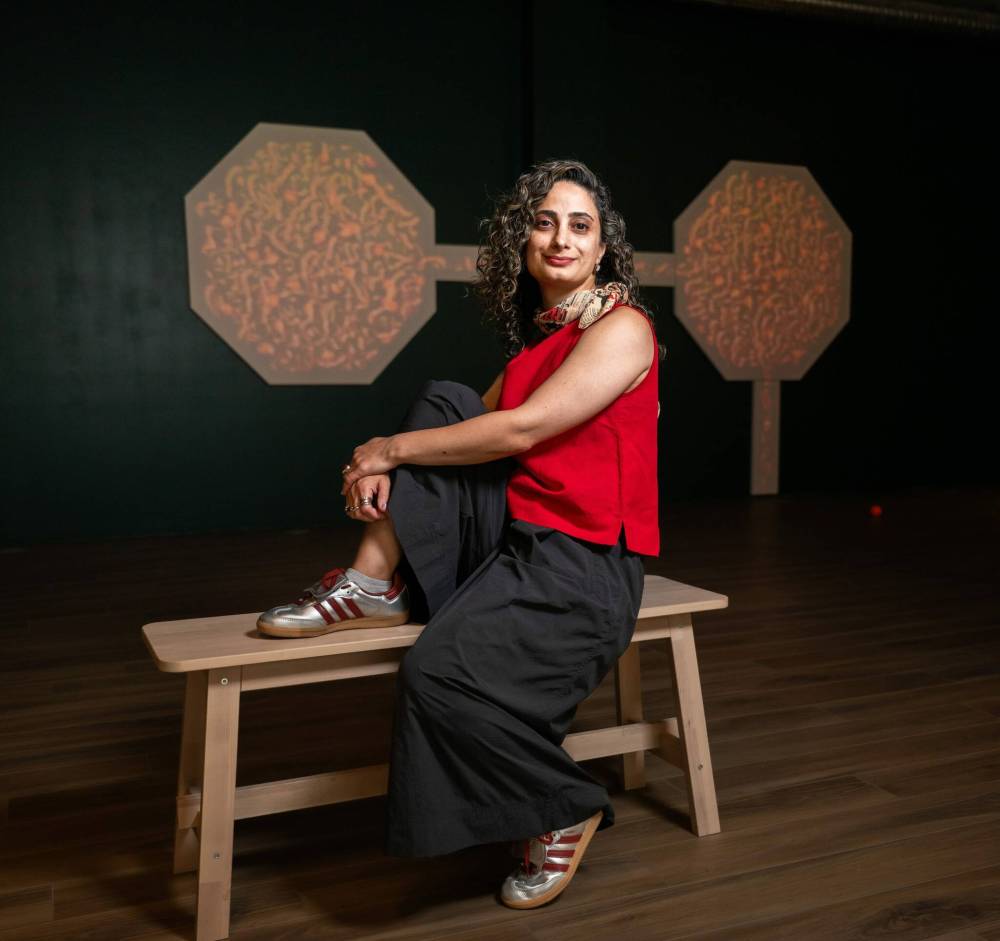
Behgar, 38, came to Winnipeg from Iran in 2021 to earn her MFA at the School of Art at the University of Manitoba, which she completed in 2023.
As she was trying to get a handle on what she might do for her thesis — fine art was a newer practice for her; she has a bachelor’s degree in graphic design from the University of Applied Science & Technology in Kish, Iran — she spent a lot of time walking in King’s Park.
“We have snow in Iran, but you cannot even compare it with what you get in Canada,” she says with a laugh.
“Every day that I went there, I had my camera to take photos, and then I found that I’m getting, somehow, a repetitive pattern of the form of the snow on the ground.”
Behgar especially liked the organic shapes that form in the surface of the snow during freeze-thaw cycles — breaks and cracks and holes. She took black-and-white photos and hung them up in her studio.
The playful sculptural works in her thesis exhibition, 2023’s Embracing Imperfection, took some cues from those organic elements; Behgar wanted to explore the idea of free play and interactivity (not unlike, perhaps, the way one might play in snow).
But after she finished her thesis, those snow photos kept calling out to her. She began experimenting, making digital drawings over top of them.
And then, she had an ‘a-ha’ moment.
“I found these abstract forms that were somehow very similar to Farsi script and Farsi calligraphy… It was something … I don’t know. I felt something.”
“I found these abstract forms that were somehow very similar to Farsi script and Farsi calligraphy. They are not alphabet, you cannot read them. It was something … I don’t know. I felt something,” she says.
“Eventually, I got this visual language from the snow here, and for me it was like, OK, now I’m somehow bringing what I feel, my experiences from the memory, like from everything that I had in Iran, here in the new land that I’m living, and how I can make a bridge between these two lands?”
Those Farsi-inspired shapes can be found throughout the works in Between the Two. As Behgar says, the marks are asemic — meaning they resemble writing but cannot be read — but, as she says in her artist statement, they echo the rhythm of Farsi script.
Behgar was also inspired by the centuries-old art form of Persian miniature painting.
Whole worlds are depicted in these small but finely detailed works, which often accompanied text narratives and are characterized by vivid colours, even light (no shadows) and flat but intricately layered perspective, allowing for multiple narratives to unfold in a single scene.
“Using the Persian miniature, like the layering and everything, came to my mind during that time.”
She’d grown up seeing Persian miniature in Iran, but studying it during a residency at the Banff Centre for Arts and Creativity this past spring gave her a new perspective. The idea that the stories told in these miniature paintings are multi-layered, not linear, resonated with her.
“Using the Persian miniature, like the layering and everything, came to my mind during that time,” she says.
That time was also difficult. The war between Israel and the U.S. and Iran had just broken out and, while she was in Banff in March, she saw news of the airstrikes hitting Tehran during Nowruz, or the Persian New Year.
“So, it was a very hard time for me. I was alone in the mountains, the time that I should enjoy just being with my cohorts and making art. But somehow it was very hard for me because I had to focus and I wanted to take advantage of the time that I had there. So I just started to produce more and more work. These are all the pieces I made there.”
While her works are more abstract than traditional Persian miniature — which she is not recreating but reinterpreting — they have that same sense of overlap, some created from five or six layers of paper, and borrow from the rich colour palette.
ROBERT LEE / FREE PRESS Behgar's Between the Two draws on the visual and architectural traditions of Persian miniature painting and the snowy landscapes of Manitoba.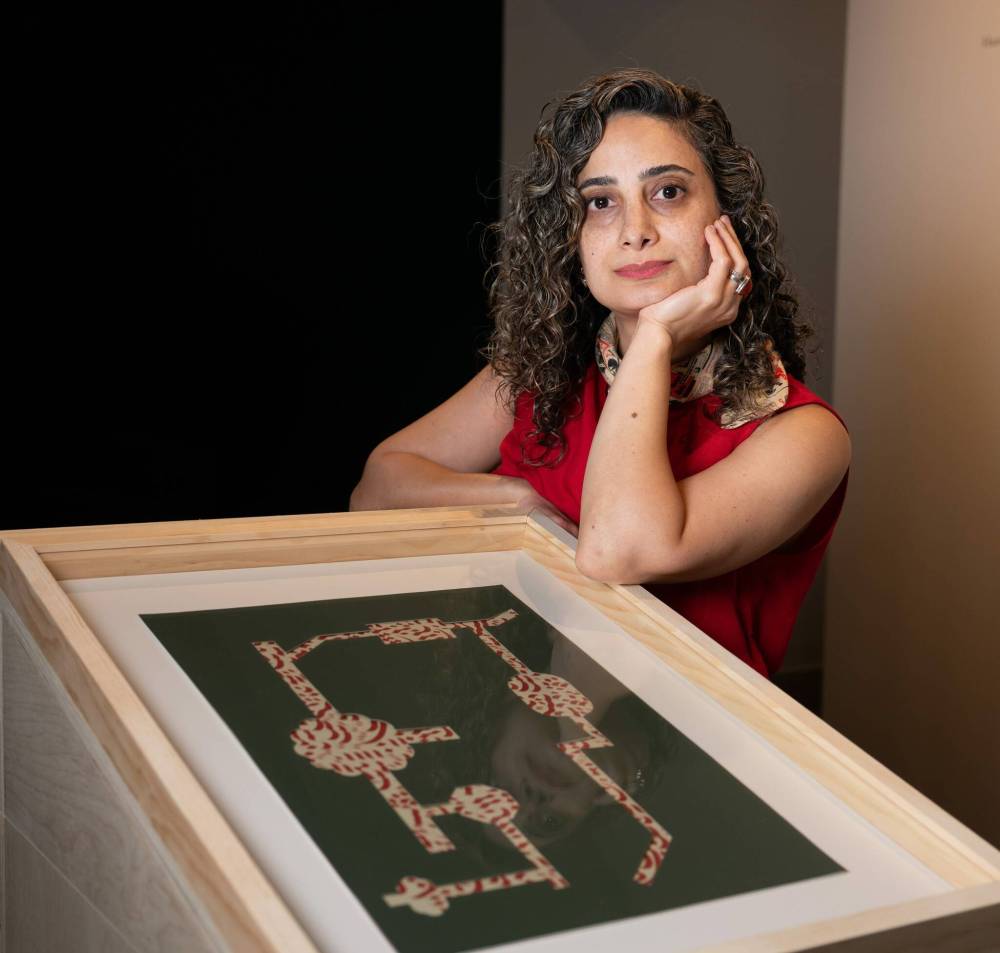
The exhibition includes physical structural elements, such as a window, staircase and curtains, that make you feel as though you’re inside of one of these miniatures. Geometric water fountains and channels, another fixture of Persian miniature, also appear in the abstract here.
Behgar gives her pieces a sense of movement, growth and momentum, but what you see — Farsi script, vines, water, snow prints — is up to you.
“These little pieces, I don’t call them alphabet. I don’t call them forms from the snow. It’s like abstract forms, organic forms, that all the time they are just moving and dancing and flowing.”
jen.zoratti@winnipegfreepress.com

Jen Zoratti is a columnist and feature writer working in the Arts & Life department, as well as the author of the weekly newsletter NEXT. A National Newspaper Award finalist for arts and entertainment writing, Jen is a graduate of the Creative Communications program at RRC Polytech and was a music writer before joining the Free Press in 2013. Read more about Jen.
Every piece of reporting Jen produces is reviewed by an editing team before it is posted online or published in print – part of the Free Press‘s tradition, since 1872, of producing reliable independent journalism. Read more about Free Press’s history and mandate, and learn how our newsroom operates.
Our newsroom depends on a growing audience of readers to power our journalism. If you are not a paid reader, please consider becoming a subscriber.
Our newsroom depends on its audience of readers to power our journalism. Thank you for your support.
Exhibition preview
Hamideh Behgar: Between the Two
● Aceartinc., 206 Princess St.
● To Sept. 26
Jen Zoratti is a columnist and feature writer working in the Arts & Life department, as well as the author of the weekly newsletter NEXT. A National Newspaper Award finalist for arts and entertainment writing, Jen is a graduate of the Creative Communications program at RRC Polytech and was a music writer before joining the Free Press in 2013. Read more about Jen.
Every piece of reporting Jen produces is reviewed by an editing team before it is posted online or published in print – part of the Free Press‘s tradition, since 1872, of producing reliable independent journalism. Read more about Free Press’s history and mandate, and learn how our newsroom operates.
Our newsroom depends on a growing audience of readers to power our journalism. If you are not a paid reader, please consider becoming a subscriber.
Our newsroom depends on its audience of readers to power our journalism. Thank you for your support.
Advertisement Advertise With Us
Advertisement Advertise With Us