

Opaskwayak restorative justice court to give offenders opportunity to ‘heal’

Advertisement
Read this article for free:
or
Already have an account? Log in here »
To continue reading, please subscribe:

Digital Subscription
One year of digital access for only $205*
- Enjoy unlimited reading on winnipegfreepress.com
- Read the E-Edition, our digital replica newspaper
- Access News Break, our award-winning app
- Play interactive puzzles
*First annual payment billed as $205.00 + GST for one year. This annual subscription will automatically renew at $233.00 + GST every 52 weeks (10% off the regular annual price of $259.35). Offer available to new and qualified returning subscribers only. Cancel any time.
To continue reading, please subscribe:
Add Free Press access to your Brandon Sun subscription for only an additional
$1 for the first 4 weeks*
- Enjoy unlimited reading on winnipegfreepress.com
- Read the E-Edition, our digital replica newspaper
- Access News Break, our award-winning app
- Play interactive puzzles
*Your next Brandon Sun subscription payment will increase by $1.00 and you will be charged $17.95 plus GST for four weeks. After four weeks, your payment will increase to $24.95 plus GST every four weeks.
Read unlimited articles for free today:
or
Already have an account? Log in here »
The Manitoba government, provincial court and Opaskwayak Cree Nation are signing a memorandum of understanding today to establish a community-led court focused on Indigenous restorative justice principles.
Justice Minister Matt Wiebe is in the northern First Nation, which neighbours The Pas, to attend this week’s Opaskwayak Indigenous Days summer festival, ahead of the signing of the nation-to-nation agreement after a pipe ceremony today.
“This is really a pivotal marker on the path to reconciliation for our justice system and an incredible opportunity to begin the process of reconciling the two systems of justice, that being the traditional Indigenous justice system with our colonial system,” Wiebe told the Free Press on Wednesday.
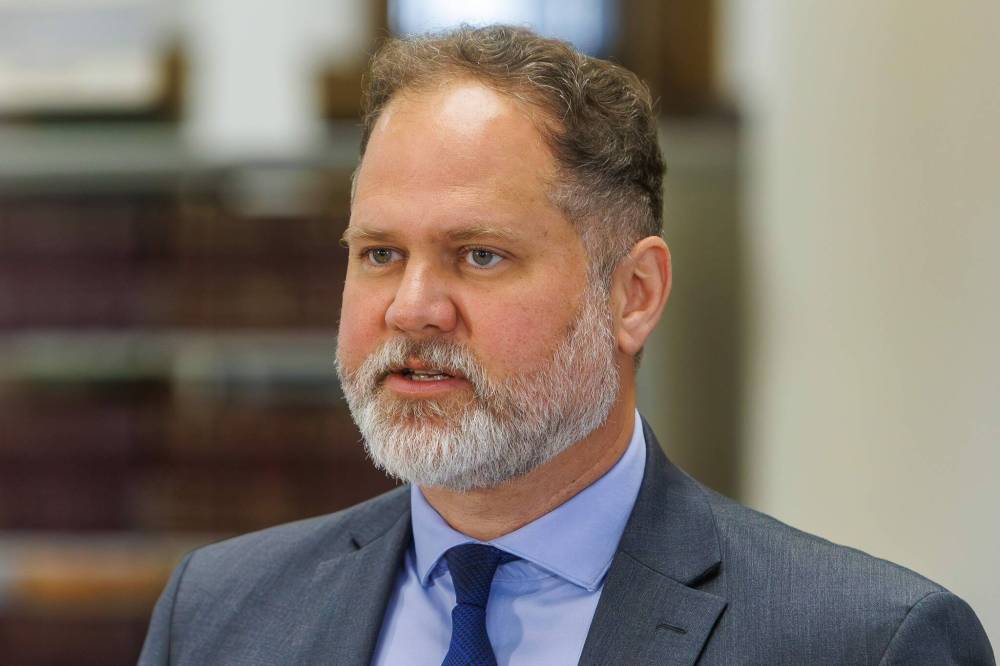
MIKE DEAL / FREE PRESS FILES
Justice Minister Matt Wiebe will be signing a memorandum of understanding today to create a community circuit court that will include the involvement of Opaskwayak elders and community resources and services.
“I’m just excited to be here to have the opportunity to formally mark the collaboration, but really to listen and to hear from community about the best ways, the best path forward.”
As part of the agreement, certain provincial court proceedings will be held on a weekly basis in Opaskwayak’s veteran’s hall.
“It’s historic for the province of Manitoba,” said Diane Pelly, the executive director of OCN’s government services, who is overseeing the community’s new restorative justice program.
The community circuit court will be overseen by a provincial court judge, but will include the involvement of Opaskwayak elders and community resources and services.
The court will see all involved — judge, Crown prosecutors, defence lawyers, elders, the offender and victim, if appropriate — sit across from each other in a circle, after smudging ceremonies.
The aim of the new court will be to resolve offenders’ criminal charges via diversions to the community’s restorative justice program, and to set them up toward a better path in life — away from the justice system.
Members of Opaskwayak charged with criminal offences have previously gone to court in The Pas but all will make their first appearance in the community court once it begins operating.
Depending on the nature of the offence, and with input of the judge overseeing the court, some cases will be referred to Opaskwayak’s justice council to decide whether it can be diverted to the restorative justice program or should proceed through the regular court system, said Pelly.
“Our new system is going to focus on healing. It’s going to focus on not so much the offence — that’s a big part of it, but it’s going to focus on the reasons why,” said Pelly.
“We know that even in this day and age, in 2026, our people are still going through what is called intergenerational impacts (of residential schools and colonialism), and how long those impacts last, we don’t know. Our goal is to reduce it and start our next generation off in good, healthy, healing ways.”
Those who participate will be given wraparound supports and will be expected to take ownership and accountability for what they’ve done, then take steps to correct their behaviour, said Pelly.
The justice council will be involved in determining appropriate sentences for offenders participating in the program — which may include sessions in a traditional healing program out on the land.
If someone consistently does not participate, their case would be sent back to the regular court system.
“It’s important to recognize that. ‘Here’s an opportunity for you. Take it, heal, heal your family, become a good community member.’ And if they choose to, great, and that’s the goal,” said Pelly.
“But if they don’t, then they still need to go back to be held accountable for their actions in another venue, which would be provincial court in The Pas.”
Pelly said Opaskwayak’s restorative justice program will also include prevention services and anti-gang programming meant to keep people, especially youth, away from crime and out of the system in the first place, and programming to help OCN members who’ve been incarcerated reintegrate into the community in a positive way.
She said the community’s chief and council have supported the establishment of the program, which will employ about 15, with more than $1-million in funding this year.
Wiebe said the new court will create opportunities for victims and the community at large to be involved in the justice process.

“What we’re talking here is really building, from the ground up, a new way of doing justice in a community,” said Wiebe.
“By bringing in those traditional values, the traditional spiritual practice, the land-based healing, involving elders in the process, while continually focusing on the victim, we know that there’s more opportunity to get justice right in a community, to do it in a way that speaks to the people who are affected.”
Wiebe and Pelly said the approach is aimed at reducing the over-representation of Indigenous people in the justice system.
Officials have not yet disclosed a timeline for when the weekly court sittings may begin.
erik.pindera@freepress.mb.ca
Erik Pindera is a reporter for the Free Press, mostly focusing on crime and justice. The born-and-bred Winnipegger attended Red River College Polytechnic, wrote for the community newspaper in Kenora, Ont. and reported on television and radio in Winnipeg before joining the Free Press in 2020. Read more about Erik.
Every piece of reporting Erik produces is reviewed by an editing team before it is posted online or published in print — part of the Free Press‘s tradition, since 1872, of producing reliable independent journalism. Read more about Free Press’s history and mandate, and learn how our newsroom operates.
Our newsroom depends on a growing audience of readers to power our journalism. If you are not a paid reader, please consider becoming a subscriber.
Our newsroom depends on its audience of readers to power our journalism. Thank you for your support.
Erik Pindera is a reporter for the Free Press, mostly focusing on crime and justice. The born-and-bred Winnipegger attended Red River College Polytechnic, wrote for the community newspaper in Kenora, Ont. and reported on television and radio in Winnipeg before joining the Free Press in 2020. Read more about Erik.
Every piece of reporting Erik produces is reviewed by an editing team before it is posted online or published in print — part of the Free Press‘s tradition, since 1872, of producing reliable independent journalism. Read more about Free Press’s history and mandate, and learn how our newsroom operates.
Our newsroom depends on a growing audience of readers to power our journalism. If you are not a paid reader, please consider becoming a subscriber.
Our newsroom depends on its audience of readers to power our journalism. Thank you for your support.
Related Articles
Restorative justice program helps newcomers find their way



Advertisement Advertise With Us
Advertisement Advertise With Us