Hidden danger
Rare and tough to notice, sarcomas may lurk in the body

Advertisement
Read this article for free:
or
Already have an account? Log in here »
To continue reading, please subscribe:

Digital Subscription
One year of digital access for only $205*
- Enjoy unlimited reading on winnipegfreepress.com
- Read the E-Edition, our digital replica newspaper
- Access News Break, our award-winning app
- Play interactive puzzles
*First annual payment billed as $205.00 + GST for one year. This annual subscription will automatically renew at $233.00 + GST every 52 weeks (10% off the regular annual price of $259.35). Offer available to new and qualified returning subscribers only. Cancel any time.
To continue reading, please subscribe:
Add Free Press access to your Brandon Sun subscription for only an additional
$1 for the first 4 weeks*
- Enjoy unlimited reading on winnipegfreepress.com
- Read the E-Edition, our digital replica newspaper
- Access News Break, our award-winning app
- Play interactive puzzles
*Your next Brandon Sun subscription payment will increase by $1.00 and you will be charged $17.95 plus GST for four weeks. After four weeks, your payment will increase to $24.95 plus GST every four weeks.
Read unlimited articles for free today:
or
Already have an account? Log in here »
Last summer, Michelle Finley was going about a normal day.
She had just dropped her car off at a garage and was walking back to her office building downtown when, suddenly, she was stopped in her tracks by a searing cramp on the bottom of her right foot.
“It was so painful it took my breath away,” says Finley, now 52. “I stopped and held on to the side of a building for a second — like, it was bringing tears to my eyes.”
MIKAELA MACKENZIE / FREE PRESS Michelle Finley had to have her foot amputated due to an aggressive sarcoma — a type of cancer that starts in the body’s connective and supportive tissues.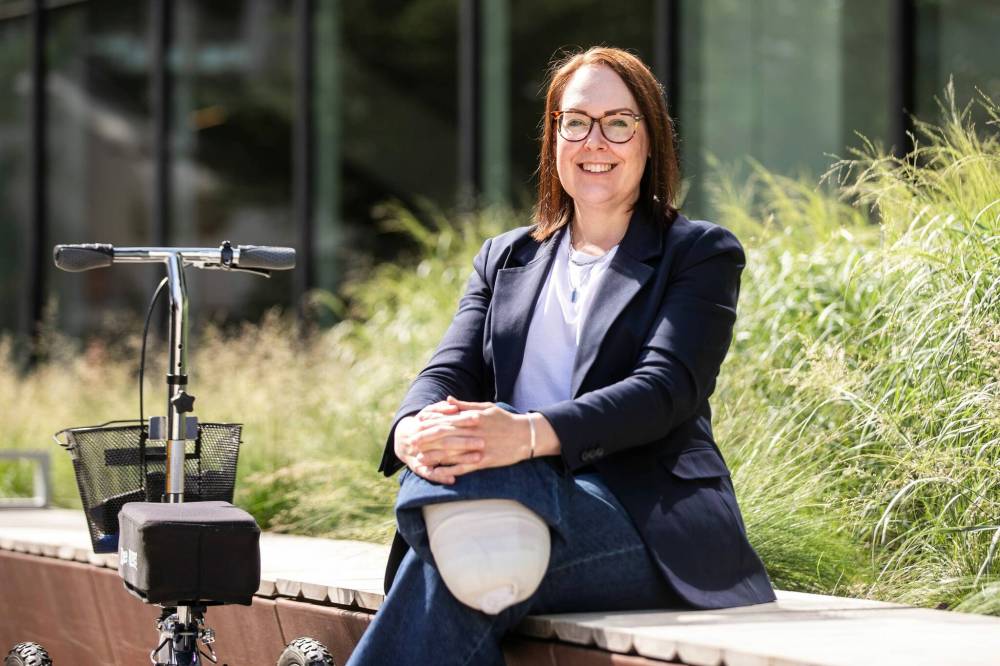
Finley thought she had a really bad case of plantar fasciitis. Nine months later she would lose her foot to sarcoma.
Sarcomas are cancers which develop in connective tissue and are generally divided into two groups: bone or soft tissue, such as muscle, nerves or skin. Bone sarcomas are most commonly seen in the pediatric or younger population; soft-tissue sarcomas are most commonly found in adult or elderly populations.
“We can have sarcomas anywhere on our body because we have connective tissue everywhere on our body,” says Dr. David Perrin, a cancer surgeon at CancerCare Manitoba in Winnipeg and the province’s first and only orthopedic oncologist — though he’s quick to point out he’s not the only sarcoma surgeon in the province and that he’s surrounded by a team of sarcoma specialists. He is also the doctor who treated Finley.
Sarcomas are rare. So rare, in fact, that they don’t have the name recognition of other types of cancer.
“When I teach medical students, I always ask, ‘Who knows what Terry Fox died of?’ And most everyone knows Terry Fox. Everyone knows he died of cancer, but nobody knows what cancer he had. So whenever I tell med students Terry Fox died of an osteosarcoma, all these light bulbs go on.”
CANADIAN PRESS ARCHIVE Terry Fox died of an osteosarcoma.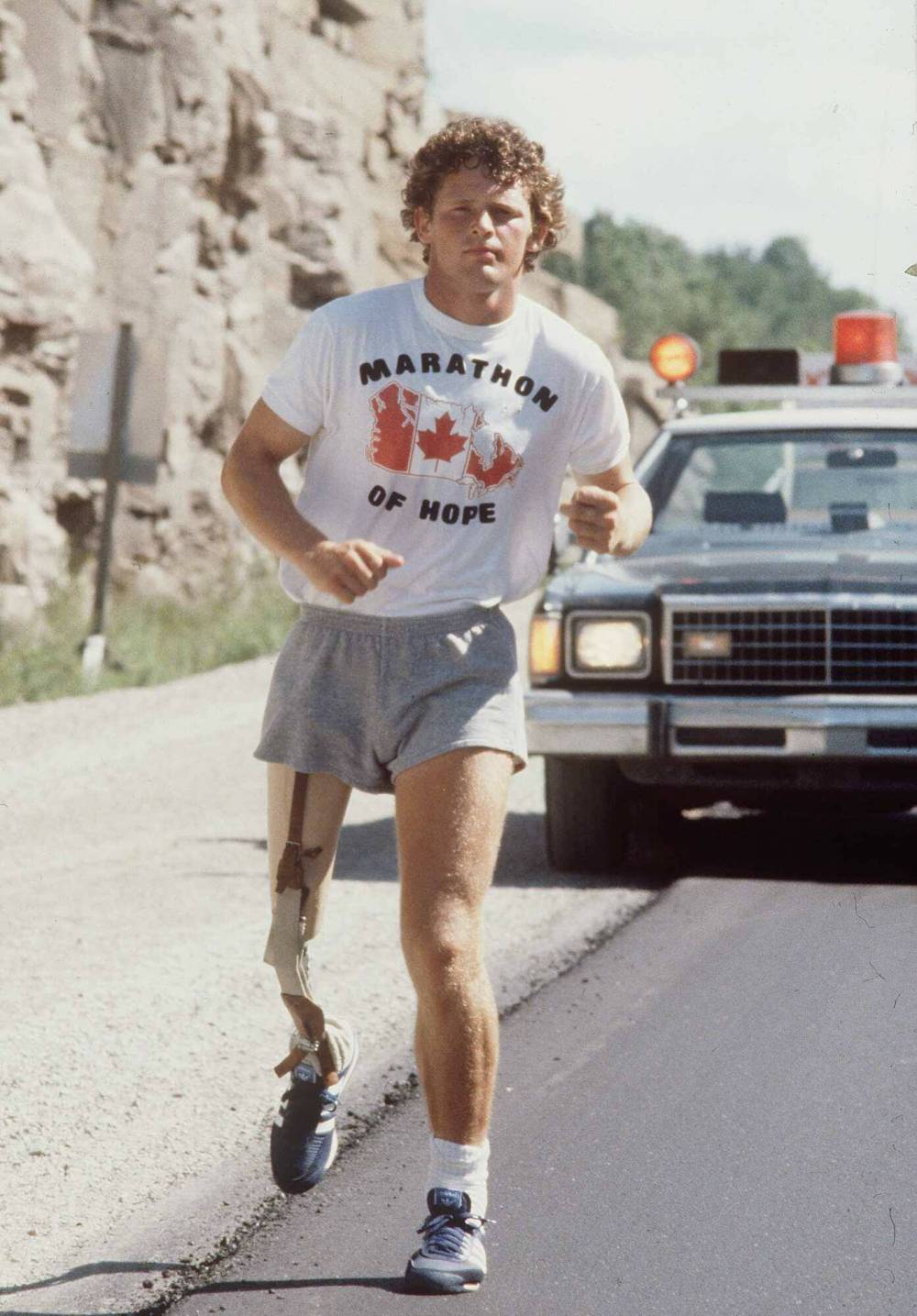
Their rarity is, in part, what makes them difficult to diagnose, Perrin says.
“It’s not the first thing that a family doctor or the emergency physician will think about when you have a lump,” he says.
Soft-tissue sarcomas can be very well hidden in the body, so sometimes they aren’t discovered until they are more advanced, he adds.
Often they are asymptomatic, which means they aren’t painful.
And while sarcoma accounts for one per cent of adult cancer diagnoses, that number jumps to 15 per cent of childhood cancer diagnoses.
Even so, they are also tricky to diagnose in kids.
“Bone sarcomas arise more in children and children have a lot of reasons to have a limp or an injury or swelling just because of the day-to-day activities of a child,” Perrin says.
“I do have a lot of patients that are frustrated by the time they come to see me because it wasn’t the first thing on someone’s differential diagnosis in the medical system.”
That day last August, Finley was able to walk it off and get herself back to work on foot. But the pain persisted, particularly while she was driving.
By November, a lump had developed. It was soft, the size of a quarter. The lump itself didn’t hurt, but doing any kind of flexion motion — to press down a gas pedal, say — was incredibly painful.
Finley went to a sports medicine clinic and was told she likely had something called Morton’s neuroma — an enlarged, damaged nerve that causes pain on the bottom of the forefoot — because of her age and its location on her foot.
MIKAELA MACKENZIE / FREE PRESS Michelle Finley lived with excruciating pain before having her foot amputated.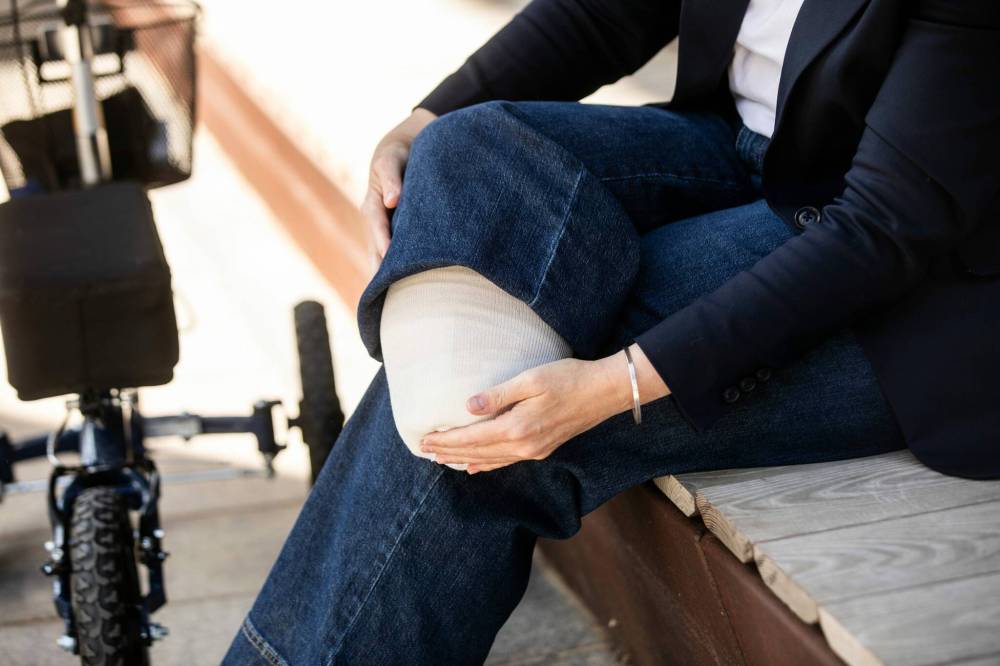
“They gave me a prescription for this little pad to put near it to take the pressure off of it. So I did that, and it didn’t get better. In fact, it started to grow.”
By December, Finley was altering her habits around her foot. She began to stop midway to apply ice when driving to the barn to visit her horse. She was in tears pulling into the garage on Christmas Eve driving home from an out-of-town holiday celebration.
By February this year, she could no longer drive at all.
“My world was getting smaller and smaller and smaller,” she says.
By this time, the lump had quadrupled in size. Finley had joined Facebook support groups for Morton’s neuroma and went to see a podiatrist on the suggestion of a member she happened to know offline.
The podiatrist suspected she might have Ledderhose disease, or plantar fibromatosis, a condition in which non-cancerous growths develop on the bottom of the foot, making it painful and difficult to walk.
“I was like, what the…? What a dumb name — of course I have something named after Oktoberfest,” Finley says, deadpan.
“It’s not the first thing that a family doctor or the emergency physician will think about when you have a lump.”
But when she went back to be fitted for insoles, the lump had grown again. It was recommended she get an MRI, which she had in Winkler in March.
“It was excruciating. They have to put your foot in this boot and my foot was at a right angle, which was the worst possible position. I think I made it eight minutes.”
Finley downloaded an app that allowed her to access her images as well as a copy of the radiology report from her MRI.
“It said it was one of three things: Ledderhose disease, giant T cell tumour of the tendon sheath or sarcoma,” she says. “And I was like, I know what sarcoma is. That’s not good news.”
When Finley saw Perrin, he ordered a battery of tests, including an MRI with contrast, a CT scan of the abdomen to the neck — to check her lungs because that is often where sarcoma spreads — and an ultrasound guided biopsy.
Meanwhile, her health and quality of life had rapidly deteriorated.
“I was in so much pain. I was losing weight, I was not eating and I was miserable. I was basically existing on the couch. There was not a lot of life happening at this point,” she says.
“I was in so much pain. I was losing weight, I was not eating and I was miserable.”
On April 29, Finley finally got an official diagnosis: an aggressive, undefined pleomorphic sarcoma was ravaging her right foot.
Perrin’s recommendation was to amputate.
“A lot of the training that I do is in what’s called limb salvage, so that’s trying to remove the cancer by saving the leg or arm,” Perrin says.
“There are, unfortunately, a lot of scenarios where even if I try to think of every creative option, there’s no good options and amputation is recommended.
“I never like to recommend it, but if I do, it’s for a reason, and that’s because the main goal is life over limb.”
Finley chose life.
“I had already had some really wacky conversations with my husband and my two best friends, and I was like, if this is going to be my future, if this is what Ledderhose disease is, I think I just want my foot amputated and I would be better off with a prosthetic,” she says. “I’d already been thinking that way because the pain was so significant.”
When she woke up in the recovery room after her surgery in May, Finley finally felt relief.
“For the first time in months, I had no pain. It was, like, euphoric.”
The path forward for sarcoma patients looks different depending on their disease. Bone sarcomas are treated with chemotherapy, whereas soft-tissue sarcomas are treated with radiation therapy.
“With bone sarcomas, (patients) have to finish their chemo even after surgery, so it’s a long haul. It’s like nine months, it’s terrible. Whereas the soft tissues, they get the radiation and then they have their surgery and then usually treatment is done,” Perrin says.
MIKE DEAL / FREE PRESS Dr. David Perrin is Manitoba’s first and only orthopedic oncologist, specializing in sarcoma. Perrin says removing a sarcoma doesn’t necessarily mean the cancer is gone, so patients are monitored for a long period after removal.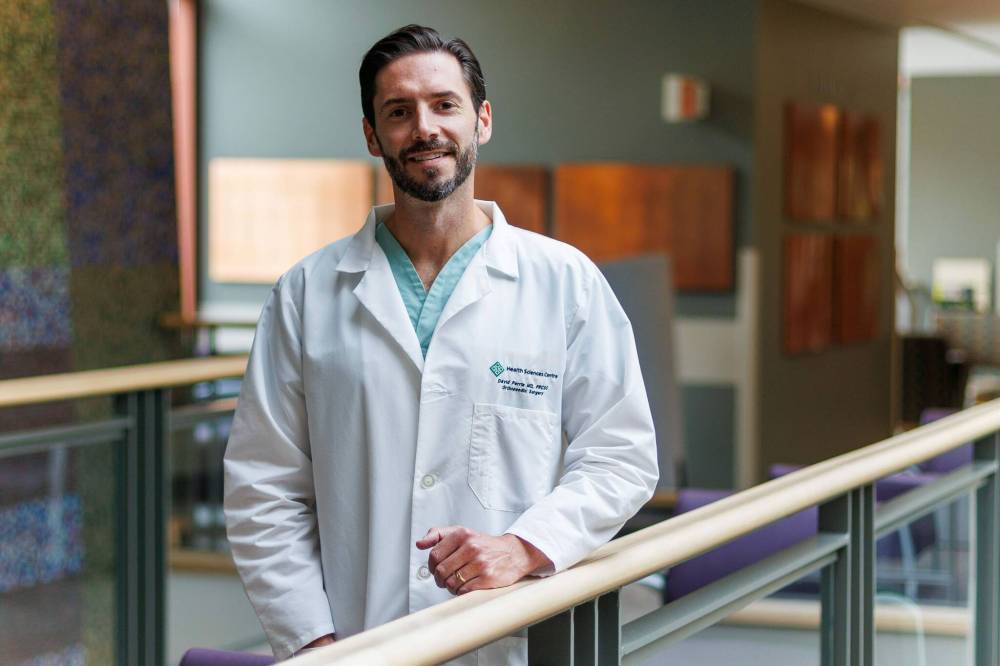
“Oftentimes, the surgeries that I would perform require a lot of physiotherapy and rehabilitation, whether it’s an amputation or limb salvage, all of these require some kind of rehab, adjustment, physiotherapy, restrengthening, all of that. So, despite putting the cancer behind them, there’s still a new life with their limb.”
Most sarcoma patients are monitored for a decade after surgery, and doctors will look for two things: 1) is the cancer back, and 2) has it spread?
“Just because we remove it doesn’t mean that it can’t spread later, unfortunately. Because the lungs are the No. 1 area of spread, we often monitor their lungs closely for 10 years,” Perrin says.
Finley is adjusting to life without her foot. She was able to stop taking pain medication within days of the surgery, and went back to work after six weeks. She’s eager to gain more independence, and to spend more time with her horse.
For her, both of those things mean driving again.
“That’s the milestone. That’s the ultimate goal,” she says.
But healing has required patience, as well as adjusting expectations.
“Originally, I had thought in my head, ‘I’ll have my surgery. I’m gonna have a prosthetic foot and be back to normal by the end of August.’ I have an acquaintance who is a below-the-knee amputee — he’s an amputation ambassador — and he came over, met with me, and kind of gave me a reality check as to the timeline,” Finley says.
She has to wait for the residual limb to heal, then she’ll start the process in the amputee program to ready it for the prosthetic.
“Sometimes a lump is not just a lump.”
“I will get a temporary prosthetic to go through rehab with, and then I’ll be working with my prosthetist,” Finley says. “I’m going to need to learn to walk again and learn how to maintain my residual limb to make sure it stays healthy. And then I’ll be working to get my driver’s licence back.”
But her expectations have been upended in surprising ways, too. Finley recalls a difficult weekend at home before the surgery.
“Time seemed to accelerate in a strange way, and like everything was the last time. This is the last time I will put my pyjamas on over this foot, or this is the last time I’m gonna see this foot. In my head, I had this idea that it was the end of one life and the beginning of another,” she says.
“In reality, that’s not really what happened. I wouldn’t have imagined that it would actually be this positive. Yes, there are lots of drawbacks, and I’m frustrated a lot of the time, and I’m naturally not a patient person so the goalposts that keep changing for me is challenging to manage. But overall, life is good. I’m healthy and I’m strong again, and I’m getting stronger, and my husband and I have made a very strong commitment to approaching this with humour and with gratitude.”
Among the things for which she is grateful: a supportive network of family and friends, a supportive workplace and access to things — mobility aids, a computer, delivery apps, etc. — that have made her recovery easier.
“One of the things I became aware of really, really early — in the hospital, for sure — was like, holy shit, am I ever privileged in this experience. I know other people’s experiences will look different than mine,” she says.
She also tries not to dwell on “what ifs” or “why mes.”
“It did come out of nowhere. I have been healthy my whole life. I had no major health concerns my whole life, and what started out with a sore foot ended up with me losing my foot. I try not to dwell because I don’t think there was any way, unless you were a sarcoma specialist, I don’t know why anyone would think that a small lump should have had more investigation,” she says.
There are no routine scans for sarcoma.
“In most circumstances, because we don’t know what causes it, we also don’t know how to prevent it,” Perrin says.
That said, he doesn’t want to instil fear in people. But there are things one can look out for that could indicate something more serious. In children, for example, a limp lasting for more than six weeks warrants an X-ray. In adults, lumps that are changing, rapidly growing or becoming painful should be checked out.
Finley encourages people to be aware of their bodies.
“If your body is doing something that’s out of the norm for a sustained period of time, then it warrants investigation — and that process can take a little bit of time to get to an answer,” Finley says.
“Be aware of your body and what’s normal, and if it starts to go beyond what’s normal, pay attention to it. Don’t discount your pain and try to grin and bear it.
“Sometimes a lump is not just a lump.”
jen.zoratti@winnipegfreepress.com
Jen Zoratti is a columnist and feature writer working in the Arts & Life department, as well as the author of the weekly newsletter NEXT. A National Newspaper Award finalist for arts and entertainment writing, Jen is a graduate of the Creative Communications program at RRC Polytech and was a music writer before joining the Free Press in 2013. Read more about Jen.
Every piece of reporting Jen produces is reviewed by an editing team before it is posted online or published in print – part of the Free Press‘s tradition, since 1872, of producing reliable independent journalism. Read more about Free Press’s history and mandate, and learn how our newsroom operates.
Our newsroom depends on a growing audience of readers to power our journalism. If you are not a paid reader, please consider becoming a subscriber.
Our newsroom depends on its audience of readers to power our journalism. Thank you for your support.
Jen Zoratti is a columnist and feature writer working in the Arts & Life department, as well as the author of the weekly newsletter NEXT. A National Newspaper Award finalist for arts and entertainment writing, Jen is a graduate of the Creative Communications program at RRC Polytech and was a music writer before joining the Free Press in 2013. Read more about Jen.
Every piece of reporting Jen produces is reviewed by an editing team before it is posted online or published in print – part of the Free Press‘s tradition, since 1872, of producing reliable independent journalism. Read more about Free Press’s history and mandate, and learn how our newsroom operates.
Our newsroom depends on a growing audience of readers to power our journalism. If you are not a paid reader, please consider becoming a subscriber.
Our newsroom depends on its audience of readers to power our journalism. Thank you for your support.
Advertisement Advertise With Us
Advertisement Advertise With Us