Play asks the cutting questions
Tensions emerge in story of interfaith relationships

Advertisement
Read this article for free:
or
Already have an account? Log in here »
To continue reading, please subscribe:
Digital Subscription
One year of digital access for only $1.44 a week*
- Enjoy unlimited reading on winnipegfreepress.com
- Read the E-Edition, our digital replica newspaper
- Access News Break, our award-winning app
- Play interactive puzzles
*Billed as $5.77 plus GST every four weeks. After 52 weeks, price increases to the regular rate of $19.95 plus GST every four weeks. Offer available to new and qualified returning subscribers only. Cancel any time.
To continue reading, please subscribe:
Add Free Press access to your Brandon Sun subscription for only an additional
$1 for the first 4 weeks*
- Enjoy unlimited reading on winnipegfreepress.com
- Read the E-Edition, our digital replica newspaper
- Access News Break, our award-winning app
- Play interactive puzzles
*Your next Brandon Sun subscription payment will increase by $1.00 and you will be charged $17.95 plus GST for four weeks. After four weeks, your payment will increase to $24.95 plus GST every four weeks.
Read unlimited articles for free today:
or
Already have an account? Log in here »
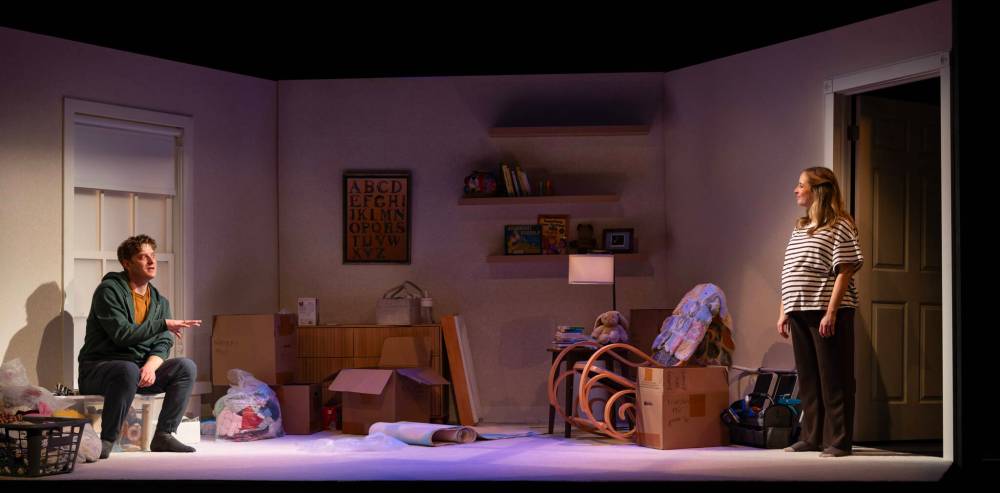
An IKEA nursery awaiting its tenant is the first stage into which visitors are allowed entry in playwright Jordi Mand’s The Cut.
We see an antique rocker and unmarked boxes strewn about, with a table lamp — an unofficial Ner tamid, eternal candle — sitting on the unblemished carpet in the centre of the room. Sarah (Hallie Seline) and Andrew (Wade Bogert O’Brien) have a lot to unpack as they settle into their own home: two shelves of biography waiting for a third.
The box of books from Sarah’s parents is opened early.
Supplied
Andrew (Wade Bogert O’Brien, left) and Sarah (Hallie Seline) and are expectant parents in The Cut.
“Something From Nothing? Goodnight Bubbala?” Andrew laughs, turning the volumes cover-out on the wall of his future son’s room. “What are they building? A Jewish bookshelf?”
Wait.
What did he just say about Something From Nothing? Phoebe Gilman’s beloved children’s folk tale about Joseph’s blanket, a grandfather, a needle and a thread?
Andrew (played with new-father frenzy by Bogert-O’Brien) and Sarah (Seline, whose character is attached to anxiety and a window of blue-sky hope) have been together for over a decade: he knows she’s Jewish, while her parents have reminded her over and again that he’s not. Mand never tells us Andrew’s last name, but it certainly isn’t Cohen.
They know each other’s religious affiliations, but until Sarah is pregnant with her parents’ first and possibly only grandchild, the couple hasn’t adequately addressed their respective faiths.
Shauna Jones’s set is planted at the centre of the Berney Theatre’s stage, a small, elevated room that carries a sense of forboding enclosure despite the vast darkness extending on either side of the nursery. When most tightly conveyed, this mood, in a room with covered windows and no mirrors, might also remind viewers of filmmaker Emma Seligman’s Shiva Baby.
Unlike that 2020 ritual anxiety horror picture, set during a Jewish period of mourning, The Cut focuses on a rite of passage at an earlier stage of a Jewish life, but the set — with its unblemished linen and simple pine — contains material reminders of the tenuousness of leading a religious life: ashes to ashes and dust to dust. A Jewish burial is a biodegradable one, unadorned.
Based on the presence of Goodnight Bubbala — published in 2019 — this trimester is set right about now. So we can assume that Andrew and Sarah both watched animated Christian show Veggie Tales, but only one dipped the bitter herbs, sampled the horseradish and asked the four questions.
Directed by Brendan McMurtry-Howlett, the couple is at odds, overstepping and understepping in conversations that might’ve come earlier on. If only Andrew had been invited to Sarah’s family’s Passover meal the first year they were dating.
In 1956, Winnipeg’s Adele Wiseman wrote about a pogrom-surviving couple named Sarah and Abraham raising a miracle son named Isaac in a city’s North End in The Sacrifice, a Governor General-award-winning novel that lives and ends in tragic resilience.
Mand’s work should inspire readers to revisit Wiseman’s words. It should also inspire engagement with the Torah portions Lech lecha and Chayei Sarah, the latter of which which reminds readers that Sarah lived to the age of 127, dying in Kiriat Arba and buried in Qiriat Arbah in the “choicest of our graves.”
In The Cut, Sarah doesn’t marry Abraham. Will they cry or will they laugh when their first son is born?
The questions of what it takes to be a Jewish person, what it means to actively choose to live a meaningful Jewish life, and an assessment of the pressure inherent to being perceived as an other are the central focuses of The Cut.
Sarah’s insistence on having her and Andrew’s unborn son circumcised is grounded in her belief that his participation in the covenant of Brit Milah is necessary for the child to some day gain access to the cultural understanding and teachings of the Torah. Her choice is also freighted by the reality that the events of any people’s living history is closer in the rearview mirror than it appears.
In a sequence driven by rapid breathing and panicked tidying, the couple leave their home for Sarah to receive medical attention. Andrew grabs the “go-bag” as the lights — designed by Larry Isacoff — bathe the room in pulses of red and blue, powerful pumps of oxygenated and deoxygenated blood.
Meanwhile, Sarah is on the floor, trying to get the new carpet cleaner to work, living out a coping mechanism that can’t staunch bleeding.
In these moments, sound designer Ashley Au’s work is infused with inspiration from a 2025 research stint at St. Boniface Hospital’s Buhler Gallery, an opportunity that allowed the musician to listen in on the whooshes and beeps of the ER.
Andrew’s opinion is layered and mostly delivered with lived-in specificity, but as Rabbi Allan Finkel reminded the audience in a post-show talkback, perhaps the stress could’ve been avoided if the conversation happened sooner.
This calls to mind one instance of Mand’s edgier, best-timed punchlines.
When Andrew reminds Sarah that she had reassured him throughout every stage of their relationship — college, 20s, beyond — that their future son wouldn’t need to be circumcised, Sarah looks at Andrew.
“But you must’ve known,” she says, delivering.
ben.waldman@winnipegfreepress.com
If you value coverage of Manitoba’s arts scene, help us do more.
Your contribution of $10, $25 or more will allow the Free Press to deepen our reporting on theatre, dance, music and galleries while also ensuring the broadest possible audience can access our arts journalism.
BECOME AN ARTS JOURNALISM SUPPORTER
Click here to learn more about the project.
Ben Waldman is a National Newspaper Award-nominated reporter on the Arts & Life desk at the Free Press. Born and raised in Winnipeg, Ben completed three internships with the Free Press while earning his degree at Ryerson University’s (now Toronto Metropolitan University’s) School of Journalism before joining the newsroom full-time in 2019. Read more about Ben.
Every piece of reporting Ben produces is reviewed by an editing team before it is posted online or published in print — part of the Free Press‘s tradition, since 1872, of producing reliable independent journalism. Read more about Free Press’s history and mandate, and learn how our newsroom operates.
Our newsroom depends on a growing audience of readers to power our journalism. If you are not a paid reader, please consider becoming a subscriber.
Our newsroom depends on its audience of readers to power our journalism. Thank you for your support.
Theatre review
The Cut
Winnipeg Jewish Theatre
Berney Theatre, Rady JCC
To Sunday
Three stars out of five
If you value coverage of Manitoba’s arts scene, help us do more.
Your contribution of $10, $25 or more will allow the Free Press to deepen our reporting on theatre, dance, music and galleries while also ensuring the broadest possible audience can access our arts journalism.
BECOME AN ARTS JOURNALISM SUPPORTER
Click here to learn more about the project.
Ben Waldman is a National Newspaper Award-nominated reporter on the Arts & Life desk at the Free Press. Born and raised in Winnipeg, Ben completed three internships with the Free Press while earning his degree at Ryerson University’s (now Toronto Metropolitan University’s) School of Journalism before joining the newsroom full-time in 2019. Read more about Ben.
Every piece of reporting Ben produces is reviewed by an editing team before it is posted online or published in print — part of the Free Press‘s tradition, since 1872, of producing reliable independent journalism. Read more about Free Press’s history and mandate, and learn how our newsroom operates.
Our newsroom depends on a growing audience of readers to power our journalism. If you are not a paid reader, please consider becoming a subscriber.
Our newsroom depends on its audience of readers to power our journalism. Thank you for your support.
Advertisement Advertise With Us
Advertisement Advertise With Us