WHO expert ‘had concerns’ about lab close to 1st COVID cases
Advertisement
Read this article for free:
or
Already have an account? Log in here »
To continue reading, please subscribe:

Digital Subscription
One year of digital access for only $205*
- Enjoy unlimited reading on winnipegfreepress.com
- Read the E-Edition, our digital replica newspaper
- Access News Break, our award-winning app
- Play interactive puzzles
*First annual payment billed as $205.00 + GST for one year. This annual subscription will automatically renew at $233.00 + GST every 52 weeks (10% off the regular annual price of $259.35). Offer available to new and qualified returning subscribers only. Cancel any time.
To continue reading, please subscribe:
Add Free Press access to your Brandon Sun subscription for only an additional
$1 for the first 4 weeks*
- Enjoy unlimited reading on winnipegfreepress.com
- Read the E-Edition, our digital replica newspaper
- Access News Break, our award-winning app
- Play interactive puzzles
*Your next Brandon Sun subscription payment will increase by $1.00 and you will be charged $17.95 plus GST for four weeks. After four weeks, your payment will increase to $24.95 plus GST every four weeks.
Read unlimited articles for free today:
or
Already have an account? Log in here »
Hey there, time traveller!
This article was published 12/08/2021 (1826 days ago), so information in it may no longer be current.
LONDON (AP) — When a World Health Organization-led team traveled to China earlier this year to investigate the origins of the COVID-19 pandemic, a top official said he was worried about safety standards at a laboratory close to the seafood market where the first human cases were detected, according to a documentary released Thursday by Danish television channel TV2.
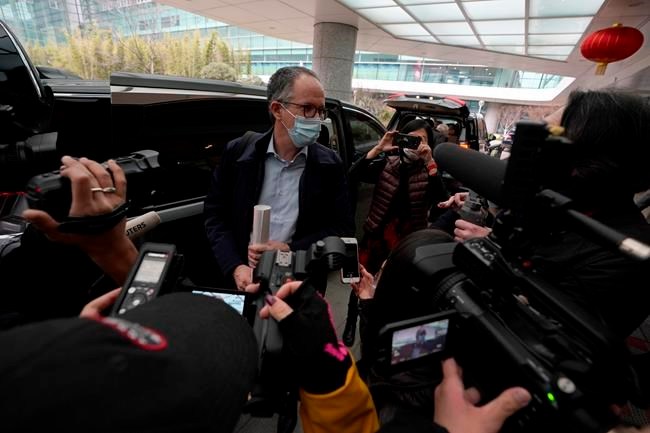
The Wuhan branch of the Chinese Center for Disease Control and Prevention was handling coronaviruses “without potentially having the same level of expertise or safety or who knows,” Peter Ben Embarek said during a conference call in January, according to footage shown by TV2. Ben Embarek is a WHO expert on disease transmission from animals to humans and one of the team’s leaders
But months later, when WHO released its dense report on its mission to Wuhan, the U.N. health agency concluded that a leak of the virus from the lab was “extremely unlikely” to have caused COVID-19. The WHO report even lent credence to a fringe theory promoted by the Chinese government that the virus may have been spread via frozen seafood packaging.
In recent weeks, however, WHO chief Tedros Adhanom Ghebreyesus has acknowledged it was “ premature ” to rule out a possible lab leak as the source of COVID-19, saying last month that he was asking China to be more transparent about the early days of the pandemic.
“I was a lab technician myself. I’m an immunologist and I have worked in the lab and lab accidents happen,” Tedros said. “It’s common.”
In the Danish TV2 documentary, the WHO’s Ben Embarek is pictured arriving in China, inspecting the stalls at the Huanan seafood market in Wuhan and examining what he hypothesizes might have been living quarters for people who handled live animals there — raising the possibility that the virus may have jumped from animals to people at the market.
“It would mean that the contact between the human beings and whatever may have been in the market i.e. virus and maybe live animals would have been more intense,” Ben Embarek said. “It goes without saying that the close contact would be doubled many times between humans and animals if you are among them around the clock.”
Scientists have previously thought that because many of the earliest known human cases at Wuhan’s Huanan market appeared to have no prior connection to each other, the market might have simply been the place where cases were amplified, not where the virus first breached the species barrier.
The Danish documentary also featured Ben Embarek expressing his worries in January about the Wuhan branch of the Chinese CDC, concerns that have never been publicly disclosed by WHO. While numerous experts have questioned whether there might have been a lab accident at the Wuhan Institute of Virology — where scientists were studying coronaviruses — there has been less interest in another nearby facility.
“What is more concerning to me is the other lab,” Ben Embarek said. “The one that is next to the market,” he explained, referring to the Wuhan branch of the Chinese CDC, located just 500 meters (547 yards) away from the Huanan market.
In a June interview, Ben Embarek told TV2 that the possibility of a lab staffer being infected with the coronavirus while collecting bat samples was “likely.”
Although the idea that the pandemic somehow started in a laboratory was largely dismissed last year, it has gained traction recently, with U.S. President Joe Biden ordering a review of U.S. intelligence and i ncreasing numbers of scientists calling for an independent investigation to be conducted by authorities beyond the WHO.
Jamie Metzl, who has been leading an effort calling for an independent investigation of how COVID-19 started, called Ben Embarek’s comments “a game-changer,” describing his earlier declaration that a lab leak was unlikely “shameful.”

“It’s even more significant that the international expert team who stated with such confidence in the February Wuhan press event that a lab origin was unlikely themselves believed this was not the case and were simply trying to assuage their Chinese government-affiliated hosts,” said Metzl, who sits on a WHO advisory board on human genome editing.
All of the scientists on the WHO-led team were approved by China and the team’s agenda and final report were also vetted by the Chinese government. Ben Embarek told TV2 the purpose of the WHO team’s visit was “collaboration and discussion” with China.
In a statement on Thursday, the WHO said the search for the pandemic’s origins “should not be an exercise in attributing blame, finger-pointing or political point-scoring.” The agency said its first analysis of the coronavirus origins found “there was insufficient scientific evidence to rule any of the hypotheses out.”
____
David Keyton in Stockholm and Jamey Keaten in Geneva contributed to this report.