Cineplex awarded $1.24-billion in damages in takeover suit, Cineworld to appeal

Advertisement

Advertise with us

TORONTO - Cineplex Inc. says it has won a court battle against a U.K. theatre giant that was due to purchase the Canadian cinema company before the COVID-19 pandemic struck.

Read this article for free:


or

Already have an account? Log in here »

To continue reading, please subscribe:

Subscribe and receive a limited-edition Free Press branded hat or tote.

Digital Subscription

One year of digital access for only $205*

  • Enjoy unlimited reading on winnipegfreepress.com
  • Read the E-Edition, our digital replica newspaper
  • Access News Break, our award-winning app
  • Play interactive puzzles

*First annual payment billed as $205.00 + GST for one year. This annual subscription will automatically renew at $233.00 + GST every 52 weeks (10% off the regular annual price of $259.35). Offer available to new and qualified returning subscribers only. Cancel any time.

To continue reading, please subscribe:

Add Free Press access to your Brandon Sun subscription for only an additional

$1 for the first 4 weeks*

  • Enjoy unlimited reading on winnipegfreepress.com
  • Read the E-Edition, our digital replica newspaper
  • Access News Break, our award-winning app
  • Play interactive puzzles
Start now

*Your next Brandon Sun subscription payment will increase by $1.00 and you will be charged $17.95 plus GST for four weeks. After four weeks, your payment will increase to $24.95 plus GST every four weeks.

Hey there, time traveller!
This article was published 14/12/2021 (1754 days ago), so information in it may no longer be current.

TORONTO – Cineplex Inc. says it has won a court battle against a U.K. theatre giant that was due to purchase the Canadian cinema company before the COVID-19 pandemic struck.

Toronto-based Cineplex announced Thursday evening that the Ontario Superior Court of Justice ruled in its favour in a breach of contract lawsuit against its former suitor Cineworld Group PLC.

Judge Barbara Conway awarded damages of $1.24 billion and denied a counterclaim by Cineworld, Cineplex said.
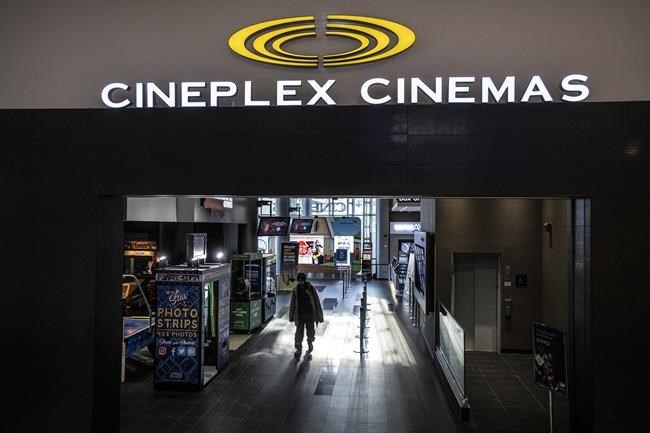
A Cineplex Theatre at Yonge and Eglinton in Toronto on Monday December 16, 2019. Cineplex Inc. says the Ontario Superior Court of Justice has ruled in its favour in a breach of contract lawsuit against its former suitor and U.K. theatre operator Cineworld Group PLC. THE CANADIAN PRESS/Aaron Vincent Elkaim

“We are pleased that the court found Cineplex acted properly throughout this difficult period in our history,” said Cineplex president and CEO Ellis Jacob in a statement.

But Cineworld isn’t giving up. Shortly after Cineplex announced its victory, Cineworld acknowledged the ruling and noted that the court had also ordered it to pay $5.5 million for lost transaction costs.

“Cineworld disagrees with this judgment and will appeal the decision,” the company said in a statement.

“Cineworld does not expect damages to be payable whilst any appeal is ongoing.”

The acrimony between the two cinema chains began when Cineworld walked away from its deal to acquire Cineplex in June 2020.

By then, the pandemic was in full swing and theatre operators in many corners of the globe had been forced to close cinemas.

Cineplex and Cineworld reported massive losses and turned to layoffs to save any cash they could as bills from landlords, studios and concession stand suppliers came due.

As the companies navigated the crisis and awaited final approvals from Canadian regulators for their deal, Cineworld backed out of the takeover, alleging the company it was due to buy was responsible for “material adverse effects and breaches.”

Cineplex chalked up the adverse effects Cineworld was blaming it for as “nothing more than a case of buyer’s remorse” and decided to sue its former suitor for more than $2.18 billion in damages.

Cineworld filed a counter claim valued at about $54.8 million.

The court was left to decide whether Cineworld had the right to terminate the takeover agreement it signed with Cineplex in December 2019 without payment.

Cineworld argued it was free to walk away from the deal because Cineplex strayed from “ordinary course,” when it deferred its accounts payable by at least 60 days, reduced spending to the “bare minimum” and stopped paying landlords, movie studios, film distributors and suppliers at the start of the pandemic.

“Ordinary course” is a legal term that often features in acquisition agreements when companies want to ensure they will have the ability to terminate a deal and limit their risks, if other parties deviate wildly from their current operations or business model.

In response to Cineworld’s claims, Cineplex argued it fulfilled all of its obligations and continued with an “ordinary course” for the industry during the pandemic.

It said the deferred payments to landlords, film distributors and suppliers were the norm for the industry during COVID-19 and introduced testimony from studio and real estate executives, who said the delays had not strained their relationship with Cineplex.

Cineplex also claimed that Cineworld did not have grounds to terminate the deal because there was a clause exempting outbreaks of illness or changes affecting the motion picture theatre industry from being considered “material adverse effects.”

Cineworld, however, felt the clause should have no bearing on the case because it claimed it terminated the contract because of Cineplex’s inactions rather than COVID-19.

The case was seen by some observers as potentially precedent-setting for other companies that may be embroiled in their own litigations over abandoned acquisitions and material adverse effects caused by the COVID-19 pandemic.

This report by The Canadian Press was first published Dec. 14, 2021.

Companies in this story: (TSX:CGX)

Report Error Submit a Tip

More Stories

Jets bench boss Arniel talks rebuilding from last season’s struggles

Mike McIntyre and Ken Wiebe 12 minute read Preview

Jets bench boss Arniel talks rebuilding from last season’s struggles

Mike McIntyre and Ken Wiebe 12 minute read Thursday, Oct. 1, 2026

Scott Arniel has a lot on his plate these days.

But the head coach of the Winnipeg Jets took some time Thursday to sit down with Free Press hockey writers Mike McIntyre and Ken Wiebe to discuss a number of topics on the eve of a new hockey season. This interview has been condensed and edited for clarity.

Wiebe: What was the evaluation of last season like? What did you personally do in an attempt to improve after going from first-overall to 26th-overall?

I just went back and looked at things and made sure my communication was where it needed to be with my players. Was my communication where it needed to be with my boss, with my general manager (Kevin Cheveldayoff)? How our coaching staff worked. How we handled highs and lows. Things I felt I could have done better.

Read
Thursday, Oct. 1, 2026

Mayoral candidate Vogiatzakis criticized for living outside Winnipeg

Malak Abas 4 minute read Preview

Mayoral candidate Vogiatzakis criticized for living outside Winnipeg

Malak Abas 4 minute read Updated: Yesterday at 6:03 PM CDT

A mayoral hopeful took heat from other candidates Friday for living outside Winnipeg while running in the civic election.

Mike Vogiatzakis’s primary residence is in the Rural Municipality of St. Andrews, about 25 kilometres north of Winnipeg — a community with its own mayor and councillors.

But the funeral director said he owns a home in Winnipeg where he divides his time, and he would move to the city full-time if elected mayor.

“It doesn’t matter where a person lives. Why are we dividing St. Andrews and Manitoba and Winnipeg? I’ve met the criteria to run for mayor,” Vogiatzakis said Friday morning.

Read
Updated: Yesterday at 6:03 PM CDT

International flavour: Canadian investors may want to make like Ottawa, diversify beyond U.S.

Joel Schlesinger 6 minute read Preview

International flavour: Canadian investors may want to make like Ottawa, diversify beyond U.S.

Joel Schlesinger 6 minute read 2:01 AM CDT

Canada is learning the hard way about the dangers of putting too many eggs in its U.S. economic basket.

Much has been made about the need to diversify our economy away from the United States.

Diversification is understandably beneficial. The more varied streams of revenue a nation has, the less affected the economy will be when one of those sources is interrupted.

The same can be said about investment portfolios.

Read
2:01 AM CDT

Broadening prediction-market gambling a bad idea

Editorial 4 minute read Preview

Broadening prediction-market gambling a bad idea

Editorial 4 minute read 2:01 AM CDT

Let’s make a prediction: sooner or later, when Canadian governments find a way to take their own cut of the action, prediction-contract gambling on everything from sports to entertainment to political decisions is going to come to Canada.

And that’s a horrible, dangerous, pernicious idea.

Unless you have particular access to information — either inside information or strategic information based on skills or education — you’re not likely to make money at it. In fact, structurally, you’re likely to lose. In prediction markets, you basically pay an amount, plus fees from the company involved, to bet on whether something will or will not happen within a certain time frame. The amount you pay for your contract depends on how other people are also betting.

As Wealthsimple describes it, “You buy whichever side you think is right. Prices move with demand, so if the market leans towards one outcome, the more that side costs. If a lot of people are backing the TSX to finish above 38,000, yes gets more expensive and no gets cheaper.”

Read
2:01 AM CDT

A day on the campaign trail: Winnipeg's mayor, seeking a second term, does double duty

Malak Abas 12 minute read Preview

A day on the campaign trail: Winnipeg's mayor, seeking a second term, does double duty

Malak Abas 12 minute read Updated: Yesterday at 5:56 PM CDT

In the weeks leading up to the civic election, Scott Gillingham has been performing a juggling act: he’s running to be Winnipeg’s 45th mayor, while still serving as its 44th.

“If someone asks me about the campaign, I’m going to answer them. But I think for most people, I’m the mayor of Winnipeg, even if I’m showing up as a candidate,” Gillingham, 58, says. “I try to do all I can to maintain that distinction.”

The Free Press joined Gillingham on a recent rainy September Saturday on the campaign trail, where he served in both roles during an event-laden day. City council’s final meeting before the Oct. 28 election was days earlier.

In Winnipeg, it’s rare for an incumbent to be defeated. But Gillingham knows his win in 2022 wasn’t exactly a landslide — he won with 27.5 per cent of the vote — and he’s been thinking about his second term ever since.

Read
Updated: Yesterday at 5:56 PM CDT

A spiritual vision will help anchor a health civic outlook

John Longhurst 5 minute read 2:01 AM CDT

We have an election coming up. With that in mind, the Free Press asked some of their columnists to write about the challenges ahead and how the city can become better.

For Tom Brodbeck, the main challenge is finances — and how candidates will pay for their many promises for fixing roads, improving public safety and making transit better.

Rebecca Chambers said that the concerns of inner-city residents need to be taken seriously by those who aspire to work at city hall.

Niigaan Sinclair said the most pressing issue in Winnipeg isn’t construction projects, light-rail transit, public safety, taxes or social services. For him, it’s the city’s relationship with Indigenous people.