Troy Kotsur’s road to making history at the Oscars
Advertisement
Read this article for free:
or
Already have an account? Log in here »
To continue reading, please subscribe:

Digital Subscription
One year of digital access for only $205*
- Enjoy unlimited reading on winnipegfreepress.com
- Read the E-Edition, our digital replica newspaper
- Access News Break, our award-winning app
- Play interactive puzzles
*First annual payment billed as $205.00 + GST for one year. This annual subscription will automatically renew at $233.00 + GST every 52 weeks (10% off the regular annual price of $259.35). Offer available to new and qualified returning subscribers only. Cancel any time.
To continue reading, please subscribe:
Add Free Press access to your Brandon Sun subscription for only an additional
$1 for the first 4 weeks*
- Enjoy unlimited reading on winnipegfreepress.com
- Read the E-Edition, our digital replica newspaper
- Access News Break, our award-winning app
- Play interactive puzzles
*Your next Brandon Sun subscription payment will increase by $1.00 and you will be charged $17.95 plus GST for four weeks. After four weeks, your payment will increase to $24.95 plus GST every four weeks.
Read unlimited articles for free today:
or
Already have an account? Log in here »
Hey there, time traveller!
This article was published 24/03/2022 (1637 days ago), so information in it may no longer be current.
NEW YORK (AP) — In his Oscar-nominated performance in “CODA,” Troy Kotsur has one spoken line, but it’s a good one. Urging his daughter, played by Emilia Jones, to pursue her dreams of singing and attending college, he says aloud: “Go!”
For Kotsur, that one line meant lots of rehearsal plus the courage to, on a film set, speak dialogue he couldn’t himself hear. But Kotsur had also done it before. Years before, as Stanley Kowalski in a Deaf West Theatre production of “A Streetcar Named Desire,” he exclaimed “Stella!” night after night.
“Sometimes I’ll ask hearing audience members what my voice sounds like,” signs Kotsur. “One person described it as feeling like being cozy and tucked in bed.”
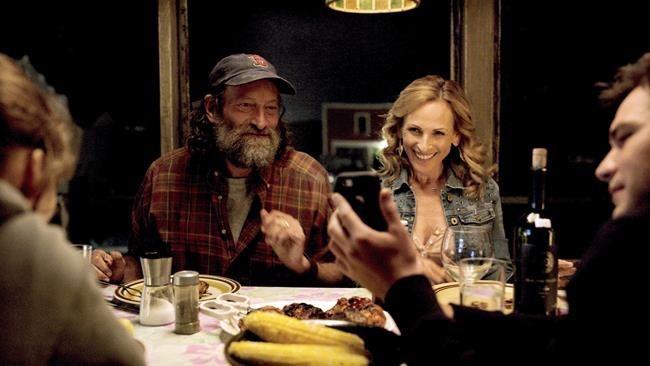
Kotsur, who does indeed radiate a rumpled warmth, is just the second actor who is deaf to be nominated for an Academy Award. And like that “Go!” the 53-year-old Kotsur hopes his achievement resonates with inspiration.
“I hope that young people who happen to be deaf or hard of hearing can get an increased confidence and be inspired that they can pursue their dreams,” Kotsur says. “I want those kids to not feel limited.”
The Apple TV+ release “CODA,” Sian Heder’s best-picture nominee, has elevated Kotsur to Hollywood’s biggest stages while making history for the Deaf community. He’s the first deaf actor ever nominated individually for a Screen Actors Guild award. The rush of accolades has been discombobulating. When he was nominated for a BAFTA, he celebrated so much he fell out of his chair. Accepting the Gotham award for best supporting performance, he told the crowd that he wasn’t speechless but “absolutely handless right now.”
“It’s just overwhelming,” Kotsur says of the acclaim. “It’s awesome. I feel like I can die happy, with a smile on my face.”
The only one to ever go through something similar was Kotsur’s “CODA” co-star Marlee Matlin. In “CODA,” they play the parents of a deaf Gloucester fishing family with a hearing daughter. Kotsur remembers watching Matlin become the first deaf actor to win an Oscar, in 1987 for “Children of a Lesser God.”
“I felt like I could have hope as a deaf actor,” Kotsur remembered in an interview by Zoom from his home in Mesa, Arizona, through an interpreter. “Of course, I didn’t realize what a tough journey it would be going through show business.”
Kotsur’s long road to the Oscars began, he figures, in elementary school. With little TV programming accessible to him, Kotsur loved highly visual cartoons like “Tom and Jerry” and would animatedly retell them to his deaf classmates on the bus. His father, a police chief, would later fondly call Kotsur a “risk taker” for pursuing performing. He studied acting at Gallaudet University, and then toured with the National Theatre of the Deaf.
With few opportunities in television and film available for deaf actors, Kotsur found freedom on the stage. Beginning with “Of Mice and Men” in 1994, Kotsur has acted in some 20 productions at Deaf West, the nonprofit Los Angeles theater company founded in 1991. In one show, he met his wife, the actress Deanne Bray. He played Cyrano de Bergerac and starred in “American Buffalo.”
DJ Kurs, director of Deaf West, remembers first being “utterly drawn in by Kotsur’s magnetism” in “Streetcar.” Many times since, he’s seen Kotsur’s immersive process close up.
“Working with him in rehearsal is like being in the presence of a mad scientist,” Kurs said by email. “He’s always tinkering and fine-tuning, bringing in different elements of the character. This process doesn’t end until the moment the curtain goes up on opening night.”
On stage, Kotsur honed the full-body physicality of his acting. “It’s really important for me on stage to show emotion through sign language,” says Kotsur. “Sometimes, sign language can be more three-dimensional and meaningful than spoken dialogue.”
Heder first saw Kotsur in a pair of Deaf West plays: “At Home in the Zoo” and “Our Town.”
“And they were very different characters,” she said. “He’s so charismatic, especially on stage. He’s just got this amazing presence and he’s so funny.”
Kotsur had long been used to seeing one-dimensional and victimized deaf characters, but “CODA” presented something he had rarely seen. The Rossis of “CODA” may have to work a little harder but they’re a family like any other, with funny dinner-table conversation and casual bickering. Kotsur’s Frank is also a little randy and a little profane. In one scene in which he instructs his daughter on safe sex, he mimes a soldier putting on a helmet.
Kotsur, long accustomed to hearing actors curse, delighted in Frank’s vulgarity; he proudly recalls the film’s back-and-forth with the MPA after “CODA” nearly received an R-rating. But to Kotsur, Frank is like a real deaf person — “a hard-working deaf person that just makes it through.”
“I want the audience to have a different perspective. I want them to get rid of their preconceived notions of what deaf people are like,” says Kotsur. “There are deaf doctors. There are deaf lawyers. There are deaf firemen. A lot of hearing people are oblivious to that.”
Perhaps Kotsur’s most moving scene is a moment shared in the bed of his truck with his daughter, Ruby. Unable to grasp Ruby’s singing talent, he listens to her sing by tenderly feeling the vibrations of her neck. The scene has deep echoes in Kotsur’s own life; he and Bray’s 17-year-old daughter is also a CODA (child of deaf adults) who’s drawn to music.
“When my daughter is playing music, she doesn’t know I’m standing behind her. I’ll walk up and I’ll touch the body of the acoustic guitar and I can feel the vibrations of the guitar,” says Kotsur. “I can do the same with the piano. I can rest my arms on the grand piano and feel the vibrations when she’s practicing.”
“I had to go to the music store and I was like, ‘What the hell is the difference between an electric and acoustic guitar?’ So I decided to buy both and give that to my daughter,” he adds. “I really enjoy watching her be so motivated with music as her hobby. I can’t take that passion away from her. I just need to encourage her.”
The first time Kotsur read the script for “CODA,” he took it as a warning sign since he, like his character, isn’t quite ready for his daughter to leave home yet. It’s personal connections like these that have made Frank difficult for the actor to let go of.
“It took me about half a year to disconnect from Frank,” says Kotsur. “My wife said, ‘Troy, will you please shave that beard? I can’t even kiss you.’”
To Kurs, Kotsur is nothing less than a trailblazer. Because of him and Matlin, he says, there will be more work for deaf actors.
“Seeing the acclaim validates what we’ve known all along, that Troy is one of the greats,” says Kurs. “We’ve been waiting for the world to recognize it for some time now and it is our hope that Troy will get all of the work and kudos that he is so deserving of, and that future deaf actors will not have to wait so long to be recognized on this level.”
A now more neatly trimmed Kotsur has since gone on to appear in the Disney+ series “The Mandalorian” as a Tusken Raider, for which he developed his own sign language. Other parts await, as does an expected lecturing tour talking to deaf children and would-be actors. But for now, he’s soaking it up as much as possible.
“I’m trying to enjoy every day and every moment,” he says. “I’m not in a rush. I’m not obsessed with winning. These days will be gone. I’ll never live them again.”
To summarize what it’s all meant, Kotsur clutches his chin and compares himself to just one hair in a thick beard of talented deaf actors who haven’t gotten the chance he did.
“I feel so blessed to have been able to take this step forward. I think it’s time for Hollywood to be more open-minded, more creative and more diverse,” says Kotsur. “Everyone has their story to tell.”
___
Follow AP Film Writer Jake Coyle on Twitter at: http://twitter.com/jakecoyleAP
___
For more on this year’s Oscars, visit: https://apnews.com/hub/academy-awards