Music Review: On Muna’s ‘Dancing On The Wall,’ desire and dread meet on the dance floor

Advertisement

Advertise with us

Four years since their last project, Muna — the Los Angeles-based synth pop band composed of Katie Gavin, Naomi McPherson and Josette Maskin — has returned with their fourth album, “Dancing On The Wall.” Electric and urgent, the record tracks the emotional highs and lows of dating and desire under the palpable weight of the current political moment. The result isn't escapist, but it's still a party.

Read this article for free:


or

Already have an account? Log in here »

To continue reading, please subscribe:

Subscribe and receive a limited-edition Free Press branded hat or tote.

Digital Subscription

One year of digital access for only $205*

  • Enjoy unlimited reading on winnipegfreepress.com
  • Read the E-Edition, our digital replica newspaper
  • Access News Break, our award-winning app
  • Play interactive puzzles

*First annual payment billed as $205.00 + GST for one year. This annual subscription will automatically renew at $233.00 + GST every 52 weeks (10% off the regular annual price of $259.35). Offer available to new and qualified returning subscribers only. Cancel any time.

To continue reading, please subscribe:

Add Free Press access to your Brandon Sun subscription for only an additional

$1 for the first 4 weeks*

  • Enjoy unlimited reading on winnipegfreepress.com
  • Read the E-Edition, our digital replica newspaper
  • Access News Break, our award-winning app
  • Play interactive puzzles
Start now

*Your next Brandon Sun subscription payment will increase by $1.00 and you will be charged $17.95 plus GST for four weeks. After four weeks, your payment will increase to $24.95 plus GST every four weeks.

Four years since their last project, Muna — the Los Angeles-based synth pop band composed of Katie Gavin, Naomi McPherson and Josette Maskin — has returned with their fourth album, “Dancing On The Wall.” Electric and urgent, the record tracks the emotional highs and lows of dating and desire under the palpable weight of the current political moment. The result isn’t escapist, but it’s still a party.

Album opener “It Gets So Hot” is about bodies in motion and sweat on the dance floor. The heat in question isn’t just figurative — it’s radiating from the Los Angeles pavement. “It gets so hot that I can’t even think straight / And she’s so hot when she’s putting on her makeup,” Gavin sings over a buoyant keyboard, synths creeping underneath. The writing is tight, the chorus booming, the production by McPherson — with those round, reverberating drums — recalling sound effects that might accompany a cable TV news flash.

That reference, intentional or not, adds to the feeling that these songs are set in a world of contradictory experiences. It is the exuberance or excitement that can exist alongside despair, the way anxiety can oscillate from being personal and existential.
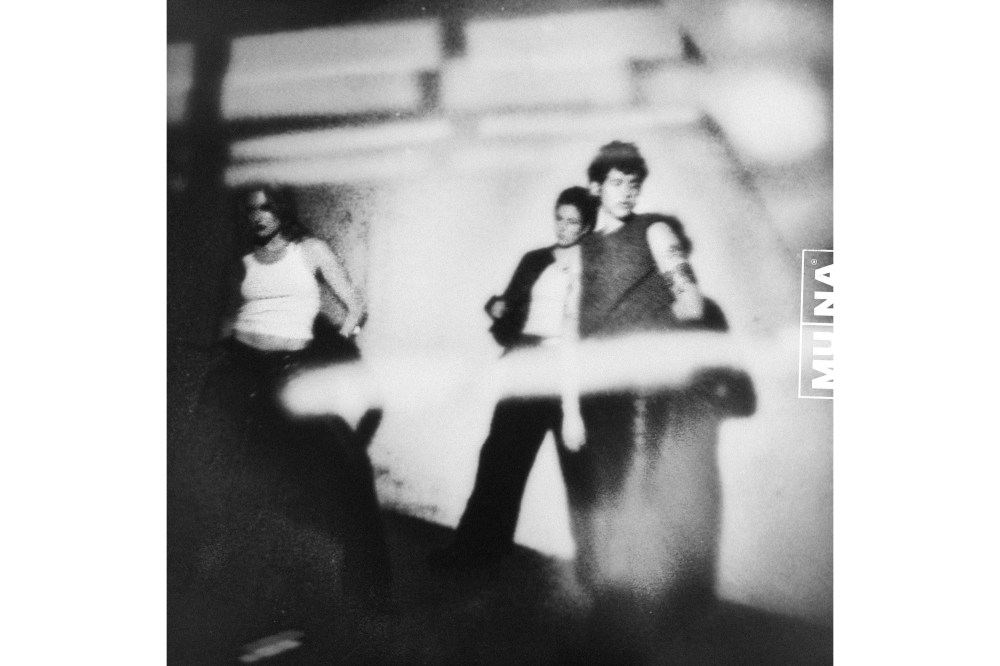
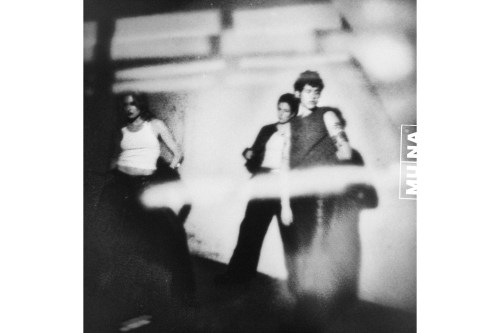
This album cover image released by Saddest Factory Records shows
This album cover image released by Saddest Factory Records shows "Dancing On the Wall" by MUNA. (Saddest Factory Records via AP)

That’s part of the approach to “Big Stick,” the record’s most politically-pointed song. Gavin sings about the numbing influence of power: from the government, the media, wealthy individuals to influencers, and how it encourages group-think and the acceptance of atrocities. “And I control the airwaves I control the news so / I can make you want anything that I want you to,” she sings in the chorus. Examples of what that “anything” is intensifies as the song continues: “Make you want to build an army and wage a war,” she sings. The lyrics are expansive, the message unwavering.

Bold drums and warped backing vocals underline Gavin’s voice across the album, placing these tracks firmly within Muna’s synth pop discography. And like they’ve become known for, the songs are danceable, queer and unapologetically Los Angeles — written with an insider’s attention to detail without becoming exclusionary. The addictive “Eastside Girls,” a L.A.-based lesbian reimagining of Billy Joel’s “We Didn’t Start the Fire,” is a burning example.

But above all, these songs are of the moment. Amid everything, there is still love and lust — and those things too, aren’t uncomplicated. “I know how to hurt myself on you,” Gavin sings on the title track. The melancholic “Buzzkiller,” sums up the complicated nature of feeling all of that at once. “You think I’m so easy to love / Baby please you’re just buzzed,” she sings. “I’m a buzzkiller.”

Gone is the weightless freedom of their breakthrough single “Silk Chiffon.” But the dance floor still calls.

___

“Dancing On The Wall” by Muna

Four stars out of five.

On repeat: “Eastside Girls,” “Dancing On The Wall”

Skip it: “Party’s Over,” “Unless …”

For fans of: Dancing on your own, waiting by the phone, Los Angeles, hot city streets
Report Error Submit a Tip

More Stories

Six high school hockey programs ceased operations following new Hockey Manitoba policy

Joshua Frey-Sam 7 minute read Preview

Six high school hockey programs ceased operations following new Hockey Manitoba policy

Joshua Frey-Sam 7 minute read Friday, Oct. 2, 2026

She lived the best of both worlds.

For the last three years, the 17-year-old wore a sweater for two different hockey programs — her high school team and AAA club in the Manitoba Female Hockey League — and was preparing to flourish in both colours again this winter.

Recently, however, the blue-liner was disappointed to learn she is no longer eligible to play her Grade 12 season with her school owing to a new policy imposed by Hockey Manitoba that bans players from participating in the Manitoba Women’s High School Hockey League if they are rostered on a U18 AAA team.

The rule applies to all athletes who play for both Winnipeg-based and rural AAA teams.

Read
Friday, Oct. 2, 2026

Thank Manitoba’s teachers by investing in students

Lillian Klausen 5 minute read 2:00 AM CDT

Manitoba’s students are settling into a new school year. Whether you graduated in 1986 or 2006, today’s classrooms look very different from the ones you remember.

Students reflect the changing makeup of our communities — differences in social, emotional, physical and cognitive abilities and socioeconomic stresses are all increasingly present and adding to the complexity of our classrooms.

Meeting these differing individual needs is no easy feat. It requires manageable class sizes, school counsellors, social workers, specialized resource teachers and investment in the systems that can help students thrive. But when those supports aren’t available, students’ needs don’t disappear. Increasingly, it falls to classroom teachers to try to fill the gaps.

When I started working as a teacher more than 30 years ago, we had budgets for resources when we needed them. Today, the needs of students have diversified and increased, but the funding for our public schools is failing to meet them.

Hydro Québec faces issue we should avoid

Editorial 4 minute read Preview

Hydro Québec faces issue we should avoid

Editorial 4 minute read 2:01 AM CDT

You might be tempted to call it a canary in an electric power generation coal mine.

But instead, it’s just another heads-up into the already-obvious problem with the proliferation of data centres.

This week, Hydro-Québec went before the Régie de l’énergie, Québec’s public utilities board, to change the rules for new and existing large data centres.

Now, it was not that long ago that Hydro Québec was actively wooing data centres — offering bulk power rates to be used to lure labour-intensive, power-hungry heavy industry (think aluminum smelters) with rates substantially lower than they offer Québec’s own residential customers. It was a way to use surplus power to create jobs and drive economic activity.

Read
2:01 AM CDT

Music Review: On Muna’s ‘Dancing On The Wall,’ desire and dread meet on the dance floor

Elise Ryan, The Associated Press 3 minute read Preview

Music Review: On Muna’s ‘Dancing On The Wall,’ desire and dread meet on the dance floor

Elise Ryan, The Associated Press 3 minute read Thursday, May. 7, 2026

Four years since their last project, Muna — the Los Angeles-based synth pop band composed of Katie Gavin, Naomi McPherson and Josette Maskin — has returned with their fourth album, “Dancing On The Wall.” Electric and urgent, the record tracks the emotional highs and lows of dating and desire under the palpable weight of the current political moment. The result isn't escapist, but it's still a party.

Album opener “It Gets So Hot” is about bodies in motion and sweat on the dance floor. The heat in question isn’t just figurative — it's radiating from the Los Angeles pavement. “It gets so hot that I can’t even think straight / And she’s so hot when she’s putting on her makeup,” Gavin sings over a buoyant keyboard, synths creeping underneath. The writing is tight, the chorus booming, the production by McPherson — with those round, reverberating drums — recalling sound effects that might accompany a cable TV news flash.

That reference, intentional or not, adds to the feeling that these songs are set in a world of contradictory experiences. It is the exuberance or excitement that can exist alongside despair, the way anxiety can oscillate from being personal and existential.

That's part of the approach to “Big Stick,” the record's most politically-pointed song. Gavin sings about the numbing influence of power: from the government, the media, wealthy individuals to influencers, and how it encourages group-think and the acceptance of atrocities. “And I control the airwaves I control the news so / I can make you want anything that I want you to,” she sings in the chorus. Examples of what that “anything” is intensifies as the song continues: “Make you want to build an army and wage a war,” she sings. The lyrics are expansive, the message unwavering.

Read
Thursday, May. 7, 2026

Living the dream

Ken Wiebe 7 minute read Preview

Living the dream

Ken Wiebe 7 minute read Saturday, Oct. 3, 2026

DETROIT – As Tyrel Bauer took a left turn out of the tunnel from the Winnipeg Jets dressing room and into the stands, he was met with a hearty round of applause from the 25 friends and family members who had made the trek from various points around North America.

Bauer had just realized a childhood dream and the significance of the moment was not lost on some of his biggest supporters.

“It was a special walk, for sure. A special walk,” Bauer said on Saturday afternoon before the Jets departed for a two-game road trip that begins on Sunday in Detroit against the Red Wings. “Those people who came – and many more that weren’t there and were cheering on from afar – they’ve always been there.

“I wanted that for my family, maybe even more than I wanted it for me. They’ve been through thick and thin. I’ve stressed mom out quite a bit over the years doing my job. That meant a lot for them and I’m really happy they could be there for it.”

Read
Saturday, Oct. 3, 2026

Puzzles Palace

1 minute read Monday, Jul. 27, 2026

To solve our puzzles, please subscribe with this special offer: |