How Americans celebrated the bicentennial – with fireworks, a Freedom Train and Farrah
Advertisement
Read this article for free:
or
Already have an account? Log in here »
To continue reading, please subscribe:

Digital Subscription
One year of digital access for only $205*
- Enjoy unlimited reading on winnipegfreepress.com
- Read the E-Edition, our digital replica newspaper
- Access News Break, our award-winning app
- Play interactive puzzles
*First annual payment billed as $205.00 + GST for one year. This annual subscription will automatically renew at $233.00 + GST every 52 weeks (10% off the regular annual price of $259.35). Offer available to new and qualified returning subscribers only. Cancel any time.
To continue reading, please subscribe:
Add Free Press access to your Brandon Sun subscription for only an additional
$1 for the first 4 weeks*
- Enjoy unlimited reading on winnipegfreepress.com
- Read the E-Edition, our digital replica newspaper
- Access News Break, our award-winning app
- Play interactive puzzles
*Your next Brandon Sun subscription payment will increase by $1.00 and you will be charged $17.95 plus GST for four weeks. After four weeks, your payment will increase to $24.95 plus GST every four weeks.
Read unlimited articles for free today:
or
Already have an account? Log in here »
WASHINGTON (AP) — In 1976’s “ Rocky,” heavyweight champion Apollo Creed arrives for the title fight dressed as George Washington, reenacting the crossing of the Delaware as models costumed as the Statue of Liberty lead the way.
After entering the ring, Apollo switches into an Uncle Sam costume. “I want YOU!” he roars as he points to Rocky Balboa, the far less flamboyant palooka he’s chosen for this bicentennial bout in Philadelphia.
Then the two boxers pound the daylights out of each other.
It’s as accurate a representation of the American bicentennial vibe as has ever been put on film — plenty of fireworks, but not much thought about how 200 years of independence led to this.
I was 13 years old in 1976. Kids my age — the tail end of the Baby Boom, or the vanguard of Generation X — grew up skeptical of the government. We had outlasted the Vietnam War and the Watergate scandal, with the occasional moment of joy — the moon landing, say — to break the gloom. The state of the union was intact, even if many Americans were still on edge.
My family lived in Newport News, Virginia, not far from the Historic Triangle of Jamestown, Yorktown and Williamsburg. So there was plenty of buzz surrounding the bicentennial. President Gerald Ford and his wife, Betty, took a carriage ride through Colonial Williamsburg, foreign leaders came to visit, and the living museum regularly staged reenactments of the events leading up to the signing of the Declaration of Independence.
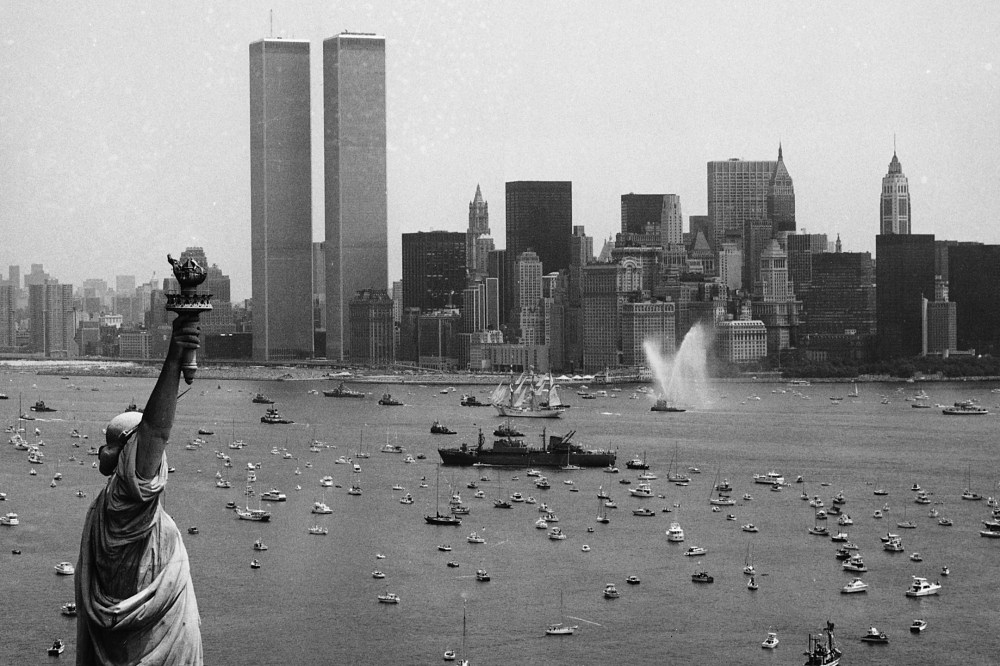
Ford and plenty of other dignitaries went to New York for what the president called “the greatest Fourth of July any of us will ever see.” Operation Sail was a floating parade of 16 tall ships and more than 100 smaller vessels from around the world — including, even, the Soviet Union. It was a boon for the beleaguered Big Apple, proving that “New Yorkers could get along, even during difficult times,” according to the Gotham Center for New York History.
All aboard the Freedom Train
For history buffs who couldn’t make the trip east, there was the American Freedom Train, a 26-car behemoth that toured all 48 contiguous states. It displayed two centuries of artifacts like George Washington’s copy of the Constitution, the original Louisiana Purchase, Judy Garland’s dress from “The Wizard of Oz” and a moon rock. Merle Haggard even released a song about it.
I had a nifty 3D poster of the Freedom Train on my bedroom wall. A different poster captured everyone’s eye later in 1976 — one featuring “Charlie’s Angels” star Farrah Fawcett-Majors.
It’s patriotic in its own way. There’s Farrah, sporting big hair, a blinding white smile and a red swimsuit, posed in front of a red, white and blue blanket. The color scheme may not have been intentional, but it might as well be titled “All-American Girl” for its presentation of what much of society saw as one.
There were plenty of more deliberate anniversary collectibles out there. A quick search of eBay in 2026 digs up hundreds of collectible plates, glasses, beer mugs and bumper stickers. The government unleashed special quarters, stamps and license plates. And of course Madison Avenue jumped in, selling bicentennial cereal, candy, beer and soda. You could get a different 7-Up can for each of the 50 states.
Even the creator of the Pet Rock — the preposterous 1975 phenomenon that was, yes, a rock in a box — tried to get in on the act. That fad, alas, had run its course, and the Bicentennial Pet Rock flopped. You’d have been better off buying a Pez dispenser with the head of Paul Revere or Betsy Ross.
Broadcast television — remember, we only had three networks — was more subdued. For kids, ABC’s beloved “Schoolhouse Rock!” spun off “America Rock.” But while that cartoon did include some history, it’s best remembered for the mournful civics lesson “I’m Just a Bill.”
More prominent was CBS News’ “Bicentennial Minute.” Starting July 4, 1974, barely a month before President Richard Nixon resigned, it ran every night in prime time, presenting the news from 200 years earlier. It was so unavoidable that sitcoms like “All in the Family” referred to it; “Saturday Night Live,” which debuted in 1975, paid tribute with a “Bisexual Minute.”
Still, all three networks pulled out the stops on July 4, 1976. Walter Cronkite led the pack with 16 hours of coverage on CBS, while “Bob Hope’s Bicentennial Star-Spangled Spectacular” (“the show that took 200 years to produce”) on NBC celebrated with Sammy Davis Jr., Captain & Tennille and Donny and Marie Osmond.
The bad news bearers
Certainly, not everyone was in the mood to celebrate. Richard Pryor released an influential album whose title was “Bicentennial,” followed by an ethnic slur. The title track is a monologue from a 200-year-old slave; it ends with “I ain’t gonna never forget it.” In the same album’s ”Bicentennial Prayer,” Pryor proclaims, “We are celebrating 200 years of white folks kickin’ ass.”
Popular music wasn’t in a particularly patriotic mood either. Elton John’s 1975 hit “Philadelphia Freedom” became a de facto anthem of sorts, even though it’s barely about Philadelphia and is more about individual independence.
Indeed, the prevailing pop attitude was: Let’s forget about this mess we’ve left behind and go to the disco. So the Billboard singles charts were topped by the likes of Johnnie Taylor’s “Disco Lady,” The Sylvers’ “Boogie Fever,” The Bee Gees’ “You Should Be Dancing” and KC and the Sunshine Band’s “(Shake Shake Shake) Shake Your Booty.”
On the album charts, California’s hippie culture was shaking off its hangover with haunted LPs like the Eagles’ “Hotel California” and Jackson Browne’s “The Pretender.” Something else was breaking loose in New York, though, with aggressive debuts from the Ramones and Blondie. The Ramones’ logo included an eagle holding an olive branch and a baseball bat, and their repertoire included the future stadium anthem “Blitzkrieg Bop.” What could be more American?
Speaking of America’s pastime, I’d be remiss if I didn’t bring up the year’s funniest movie, “The Bad News Bears.” It’s baseball the way it was meant to be played — by a bunch of foul-mouthed juvenile delinquents coached by a surly, alcoholic has-been embodied by Walter Matthau. Double 50-year-old spoiler alert: Like Rocky, the Bears don’t win in the end. But they do have fun.
The same can’t be said for the characters in most of 1976’s dramatic films. Hollywood did its best to get a patriotic movie — the World War II epic “Midway” — in theaters in June, but it quickly fizzled. The top box office draw on July 4th was “The Omen,” about an angelic-looking boy who turns out to be the Antichrist.
More prestigious films continued to wrestle with the paranoia of the Nixon era. “All the President’s Men” dramatized The Washington Post’s investigation of the Watergate scandal. In “Taxi Driver,” a Vietnam War veteran plots to assassinate a presidential contender. In “Network,” a TV anchorman urges his viewers to open their windows and scream, “I’m mad as hell and I’m not going to take it anymore!”
All three are undisputed classics. All three were nominated for the Best Picture Oscar. All three lost to “Rocky.”