Plenty of food and conservation have turned B.C. waters into whale-sighting hot spot
Advertisement
Read this article for free:
or
Already have an account? Log in here »
To continue reading, please subscribe:

Digital Subscription
One year of digital access for only $205*
- Enjoy unlimited reading on winnipegfreepress.com
- Read the E-Edition, our digital replica newspaper
- Access News Break, our award-winning app
- Play interactive puzzles
*First annual payment billed as $205.00 + GST for one year. This annual subscription will automatically renew at $233.00 + GST every 52 weeks (10% off the regular annual price of $259.35). Offer available to new and qualified returning subscribers only. Cancel any time.
To continue reading, please subscribe:
Add Free Press access to your Brandon Sun subscription for only an additional
$1 for the first 4 weeks*
- Enjoy unlimited reading on winnipegfreepress.com
- Read the E-Edition, our digital replica newspaper
- Access News Break, our award-winning app
- Play interactive puzzles
*Your next Brandon Sun subscription payment will increase by $1.00 and you will be charged $17.95 plus GST for four weeks. After four weeks, your payment will increase to $24.95 plus GST every four weeks.
Read unlimited articles for free today:
or
Already have an account? Log in here »
VICTORIA – A rich food supply and past conservation efforts have turned British Columbia’s Salish Sea into a festival ground for whale-spotting, but the visibility of one species points to a case of starvation, an expert says.
Julia Adelsheim, a marine biologist with Wild Whales Vancouver, says the recent surge of sightings of orcas, humpback whales and other cetaceans along British Columbia’s southern coast match scientific studies that show populations have increased.
One paper published this month by University of British Columbia researchers says transient killer whales are spending more than two-thirds of the year in the area, while another study says humpback whales travelling from Hawaii have rediscovered the area as a feeding ground.
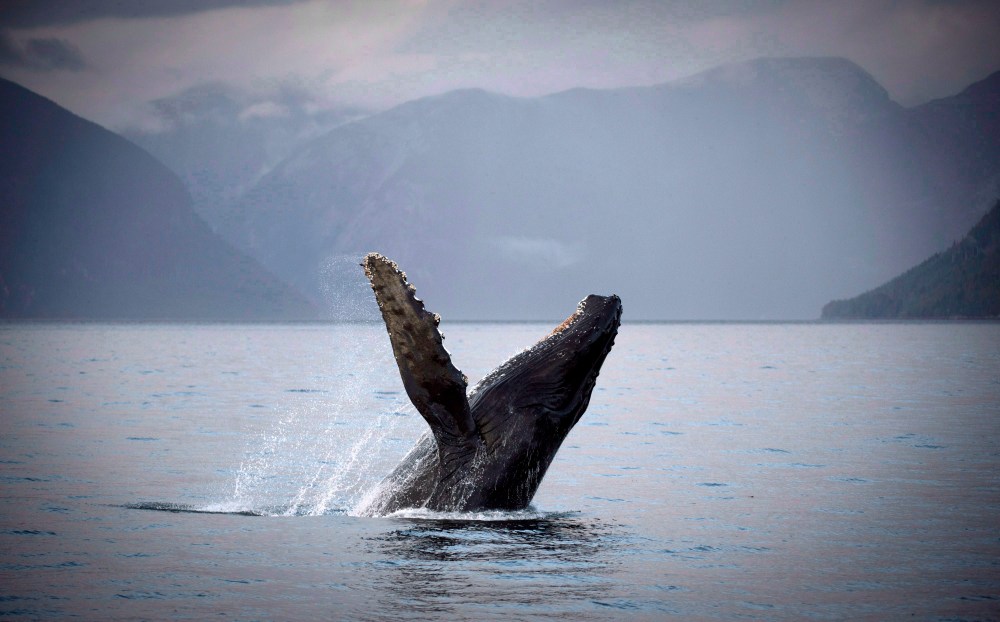
The sightings have produced a raft of social media photos and videos that show the animals in the waters near major landmarks in and around Vancouver.
Adelsheim says one reason why the public is seeing more marine mammals is the use of social media by whale-spotting groups.
“There are so many people in these sighting groups,” she says. “So, when people in West Vancouver see whales headed toward the Lions Gate Bridge, they put it on these social media platforms, and everyone in Vancouver goes to Stanley Park to get ready to see them cross under.”
But it’s not just a case of social media making it easier.
“Part of it is that there actually are a lot more whales in the area this time of the year,” she says. “A lot of it is just the seasonality of the Salish Sea and our marine environment. It really peaks in the summer.”
More sunlight means more algae and phytoplankton at the base of the aquatic food pyramid, she says. That means more fish, which then attracts more seals, sea lions and porpoises, she adds.
“Which then brings in their predators, and so on,” Adelsheim says.
The UBC research on transient killer whales shows the waters off B.C. have become a critical habitat, Adelsheim says. “They are able to be here because of the end of seal culling and having a good food source,” she says.
Adelsheim says the end of commercial whaling in Canada, coupled with other global prohibitions on whaling, has also allowed humpback whales to recover.
The researcher, who also works as a naturalist in the whale-watching industry, says B.C. waters started becoming popular with humpbacks again in the late 1990s when a female nicknamed Big Mama started to feed there.
An intensive period of commercial whaling between 1907 and 1910 wiped out most of the animals that once spent their summers off B.C., Adelsheim says.
But Big Mama’s rediscovery of the area nearly a century later changed things.
“Essentially, she is kind of the whale that is being credited for bringing her friends back to this area,” Adelsheim says in pointing to the language and social skills of the animals.
Big Mama herself has brought eight calves back to the area.
“Even last year, she had a new calf, and she has already been sighted here in the Vancouver-Victoria area a number of times. So, she is alive and well.”
That might not be the case, though, for the grey whales migrating past Vancouver on their way to feeding grounds off Alaska.
Adelsheim says the one animal, which was easily seen from Vancouver shorelines in April and May, stopped here because it might have been “really, really hungry.”
The animal’s stop in Vancouver coincides with ongoing concerns about the overall health of grey whales.
As of the second week of June, the bodies of 10 grey whales have been spotted along the coast.
The Fisheries Department said earlier this year that more whale deaths were expected due to lower food supplies in their northern feeding grounds last summer, and at least two of the whales found this year were described as in “extremely emaciated” condition.
Adelsheim says grey whales need to eat enough food in Alaska during the summer of the preceding year before making the round trip to breeding grounds off Mexico, then back to Alaska.
Marine biologists say a lot of research points to climate change affecting the food supply for grey whales.
A recent viral video of a person on a Jet Ski launching off a grey whale while it was feeding off Vancouver underscores the importance of following laws designed to keep both humans and animals safe, she says.
The government has set guidelines for minimum safe distance for marine mammals, including being no closer than 1,000 metres for the endangered southern resident killer whales.
“Most people are really happy to see whales here doing well, and we need to work together to keep them safe,” Adelsheim says.
This report by The Canadian Press was first published June 29, 2026.