Fact File: Does banning glyphosate prevent wildfires? Here’s what we know

Advertisement

Advertise with us

A social media post shared a screenshot of a satellite map that shows Quebec experiencing fewer wildfires than the rest of Canada, and suggested it was because the province banned the use of glyphosate-based weed killers in 2001. Experts who study wildfires say Quebec has seen varied wildfire seasons since then — including an extreme burn in 2023 — despite a lack of glyphosate use. They say there is no evidence linking glyphosate to increased wildfire activity. 

Read this article for free:


or

Already have an account? Log in here »

To continue reading, please subscribe:

Subscribe and receive a limited-edition Free Press branded hat or tote.

Digital Subscription

One year of digital access for only $205*

  • Enjoy unlimited reading on winnipegfreepress.com
  • Read the E-Edition, our digital replica newspaper
  • Access News Break, our award-winning app
  • Play interactive puzzles

*First annual payment billed as $205.00 + GST for one year. This annual subscription will automatically renew at $233.00 + GST every 52 weeks (10% off the regular annual price of $259.35). Offer available to new and qualified returning subscribers only. Cancel any time.

To continue reading, please subscribe:

Add Free Press access to your Brandon Sun subscription for only an additional

$1 for the first 4 weeks*

  • Enjoy unlimited reading on winnipegfreepress.com
  • Read the E-Edition, our digital replica newspaper
  • Access News Break, our award-winning app
  • Play interactive puzzles
Start now

*Your next Brandon Sun subscription payment will increase by $1.00 and you will be charged $17.95 plus GST for four weeks. After four weeks, your payment will increase to $24.95 plus GST every four weeks.

A social media post shared a screenshot of a satellite map that shows Quebec experiencing fewer wildfires than the rest of Canada, and suggested it was because the province banned the use of glyphosate-based weed killers in 2001. Experts who study wildfires say Quebec has seen varied wildfire seasons since then — including an extreme burn in 2023 — despite a lack of glyphosate use. They say there is no evidence linking glyphosate to increased wildfire activity. 

THE CLAIM

“Ahead of this wildfire season it is always important to remember that Quebec is the only jurisdiction in North America that doesn’t spray its forests with glyphosate for ‘forest management,'” reads an X post from last month with around 11,000 likes. 
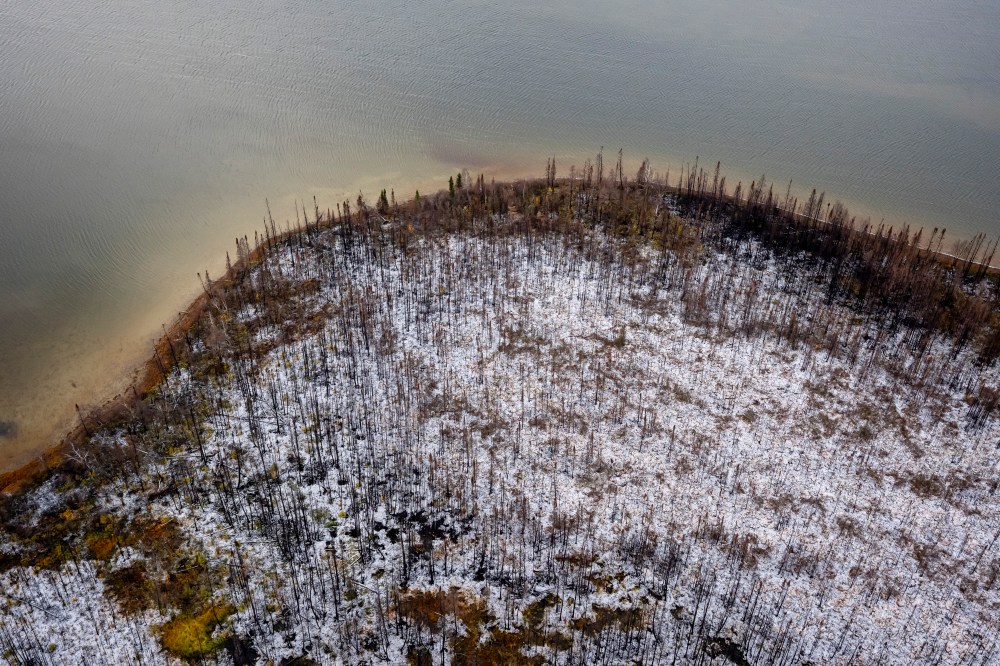
Trees that had been burnt in a recent wildfire near Webequie, Ont., on Friday, Oct. 24, 2025. THE CANADIAN PRESS/Christopher Katsarov

The post includes a screenshot of a “2025 wildfire map” that appears to mark wildfires across Canada and the United States with a flame icon. It bears the watermark of the Fire Information for Resource Management System US/Canada, a satellite fire map maintained by NASA, and the date Aug. 20, 2025. 

The majority of fires on the map are clustered in Western and Central Canada, while Quebec seems to have the fewest fires. 

The post suggests Quebec saw fewer fires than the rest of Canada because it does not use glyphosate on its forests. 

Some of those who shared the post elsewhere on social media mused glyphosate could be accelerating forest fires elsewhere in Canada. 

A similar X post to the one shared last month was posted by the same user in August 2025 and reshared on multiple social media platforms. 

THE FACTS

Glyphosate is a herbicide that is widely used for agricultural management in Canada. 

Provinces including British Columbia, Ontario and New Brunswick use glyphosate-based weed killers in forests to get rid of species that compete with conifers, the trees preferred by the forest industry. 

Quebec banned the use of glyphosate in its public forests in 2001. 

While there are legitimate health risks associated with glyphosate, Health Canada maintains its use does not cause harmful effects for Canadians if the products containing it are used according to label instructions. 

Nelson Thiffault, a research scientist with the Canadian Forest Service, said wildfire occurrence and severity depends on a complex mix of factors.

They include weather conditions, drought, temperature, wind, ignition sources and topography, he said in email to The Canadian Press. 

“I’m not aware of any scientific evidence supporting the claim that Quebec has fewer wildfires because it banned the use of glyphosate in public forests in 2001, nor that glyphosate use is a primary driver of wildfire activity,” Thiffault said.

Climate and weather would typically have the biggest impact on annual wildfire activity, he added.

Robert Gray, a fire ecologist and consultant, said glyphosate can make forest landscapes more flammable. 

“It’s converting live vegetation to dead vegetation and that changes the dynamics of fire behaviour,” he said in an interview. 

Thiffault said forest management practices that prioritize conifers create forests that are generally more flammable than those with more deciduous species, whose higher moisture content reduces fire intensity.

“However, these outcomes are shaped by overall management objectives and silvicultural systems, not by any single treatment tool in isolation,” he said. 

Jonathan Boucher, also a research scientist with the Canadian Forest Service, said there isn’t enough data to show glyphosate has a direct impact on wildfires, especially as other provinces use multiple methods to reduce the abundance of deciduous species. 

He added the map shared on social media is a snapshot in time that doesn’t reveal much about wildfire behaviour in Canada. 

“There’s a high variability from year to year, but also from regions to regions,” he said of Canada’s wildfire landscape in an interview. 

The researchers who spoke to The Canadian Press noted that Quebec experienced an unprecedented wildfire season in 2023, disproving social media conjecture about Quebec having fewer fires than other provinces as a result of its ban on glyphosate. 

He noted Quebec saw more than four million hectares burned in 2023, the most that year with the Northwest Territories a close second, despite neither the province or territory using glyphosate on forests. 

This report by The Canadian Press was first published July 2, 2026. 

Note to readers:This is a corrected story. A previous version said Quebec led the provinces in most hectares burned annually. In fact, Quebec led the provinces in number of hectares burned in 2023.


Report Error Submit a Tip

More Stories

Don’t be a big loser — check out Real Love Summer Fest ReunionBig Loser takes the stage at 8:20 p.m. tonight as part of the Real Love Summer Fest Reunion, a one-day event put on by the indie promotion company, which ran the festival in the Interlake area for a decade until last summer’s final edition near Teulon.

Bookers Gil Carroll and Adam Soloway have programmed a full day of music at Blue Note Park (220 Main St.), the outdoor venue adjacent to Times Change(d) High and Lonesome Club.

First up at 4 p.m. is folk-rock songwriter tofusmell, followed at 5 p.m. with a rare performance by indie-songwriting darlings Animal Teeth, a group with several summer fest bills under its belt. Up-and-coming pop-rockers Synthetic Friend take the stage at 6, followed at 7 by the fun electronic dance pop of French Class.

After playing with his full band at last month’s Winnipeg Folk Festival, Amos the Kid will perform a solo set at 8 p.m. Sans band, the performer shows off his affable roots as a Gord Downie acolyte with catchy earworms to match.

Sea Bears finish on top

Joshua Frey-Sam 6 minute read Preview

Sea Bears finish on top

Joshua Frey-Sam 6 minute read Yesterday at 8:27 PM CDT

Beauty. Bliss. Ecstasy.

That is how Aug. 15, 2026 will be remembered in Winnipeg.

What was once a pipe dream in the city’s hoops community became an epic reality on Saturday, when Simon Hildebrandt, who grew up playing on the courts of this very town, made good on a three-pointer from the wing to crown the Winnipeg Sea Bears Canadian Elite Basketball League champions.

A storybook ending to a 98-84 victory over the Brampton Honey Badgers sent a CEBL attendance record of 12,519 fans into pandemonium at Canada Life Centre and capped a Finals run for the ages — one that was fraught with injury, impromptu player exits and unprecedented circumstances.

Read
Yesterday at 8:27 PM CDT

Manitoba supports MAID delay: Asagwara

Carol Sanders 5 minute read Preview

Manitoba supports MAID delay: Asagwara

Carol Sanders 5 minute read Friday, Aug. 14, 2026

The number of Manitobans receiving medical assistance in dying in 2026 is on track with previous years while the plan to extend it to those suffering from mental illness is delayed indefinitely by the federal government — a move Manitoba’s health minister supports.

“There’s so much more work that needs to be done,” Uzoma Asagwara said.

The parliamentary committee that issued its recommendation in June was the third special committee of Parliament struck to assess the eligibility of people with mental illness since 2021, when MAID eligibility was expanded to include people who were not at the end of their lives.

A key condition for MAID eligibility is that a patient must be suffering from a grievous and irremediable medical condition.

Read
Friday, Aug. 14, 2026

Fact File: Does banning glyphosate prevent wildfires? Here’s what we know

Marissa Birnie, The Canadian Press 4 minute read Preview

Fact File: Does banning glyphosate prevent wildfires? Here’s what we know

Marissa Birnie, The Canadian Press 4 minute read Friday, Jul. 3, 2026

A social media post shared a screenshot of a satellite map that shows Quebec experiencing fewer wildfires than the rest of Canada, and suggested it was because the province banned the use of glyphosate-based weed killers in 2001. Experts who study wildfires say Quebec has seen varied wildfire seasons since then — including an extreme burn in 2023 — despite a lack of glyphosate use. They say there is no evidence linking glyphosate to increased wildfire activity. 

THE CLAIM

"Ahead of this wildfire season it is always important to remember that Quebec is the only jurisdiction in North America that doesn't spray its forests with glyphosate for 'forest management,'" reads an X post from last month with around 11,000 likes. 

The post includes a screenshot of a "2025 wildfire map" that appears to mark wildfires across Canada and the United States with a flame icon. It bears the watermark of the Fire Information for Resource Management System US/Canada, a satellite fire map maintained by NASA, and the date Aug. 20, 2025. 

Read
Friday, Jul. 3, 2026

Development turning long-vacant gas station in Selkirk into commercial hub

By Tiago Resko 2 minute read Preview

Development turning long-vacant gas station in Selkirk into commercial hub

By Tiago Resko 2 minute read Thursday, Aug. 13, 2026

A plot of land that has sat vacant in Selkirk for 30 years is being redeveloped to host new businesses in the heart of the city.

The former gas station site on Main Street — between Rosser and Pacific avenues — will be turned into a commercial hub that will be home to six local businesses, and will be a big stepping stone for economic growth in Selkirk, Mayor Larry Johannson said Thursday.

“For decades this site has been a reminder of what once was. Today, it represents what is possible when investors see the potential of our community and choose to be a part of its future,” he said in a news release announcing the project and Thursday’s groundbreaking.

“This development reflects confidence in Selkirk, our economy and the direction we are heading.”

Read
Thursday, Aug. 13, 2026

WRHA directs three care homes to accommodate surge of hospital patients

Malak Abas 5 minute read Preview

WRHA directs three care homes to accommodate surge of hospital patients

Malak Abas 5 minute read Friday, Aug. 14, 2026

The Winnipeg Regional Health Authority has directed three long-term care centres to make space for hospital patients, citing “exceptionally high demand for care across the health-care system.”

Read
Friday, Aug. 14, 2026