Five takeaways from final debate of Quebec election campaign

Advertisement

Advertise with us

MONTREAL - After being greeted by a raucous crowd of supporters and protesters, the leaders of Quebec's five major political parties dove into their third and final debate of the election campaign, hosted by Radio-Canada on Wednesday evening.

Read this article for free:


or

Already have an account? Log in here »

To continue reading, please subscribe:

Subscribe and receive a limited-edition Free Press branded hat or tote.

Digital Subscription

One year of digital access for only $205*

  • Enjoy unlimited reading on winnipegfreepress.com
  • Read the E-Edition, our digital replica newspaper
  • Access News Break, our award-winning app
  • Play interactive puzzles

*First annual payment billed as $205.00 + GST for one year. This annual subscription will automatically renew at $233.00 + GST every 52 weeks (10% off the regular annual price of $259.35). Offer available to new and qualified returning subscribers only. Cancel any time.

To continue reading, please subscribe:

Add Free Press access to your Brandon Sun subscription for only an additional

$1 for the first 4 weeks*

  • Enjoy unlimited reading on winnipegfreepress.com
  • Read the E-Edition, our digital replica newspaper
  • Access News Break, our award-winning app
  • Play interactive puzzles
Start now

*Your next Brandon Sun subscription payment will increase by $1.00 and you will be charged $17.95 plus GST for four weeks. After four weeks, your payment will increase to $24.95 plus GST every four weeks.

MONTREAL – After being greeted by a raucous crowd of supporters and protesters, the leaders of Quebec’s five major political parties dove into their third and final debate of the election campaign, hosted by Radio-Canada on Wednesday evening.

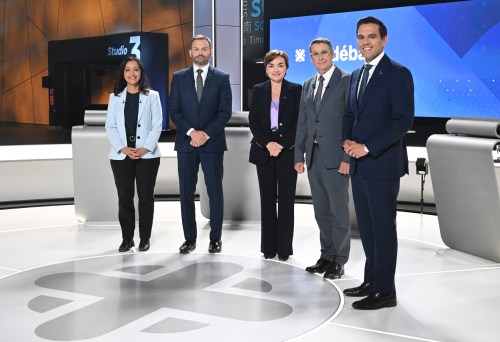
Here are five takeaways from a debate featuring Coalition Avenir Québec Leader Christine Fréchette, Quebec Liberal Leader Charles Milliard, Québec solidaire co-spokesperson Ruba Ghazal, Parti Québécois Leader Paul St-Pierre Plamondon and Quebec Conservative Leader Éric Duhaime.

1. There was a one-hour wait for sparring on sovereignty and a referendum.
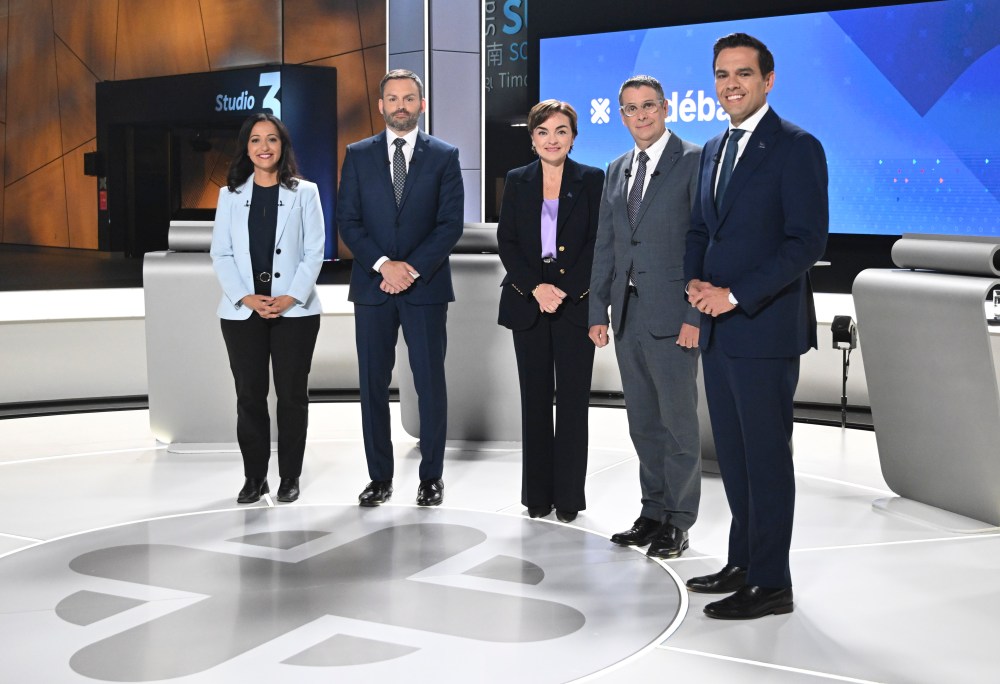
From left, Québec solidaire co-spokesperson Ruba Ghazal, Parti Québécois Leader Paul St-Pierre Plamondon, Coalition Avenir Québec Leader Christine Frechette, Quebec Conservative Leader Éric Duhaime and Quebec Liberal Leader Charles Milliard pose before the start of a leaders debate in Montreal on Wednesday, Sept. 23, 2026. Quebec votes in a provincial election on Oct. 5, 2026. THE CANADIAN PRESS/Graham Hughes

The leaders discussed five major themes during Wednesday’s debate. But voters watching at home had to wait until the second hour to hear one of the evening’s most animated exchanges — during a segment about the future of Quebec.

The PQ leader and Québec solidaire’s co-spokesperson are both in favour of sovereignty, with slightly different approaches. Ruba Ghazal promoted her plan to get Indigenous people and English-speaking Quebecers to buy into a campaign to make the province a country. This was the only mention of Quebec’s English-speaking population in the entire debate.

St-Pierre Plamondon quickly found himself on the defensive over his recent pledge to wait until after U.S. President Donald Trump leaves the White House before triggering a referendum.

Milliard pressed St-Pierre Plamondon on whether this delay was an admission a referendum would weaken Quebec — a theory, the PQ leader dismissed.

“It’s proof that we are living a very unusual moment with the Americans that is unacceptable on the part of the Trump administration,” St-Pierre Plamondon said in French. “It’s not a serene climate (while Trump is president) to reflect on our future.”

The PQ leader has pledged to spend $130 million in government to organize a referendum. This would include money for a roving commission to hold consultations on the issue in the years leading up to a vote after January 2029.

Milliard said his rivals all support sovereignty or would have supported it in the past and argued his party was the only federalist option.

Fréchette and Duhaime have said Quebecers are not interested in a referendum.

2. Waiting times in hospitals are still a problem.

Fréchette found herself on the defensive early in the debate after being challenged by her rivals from the Liberals and Parti Québécois about broken health-care promises and long wait times in hospitals after her party’s eight years in government.

Milliard said Quebecers had been betrayed by the Coalition Avenir Québec’s promises to reduce emergency room wait times and ensure every Quebecer had a doctor. St-Pierre Plamondon agreed, saying the latter promise was “disrespectful of people’s intelligence.”

Fréchette acknowledged there was still work to do, but said her party had made improvements, including in increasing the number of surgeries performed and signing up hundreds of thousands of Quebecers for groups of family doctors.

3. St-Pierre Plamondon talked a lot.

Radio-Canada tracked how long each leader spoke during the debate.

By the end of the evening, the moderator, Radio-Canada journalist Patrice Roy, allowed the PQ leader to speak for nearly 24 minutes, while the Liberal and Conservative leaders got less than 18 minutes of airtime to talk about their policies and ideas.

Québec solidaire’s Ghazal spoke for a little more than 20 minutes, while Fréchette spoke for close to 21 minutes.

4. The baby that shook the campaign landed in debate.

A baby found at a homeless encampment in east Montreal in mid-September became the topic of one of the opening segments of the debate. Police say the discovery triggered an investigation and the intervention of social services and youth protection workers.

The story has brought the plight of unhoused people and affordability issues to the forefront of the Quebec campaign, with the leaders expressing shock and pledging to address them.

Each leader was asked about the incident and had a few seconds to respond before moving on to the next topic.

5. There were five leaders on stage.

Political analysts have said Quebec voters are fragmented in a tight race that could lead to a minority government when ballots are cast Oct. 5.

That dynamic was evident on stage as each leader tried to make their points, with multiple voices in the background.

There was limited opportunity for anyone to take specific aim at a rival before others interrupted or tried to change the topic. 

This report by The Canadian Press was first published Sept. 24, 2026
Report Error Submit a Tip

More Stories

Canada resorting to its tried and true playbook

Niigaan Sinclair 5 minute read Preview

Canada resorting to its tried and true playbook

Niigaan Sinclair 5 minute read Monday, Sep. 28, 2026

In 1846, Britain faced an emergency influenced by the Irish famine, so leaders repealed the country’s “Corn Laws” and restrictions on imported food and grain, transitioning to a system of free trade.

This created a crisis in the then Province of Canada, which had relied on British “preferential” status to prop up its agricultural and resource industries.

As a result, Canada looked south for new markets and eventually negotiated a free trade agreement with the United States.

This required land to be acquired and converted for industrial use quickly, so Canada quickly dispatched Commissioner William Robinson to negotiate with Indigenous communities along Lake Huron and Lake Superior for land.

Read
Monday, Sep. 28, 2026

Khan cites infighting, quits as Tory leader

Carol Sanders 5 minute read Preview

Khan cites infighting, quits as Tory leader

Carol Sanders 5 minute read Updated: Yesterday at 9:56 AM CDT

Manitoba’s Leader of the Opposition is stepping down.

Progressive Conservative Leader Obby Khan announced late Monday afternoon he is quitting caucus and will sit in the legislature as an independent MLA, effective today.

He cited internal party fighting for his decision.

The former Winnipeg Blue Bombers offensive lineman survived a caucus confidence vote Friday. He said there were 13 votes for him to remain and six against, with one person absent.

Read
Updated: Yesterday at 9:56 AM CDT

Five takeaways from final debate of Quebec election campaign

The Canadian Press 5 minute read Preview

Five takeaways from final debate of Quebec election campaign

The Canadian Press 5 minute read Thursday, Sep. 24, 2026

MONTREAL - After being greeted by a raucous crowd of supporters and protesters, the leaders of Quebec's five major political parties dove into their third and final debate of the election campaign, hosted by Radio-Canada on Wednesday evening.

Here are five takeaways from a debate featuring Coalition Avenir Québec Leader Christine Fréchette, Quebec Liberal Leader Charles Milliard, Québec solidaire co-spokesperson Ruba Ghazal, Parti Québécois Leader Paul St-Pierre Plamondon and Quebec Conservative Leader Éric Duhaime.

1. There was a one-hour wait for sparring on sovereignty and a referendum.

The leaders discussed five major themes during Wednesday's debate. But voters watching at home had to wait until the second hour to hear one of the evening's most animated exchanges — during a segment about the future of Quebec.

Read
Thursday, Sep. 24, 2026

‘Warmest welcome’ at Manitoba, U.K. defence partnership summit

Gabrielle Piché 4 minute read 6:09 PM CDT

The working name of Manitoba’s newest defence-focused group is Tea and Textiles.

Carole and Tim Champion may become members. The British entrepreneurs spent Tuesday touring Boeing, StandardAero and Magellan Aerospace in Winnipeg, pondering how they could partner with the businesses.

They own Needles and Pins Aerospace, a United Kingdom-based company that makes and repairs covers and interior fabrics for aircraft. The firm holds internationally recognized quality management standards.

“I think we could bring something to the party,” Carole said post-tours.

Port of Churchill signs agreement with Dutch port

Aaron Epp 2 minute read Preview

Port of Churchill signs agreement with Dutch port

Aaron Epp 2 minute read Yesterday at 4:40 PM CDT

Arctic Gateway Group, operator of the Port of Churchill, has signed an agreement with the Port of Rotterdam in the Netherlands to attract business and strengthen supply chains linking Western Canada and Europe.

The agreement enables the two ports to work together to develop new trade in critical minerals and energy products, connect Canadian producers with European buyers, and identify opportunities to improve the supply chain from Western Canadian resource projects through Churchill and into European markets.

The Port of Rotterdam is Europe’s largest port and home to more than 3,000 businesses across its industrial complex, serving as a major gateway for critical raw materials and energy.

Meanwhile, the Port of Churchill has been identified as a transformative national strategy for Canada and is emerging as a northern trade corridor connecting Western Canada’s resources to global markets.

Read
Yesterday at 4:40 PM CDT

What does the PC stand for in party’s name? Seems to be Pretty Confused

Tom Brodbeck 5 minute read Preview

What does the PC stand for in party’s name? Seems to be Pretty Confused

Tom Brodbeck 5 minute read Yesterday at 1:11 PM CDT

It should have been obvious from the beginning that the Manitoba Progressive Conservative party was going to have trouble holding itself together under Obby Khan.

Read
Yesterday at 1:11 PM CDT