Obsolete technology given new life by variety of artists

Celebration of smudgy relics

Advertisement

Advertise with us

Back in the 1980s, faxing was cool and cutting-edge. Now, of course, the fax has been routed by email and text messaging, and the fax machine seems as creaky as the wind-up phonograph or the vacuum-tube television.

Read this article for free:


or

Already have an account? Log in here »

To continue reading, please subscribe:

Subscribe and receive a limited-edition Free Press branded hat or tote.

Digital Subscription

One year of digital access for only $205*

  • Enjoy unlimited reading on winnipegfreepress.com
  • Read the E-Edition, our digital replica newspaper
  • Access News Break, our award-winning app
  • Play interactive puzzles

*First annual payment billed as $205.00 + GST for one year. This annual subscription will automatically renew at $233.00 + GST every 52 weeks (10% off the regular annual price of $259.35). Offer available to new and qualified returning subscribers only. Cancel any time.

To continue reading, please subscribe:

Add Free Press access to your Brandon Sun subscription for only an additional

$1 for the first 4 weeks*

  • Enjoy unlimited reading on winnipegfreepress.com
  • Read the E-Edition, our digital replica newspaper
  • Access News Break, our award-winning app
  • Play interactive puzzles
Start now

*Your next Brandon Sun subscription payment will increase by $1.00 and you will be charged $17.95 plus GST for four weeks. After four weeks, your payment will increase to $24.95 plus GST every four weeks.

Hey there, time traveller!
This article was published 31/12/2009 (6123 days ago), so information in it may no longer be current.

Back in the 1980s, faxing was cool and cutting-edge. Now, of course, the fax has been routed by email and text messaging, and the fax machine seems as creaky as the wind-up phonograph or the vacuum-tube television.

Obsolete as a practical technology, the fax takes on strange new life as a creative tool in this unfolding exhibition at Plug In ICA. In April, 2009 curator Joao Ribas asked almost 100 people, including artists, designers, engineers and filmmakers, to send faxes to The Drawing Center in New York. These works were received, exhibited and archived while the FAX show was running. Plug In presents this core exhibition, as well as inviting local artists to contribute, via the HP fax machine that currently waits in the gallery space.

These fax-based works draw on the traditions of Mail Art, a cheap and cheerful movement in which artists send notes, jottings, rubber-stamped postcards, sketches, cartoons and other ephemera around the globe via through the postal system.
TREVOR HAGAN / WINNIPEG FREE PRESS
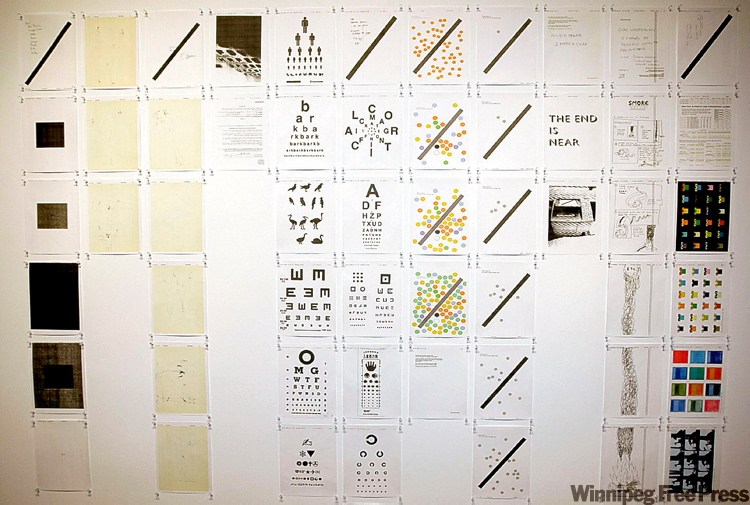
Faxed art on display at Plug In ICA touches on ideas of communication and duplication.
TREVOR HAGAN / WINNIPEG FREE PRESS Faxed art on display at Plug In ICA touches on ideas of communication and duplication.

Along with examining issues of information and communication, fax art — being an odd and evocative combination of the machine and the human hand – also looks at technology. Bearing physical traces of the sender’s handwriting and drawing, the fax can seem endearingly expressive and emotional, especially in light of what’s come along since.

Take a funny back-and-forth series of faxes from Bank, an irreverent British artists’ group that in the 1990s started offering unsolicited corrections to art world press releases. In these "fax bak" works, Bank circles phrases on faxed gallery announcement, adds cheeky comments in the margins, and then returns them. The faxed response from one gallery — PLEASE STOP WASTING OUR TIME WITH YOUR ADOLESCENT INANE COMMENTARY. GO AWAY!! — is scrawled in big, dark, angry letters. No emoticons needed.

Some of the FAX artists have sent drawings, sketches or cartoons. Since a fax is a reproduction — and a fragile, frequently screwed-up reproduction, at that — these images are smudged, hazy and flat. Most of these artists aren’t mourning what is lost in the process of duplication and dissemination, though. They’re celebrating the obscure, ghostly beauty of the copies.

Some artists are deliberately testing the limits of legibility. Barbara Bloom uses the triangular organization of eye charts in her faxes, replacing the standard letters with text-message abbreviations (OMG, WTF) or bird silhouettes. Other artists cherry-pick images that have become immediately recognizable for political or cultural reasons, like I ‘* NY or that grainy picture of Osama bin Laden.

Some works are text-based. Eric Mitchell picks up on the way replication affects the spread of information — and disinformation — with faxes that highlight spurious conspiratorial phrases plucked off the Internet ("The Illuminati," "The New World Order," "Miraculous Cancer Cure!").

Taken as a whole, FAX calls up Proustian memories of the medium’s glory days — that juddering sound when a transmission came through; the metallic smell and slippery feel of a fax fresh off the roll; the adorably limited palette of white, black, near-black and off-black. Although the show’s curatorial guidelines sternly warn artists against "fetishistic nostalgia," viewers can do as they please.

alison.gillmor@freepress.mb.ca

FAX

Plug In ICA, 286 McDermot Ave.

Until Feb. 21

Alison Gillmor

Alison Gillmor
Writer

Studying at the University of Winnipeg and later Toronto’s York University, Alison Gillmor planned to become an art historian. She ended up catching the journalism bug when she started as visual arts reviewer at the Winnipeg Free Press in 1992.

Our newsroom depends on a growing audience of readers to power our journalism. If you are not a paid reader, please consider becoming a subscriber.

Our newsroom depends on its audience of readers to power our journalism. Thank you for your support.

Report Error Submit a Tip

More Stories

Seven Wilsons, one regional spirit

Hersh Seth 5 minute read Preview

Seven Wilsons, one regional spirit

Hersh Seth 5 minute read 2:00 AM CDT

In Dryden, Ont., a 34-metre suspension bridge crosses the Wabigoon River rapids. It is named after a man who paid for a quarter of the bridge himself. A plaque recognizes Roy Wilson’s “many contributions to City Revitalization” and mentions his 40 years in the Rotary Club, whose motto is “service above self”.

My father sold business machines from the 1970s through the ’90s, during the shift from carbon copy machines and typewriters to photocopiers, fax machines, and early office computers and printers. His sales territory — which he covered mostly by car but also by propeller plane — was Saskatchewan, the Northwest Territories, Manitoba, and northwestern Ontario, though much of it really belonged to the Wilsons.

In business machines, selling the machine was only half the job — the other half was ensuring a technician would fix it in January. Wilson’s set the standard for dealers across most of my dad’s regions. My father worked with Roy’s son Greg (who would later go on to become mayor of Dryden) but really respected Roy for teaching Greg to run the company with the towns they served as the priority.

Wilson’s service routes went beyond where roads stopped. Even if customers lived north of the highway system, Wilson’s still found a way to help, using three company planes based at the Dryden airport. As a result, a stationery shop from a paper mill town served all of northwestern Ontario and later northern Manitoba. Imagine a photocopier strapped into a small plane, a technician beside it, and a gravel runway waiting at the other end.

Read
2:00 AM CDT

’Disgusting’ posters being investigated by police

Morgan Modjeski 4 minute read Updated: Yesterday at 1:32 PM CDT

The Winnipeg Police Service major crimes unit is investigating what some have labelled offensive and hateful posters on full-display at a Winnipeg home.

Essential workers ruling raises questions

Editorial 4 minute read Preview

Essential workers ruling raises questions

Editorial 4 minute read 2:00 AM CDT

Ever been to a Dynacare clinic? Most of us have been. It’s an amazing demographic and ethnic slice of the city we’ve become. Old patients. Young patients. New arrivals. Long-time Canadians. People who know the ropes — others who are startled by the crowds and the noise and the lockstep forward motion of professionals doing what they have been trained to do. It seems, all at the same time, both chaotic and diagnostic, as names of patients are steadily called out and thousands of tests are performed.

But Dynacare is at the centre of a new kind of test and this time, we’re all in the test tube together.

It’s the first real test for new labour law put in place by the government of Premier Wab Kinew in 2024 — a law that redefined what essential services are for provincially-regulated workplaces. Under this law, companies and their employee and unions must have an agreement of which employees are essential — which ones must stay on the job during a legal strike for the protection of the health and safety of the public.

Dynacare had that kind of essential employee agreement with its staff and union — the company and the union had agreed the employees were not essential.

Read
2:00 AM CDT

13 guns seized from West St. Paul homes

1 minute read Yesterday at 12:28 PM CDT

Two men have been charged with a number of firearms offences after an RCMP investigation into illegal weapons in West St. Paul yielded the seizure of more than a dozen firearms last month.

RCMP investigators from the Manitoba Integrated Law Enforcement Team, which probes organized and serious crime in the province, began looking into the two suspects on a tip from the Canada Border Services Agency.

Officers obtained warrants to search two homes, one on Pipeline Road and the other on Griffin Way, on Sept. 11.

Between the two houses, Mounties found 13 guns, including two that were sawed off, about 20,000 rounds of ammunition and several high-capacity magazines that had been altered to hold more ammunition than is legally allowed.

Telekinetic teen hits small screen

Denise Duguay 4 minute read Preview

Telekinetic teen hits small screen

Denise Duguay 4 minute read 2:00 AM CDT

At desperate times like these, it’s good to be reminded that one person can make a difference. A telekinetic high schooler, grieving lover, ambitious law firm, frantic father and spiritual climber offer a variety of inspiring lessons in this new offering of TV recommendations.

Carrie (series premières Wednesday, Oct. 7 on Prime Video)Famously over-the-top filmmaker Brian De Palma (Phantom of the Paradise, Dressed to Kill, Scarface) directed the 1976 Carrie into its status as one of the scariest films of the time and beyond. It became better known than the debut horror novel by Stephen King from which it was adapted. It even trumped the three adaptations that followed. This new TV series looks ready to challenge that supremacy. Taking the title role made famous by Sissy Spacek, Manitoba actress Summer H. Howell (see Randall King’s interview at wfp.to/carrie) plays a homeschooler thrilled to finally be allowed to attend public high school. But when the mean girls begin circling and blood manifests in scary new ways, the new girl’s telekinetic potential blossoms in spectacular fashion. Also of horrific note as Halloween approaches: Below (Netflix miniseries premièring Thursday) stars Josh Hartnett as a fisherman trying to protect his family and town from a mysterious sea creature; Eternally Yours (sitcom premièring Thursday, Oct. 8, on CBS/Global) is a new vampire comedy; and Crystal Lake (thriller series premières Oct. 15 on Crave) stars Linda Cardellini (DTF St. Louis) as Pam Voorhees, single mom of a tormented kid named Jason, in this Friday the 13th origin story. Boo!


Small Prophets (series Canadian première Wednesday, Oct. 7, on Apple TV)Canadian fans of British TV have been champing at the bit for this quirky series since its acclaimed U.K. première in February. It’s a shaggy, quietly hilarious character study in the vein of Detectorists (2014-22, AcornTV), both of which were created by Mackenzie Crook (Pirates of the Caribbean), who also starred in Detectorists and plays a supporting role in Small Prophets. When the new story opens, Michael Sleep (Detectorists’ Pearce Quigley) is living a life of quiet desperation, visiting his father (Sir Michael Palin) and pining for the return of his disappeared beloved, Clea. Until, that is, Dad shares a loony alchemical recipe that sparks hope in Michael that he might be able to summon spirits to then summon Clea to … the garden shed? Not as creepy as it sounds? A tale of hope, frustratingly indirect action, meddlesome and ineffectual neighbours and, of course, true, true love.

Read
2:00 AM CDT

Real journalists matter in an AI world

Paul Deegan 4 minute read Preview

Real journalists matter in an AI world

Paul Deegan 4 minute read 2:00 AM CDT

An algorithm can decide what you see, but it doesn’t report the news. Nunatsiaq News, an award-winning newspaper in Nunavut, recently reported that a so-called “news” website was posting AI-generated articles about the north by stealing real news stories produced by real journalists.

The articles were supposedly written by Nunavut correspondent Leah Qammaniq — a fake journalist, with a fake photo and a fake bio.

Governor General Louise Arbour warned us of fake news in her installation speech in June. She said, “We must continue to protect the public space in which our national debates take place: from schools and universities to the media, political parties, unions and civil society organizations …With instant access to vast amounts of information, it is very tempting to pay little attention to the reliability of sources. The lines between knowledge and belief, between truth and falsehood, between facts and assumptions, are increasingly blurred. AI could be threatening not only the way we live and work, but also the control we exercise over our own destiny.”

The Government of Canada has recognized the problem as well. Its recent discussion paper, Enhancing trust in artificial intelligence through increased transparency, stated, “Canadians encounter news reporting, product reviews, and audio-visual content across the internet, often without any indication of whether it was written by a person, generated by an AI system, or produced through some combination of both … A particular concern within this broader landscape is that generative AI greatly enables the creation and dissemination of deceptive or misleading content.”

Read
2:00 AM CDT