Femme fatale
Strauss's scandalous opera features a heroine who's both sensual and shocking
Advertisement
Read this article for free:
or
Already have an account? Log in here »
To continue reading, please subscribe:

Digital Subscription
One year of digital access for only $205*
- Enjoy unlimited reading on winnipegfreepress.com
- Read the E-Edition, our digital replica newspaper
- Access News Break, our award-winning app
- Play interactive puzzles
*First annual payment billed as $205.00 + GST for one year. This annual subscription will automatically renew at $233.00 + GST every 52 weeks (10% off the regular annual price of $259.35). Offer available to new and qualified returning subscribers only. Cancel any time.
To continue reading, please subscribe:
Add Free Press access to your Brandon Sun subscription for only an additional
$1 for the first 4 weeks*
- Enjoy unlimited reading on winnipegfreepress.com
- Read the E-Edition, our digital replica newspaper
- Access News Break, our award-winning app
- Play interactive puzzles
*Your next Brandon Sun subscription payment will increase by $1.00 and you will be charged $17.95 plus GST for four weeks. After four weeks, your payment will increase to $24.95 plus GST every four weeks.
Read unlimited articles for free today:
or
Already have an account? Log in here »
Hey there, time traveller!
This article was published 17/11/2011 (5376 days ago), so information in it may no longer be current.
It’s a night at the opera featuring lust, suicide, incest, an erotic striptease and a necrophiliac climax: a deranged teenage princess hungrily kissing the decapitated head of John the Baptist.
All this, and no intermission to relieve the intensity.
“It’s an incredibly riveting piece of theatre,” says Larry Desrochers, general director of Manitoba Opera, who is directing the season-opening production of Salome that opens Saturday at the Centennial Concert Hall.
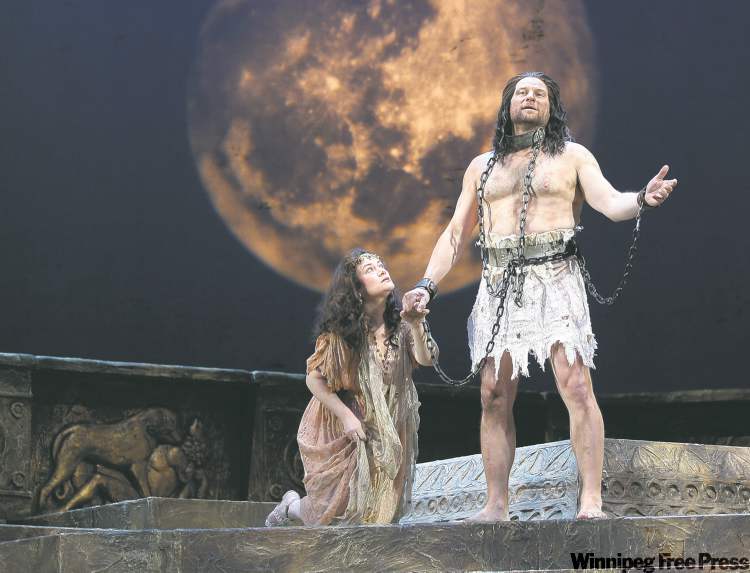
“Right at the very beginning, the page (servant) says, ‘Something terrible is going to happen.’ There’s an immediate sense of foreboding that just keeps building and building. It’s like a screw that gets turned tighter and tighter.”
Richard Strauss’s 1905 one-act opera, sung in German with projected English surtitles, has been mounted only once before by Manitoba Opera, 23 years ago. It carries a parental-guidance advisory.
Its running time is about 110 minutes. The sets and costumes, depicting the royal opulence of Judea circa AD 30, come from the Opera Company of Philadelphia.
Mlada Khudoley, the Russian-born, U.S.-based soprano who is singing the demanding title role, is something of a Salome specialist. She has performed it about a dozen times in the past 13 years.
It requires stamina to handle the role’s near-Wagnerian weight, confidence to perform the seductive dance, and acting skill to appear girlish.
“This is a big paradox,” says the self-possessed Khudoley, a Moscow native. “She must be 15 or 16 years old, but she needs to have the voice of (Wagner’s) Isolde or Brünnhilde…. Singers who are too young just cannot produce this sound; this power.”
Salome is based on a scandalous play by Oscar Wilde that was inspired by the New Testament account of John the Baptist’s execution.
In the Bible, the girl is a nameless minor character. The play and opera focus on her as a nubile teenager whose mother (mezzo-soprano Judith Forst) has murdered her father and married her uncle. The stepfather/uncle, King Herod (tenor Dennis Petersen), lusts after Salome.
Salome obsessively desires the prophet John the Baptist (baritone Gregory Dahl), who is being held prisoner by Herod. John spurns her advances.
Salome strikes a bargain with Herod that she will perform the sultry Dance of the Seven Veils for him. In return, she demands the head of the prophet on a platter.
The shocking opera was initially banned in England and shut down after one performance in New York. “Nowadays, it’s not so much shocking as disturbing,” says Desrochers.
Today’s audiences are fascinated by the family dysfunction, power dynamics and twisted psychology that make the princess fixate on the prisoner who is hated by her mother and feared by her stepfather.
“There’s all kinds of pressures on this young girl,” the director says. “It makes her construct this fantasy of her saviour, John the Baptist. She eventually snaps….
“I hope with our production we can get beyond the shock of it, to the tragedy of Salome’s character — this painful cry for love.”
Khudoley is matter-of-fact about the exotic Dance of the Seven Veils, said to be the most sensual eight minutes of music in all opera. “In many (opera) houses, people expect you to be nude, or at least topless,” she says.
Every production has a choreographer with a different approach. “Not every time is very sexy. Sometimes, it’s more decadence. This time we are doing it, I would say, in a traditional way.”
What will be revealed when Khudoley sheds her veils?
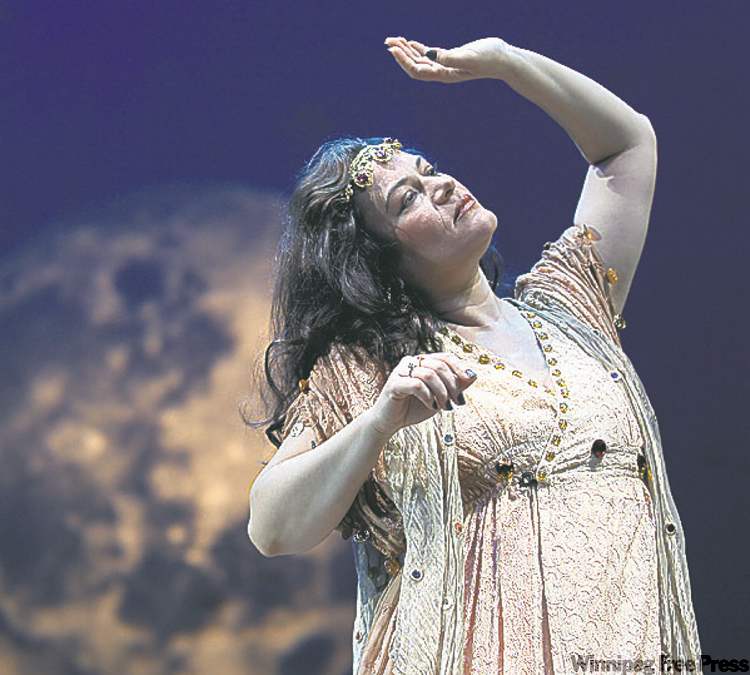
“Let’s be a little surprised,” she says. “Let the audience build up their own fantasies.”
After the dance, the soprano has to regain her breath and sing her long, debauched final aria to the macabre severed head. Khudoley finds that most designers deliver a “naturalistic replica” head, but there have been exceptions.
One production in Lithuania used a live male performer who wore a silver collar around his neck, to make it appear that his heavily made-up head was on a platter. He lay on the stage and Khudoley had to sit on his belly to make the scene work.
Another production had a rather pathetic, toy-like head. “It looked like papier-mâché, not scary,” she says. “This scene is supposed to make a shocking impression. It has to be horrifying.”
alison.mayes@freepress.mb.ca
Under Salome’s veil
Marie Wittich, who starred as Salome in the German première in 1905, refused to perform the scandalous Dance of the Seven Veils. A dancer had to step in for that part of the role. Today, some sopranos have a stand-in dancer, some strip down to a body stocking, and some bare all.
Salome requires such a large orchestra that the Winnipeg Symphony has been augmented with extra brass, woodwinds, percussion and strings. Composer Richard Strauss uses the orchestra to create vivid character and mood. “In some operas,” says director Larry Desrochers, “the orchestra is more of an accompaniment for the singers. In this opera, it’s really tied to the dramatic texture of the piece.”
Strauss uses musical effects to heighten drama and suspense. As Salome waits for John the Baptist’s beheading, the double-bass players pinch their strings while striking them with the bow. The composer likened the noise to “the suppressed, choked moaning of a woman.” In the final scene, after Salome kisses John the Baptist’s bloody severed head, there’s a jarringly dissonant chord that has been called “the most sickening chord in all opera.”

Opera Preview
Salome
— Centennial Concert Hall
— Saturday and Nov. 25 at 8 p.m.; Tuesday at 7 p.m.
— Tickets $42 to $130 at 944-8824 or manitobaopera.mb.ca