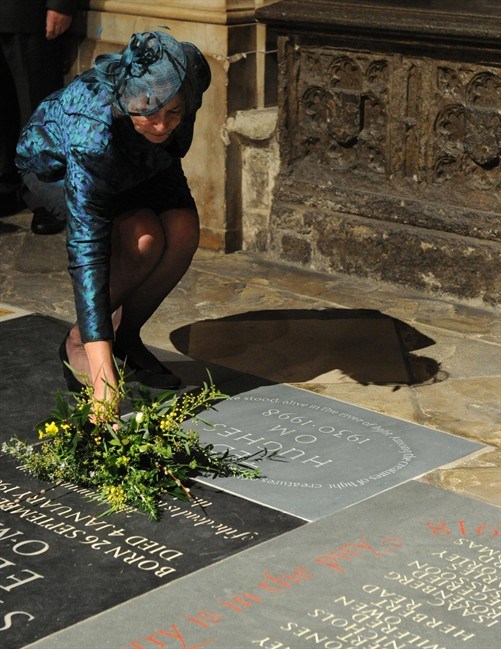
Memorial stone honouring Ted Hughes taking its place in Poets’ Corner at Westminster Abbey
Advertisement
Read this article for free:
or
Already have an account? Log in here »
To continue reading, please subscribe:

Digital Subscription
One year of digital access for only $205*
- Enjoy unlimited reading on winnipegfreepress.com
- Read the E-Edition, our digital replica newspaper
- Access News Break, our award-winning app
- Play interactive puzzles
*First annual payment billed as $205.00 + GST for one year. This annual subscription will automatically renew at $233.00 + GST every 52 weeks (10% off the regular annual price of $259.35). Offer available to new and qualified returning subscribers only. Cancel any time.
To continue reading, please subscribe:
Add Free Press access to your Brandon Sun subscription for only an additional
$1 for the first 4 weeks*
- Enjoy unlimited reading on winnipegfreepress.com
- Read the E-Edition, our digital replica newspaper
- Access News Break, our award-winning app
- Play interactive puzzles
*Your next Brandon Sun subscription payment will increase by $1.00 and you will be charged $17.95 plus GST for four weeks. After four weeks, your payment will increase to $24.95 plus GST every four weeks.
Read unlimited articles for free today:
or
Already have an account? Log in here »
Hey there, time traveller!
This article was published 06/12/2011 (5423 days ago), so information in it may no longer be current.
LONDON – British poet Ted Hughes is being honoured with a memorial stone in Poets’ Corner in Westminster Abbey, joining a line of great British writers going back to Chaucer.
The stone in the abbey floor, to be unveiled Tuesday evening, is next to one honouring T.S. Eliot, Hughes’ mentor and publisher.
Hughes’ stone is inscribed with his name and words from “That Morning,” one of his “River” poems: “So we found the end of our journey / So we stood alive in the river of light / Among the creatures of light, creatures of light.”
Some 300 people are expected to attend the ceremony, including Hughes’ widow Carol and daughter Frieda. Nobel Prize-winning Irish poet Seamus Heaney will deliver an address.
Hughes died of cancer in 1998, months after publishing “Birthday Letters,” a powerful collection reflecting on his troubled first marriage to the poet Sylvia Plath. Plath killed herself in 1963, after the couple had separated. A letter Hughes wrote to her in 1956 was chosen as one of the readings for the ceremony.
Hughes was born Aug. 17, 1930, in the mill town of Mytholmroyd in Yorkshire, northern England.
“Hawk in the Rain,” his first volume of poetry published in 1957, immediately established him as one of the most interesting of Britain’s young poets. He was appointed Poet Laureate in 1984.
“Birthday Letters” brought Hughes sympathy and a torrent of praise after long years of keeping silent about his marriage to Plath.

Hughes described the collection as “a gathering of the occasions — written with no plan over about 25 years — in which I tried to open a direct, private, inner contact with my first wife, not thinking to make a poem, thinking mainly to evoke her presence to myself and to feel her there listening.”
Hughes joins 111 writers memorialized in Poets’ Corner in the area where Geoffrey Chaucer was buried in 1400 — not because he wrote “The Canterbury Tales,” but because he was Clerk of the Works at the nearby Palace of Westminster, now almost entirely rebuilt.
A magnificent tomb for Chaucer was installed around 1550, and the poet Edmund Spenser, author of “The Fairie Queene,” was buried nearby in 1599, establishing a tradition.
Charles Dickens, Thomas Hardy, Samuel Johnson, Rudyard Kipling, John Masefield and Alfred Lord Tennyson are among the writers buried in the Abbey.
Many more are honoured with tablets and other memorials, often placed there long after death. Shakespeare was buried in Stratford-upon-Avon in 1616, and no memorial was placed in Poets’ Corner until 1740. Lord Byron died in 1824 but, because of his scandalous lifestyle, wasn’t honoured until 1969.