Painting’s pricetag could make you Scream

Advertisement
Read this article for free:
or
Already have an account? Log in here »
To continue reading, please subscribe:

Digital Subscription
One year of digital access for only $205*
- Enjoy unlimited reading on winnipegfreepress.com
- Read the E-Edition, our digital replica newspaper
- Access News Break, our award-winning app
- Play interactive puzzles
*First annual payment billed as $205.00 + GST for one year. This annual subscription will automatically renew at $233.00 + GST every 52 weeks (10% off the regular annual price of $259.35). Offer available to new and qualified returning subscribers only. Cancel any time.
To continue reading, please subscribe:
Add Free Press access to your Brandon Sun subscription for only an additional
$1 for the first 4 weeks*
- Enjoy unlimited reading on winnipegfreepress.com
- Read the E-Edition, our digital replica newspaper
- Access News Break, our award-winning app
- Play interactive puzzles
*Your next Brandon Sun subscription payment will increase by $1.00 and you will be charged $17.95 plus GST for four weeks. After four weeks, your payment will increase to $24.95 plus GST every four weeks.
Read unlimited articles for free today:
or
Already have an account? Log in here »
Hey there, time traveller!
This article was published 05/05/2012 (5219 days ago), so information in it may no longer be current.
WHAT IT IS: The Scream, an 1895 pastel-on-board work by Edvard Munch that sold at auction last week at Sotheby’s. An unnamed buyer shelled out $119.9 million for this distillation of existential dread, a record-busting sum that caused a few more shrieks.
Locked-out unionized art handlers and Occupy Wall Street protestors outside Sotheby’s denounced it as a symbol of art for the one percent. Others saw the sale as an apocalyptic sign of an inflated art bubble that’s bound to burst.
WHAT IT MEANS: The Norwegian artist created from his own experience. Walking over a bridge on the edge of Oslo one evening with two friends, Munch started to tremble with anxiety, struck with the apprehension of “an infinite scream passing through nature.” In Munch’s work, the figure’s silent O-shaped cry radiates out visually, cranked up to shivering intensity through swooning line and super-intense colour.
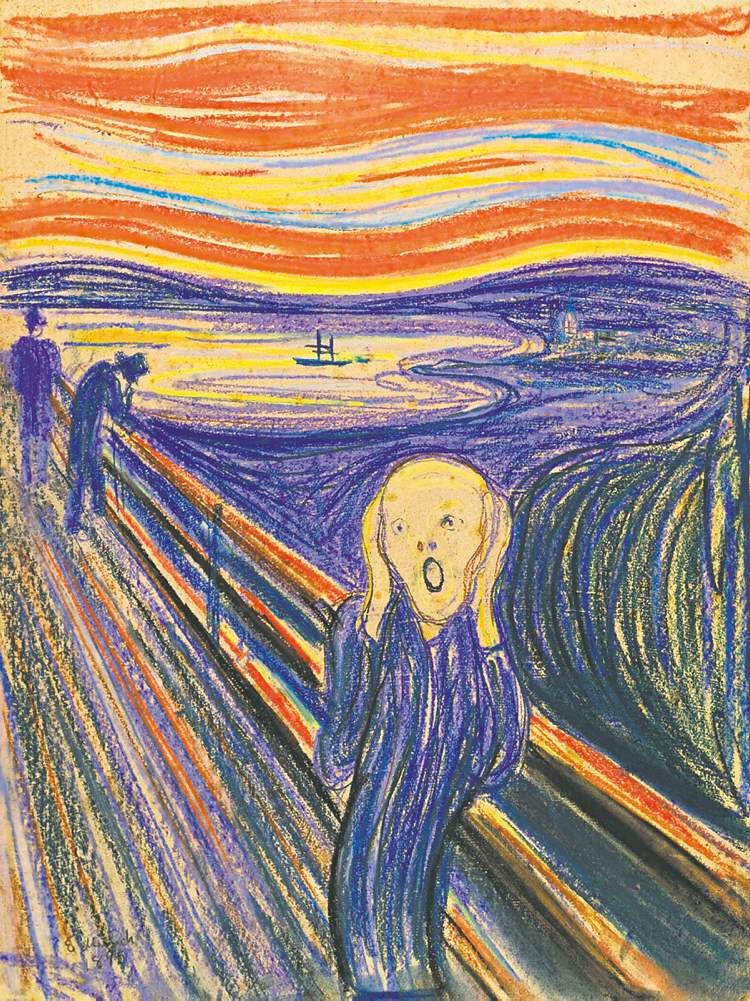
Faced with such a naked image of contemporary unease, we seem to have an impulse to explain. In one lumpishly literal interpretation, a group of astronomers suggested that Munch was just observing a natural phenomenon: Earlier, in 1883, Europe had unusually fiery sunsets because of the volcanic explosion of Krakatoa.
But Munch doesn’t “just observe” anything. He feels, and his signal contribution to 20th-century art was to make this twisting, obsessive emotion the basis of his art. Colour doesn’t describe in Munch’s work; it expresses, with a dark and bloody intensity.
A more plausible scientific take on the image suggests that Munch is giving visual form to an agoraphobic panic attack. His childhood was shadowed by the deaths of his mother and a beloved sister, Sophie, from tuberculosis, and his later life was marked by the mental breakdown of another sister and by his own anxiety, alcoholism and unremitting sense of Nordic doom. “Sickness and madness and death were the black angels that stood at my cradle,” he once wrote in his journal.

WHY IT MATTERS: Munch made two oil paintings, two pastels and many prints of this image between 1893 and 1910. (Two versions in Norwegian museums have been stolen — and later recovered.) The Scream has been further replicated in popular culture, from a Dead Kennedys album cover to the hooded killer in the Scream movies, through a raft of references in The Simpsons, the Home Alone flicks and a bizarrely cheerful Pontiac Sunfire ad. Slowly, Munch’s indelible expression of angst has become increasingly jolly and self-parodying, culminating in fun-for-the-whole-family merchandise like plush dolls and finger puppets.
The Scream is instantly recognizable, ranking just behind the inescapable Mona Lisa in art-historical familiarity. Once compelling, it is now over-exposed. A Sotheby’s spokesperson might call it “the defining image of modernity,” but it could be that The Scream has become a staggeringly expensive visual cliché.
Best to stick to the finger puppet.
Art historian Alison Gillmor looks beneath the surface of newsworthy art.
Studying at the University of Winnipeg and later Toronto’s York University, Alison Gillmor planned to become an art historian. She ended up catching the journalism bug when she started as visual arts reviewer at the Winnipeg Free Press in 1992.
Our newsroom depends on a growing audience of readers to power our journalism. If you are not a paid reader, please consider becoming a subscriber.
Our newsroom depends on its audience of readers to power our journalism. Thank you for your support.
Studying at the University of Winnipeg and later Toronto’s York University, Alison Gillmor planned to become an art historian. She ended up catching the journalism bug when she started as visual arts reviewer at the Winnipeg Free Press in 1992.
Our newsroom depends on a growing audience of readers to power our journalism. If you are not a paid reader, please consider becoming a subscriber.
Our newsroom depends on its audience of readers to power our journalism. Thank you for your support.
Advertisement Advertise With Us
Advertisement Advertise With Us