

Art interpretation is in the eye of the beholder
Advertisement
Read this article for free:
or
Already have an account? Log in here »
To continue reading, please subscribe:

Digital Subscription
One year of digital access for only $205*
- Enjoy unlimited reading on winnipegfreepress.com
- Read the E-Edition, our digital replica newspaper
- Access News Break, our award-winning app
- Play interactive puzzles
*First annual payment billed as $205.00 + GST for one year. This annual subscription will automatically renew at $233.00 + GST every 52 weeks (10% off the regular annual price of $259.35). Offer available to new and qualified returning subscribers only. Cancel any time.
To continue reading, please subscribe:
Add Free Press access to your Brandon Sun subscription for only an additional
$1 for the first 4 weeks*
- Enjoy unlimited reading on winnipegfreepress.com
- Read the E-Edition, our digital replica newspaper
- Access News Break, our award-winning app
- Play interactive puzzles
*Your next Brandon Sun subscription payment will increase by $1.00 and you will be charged $17.95 plus GST for four weeks. After four weeks, your payment will increase to $24.95 plus GST every four weeks.
Read unlimited articles for free today:
or
Already have an account? Log in here »
Hey there, time traveller!
This article was published 28/10/2013 (4733 days ago), so information in it may no longer be current.
Throughout art history, there have been plenty of arguments over how works of art should be interpreted. Willem de Kooning, for example, disagreed with how feminists interpreted his 1950s “woman series” as acts of violence towards the female form.
Interpretation has always been part of art appreciation, as people always observe aspects of artwork differently, but, is one interpretation more right than another? Who’s to say an interpretation is wrong? Does the artist’s intent matter?
Doug Smith is a Winnipeg artist who will address these questions on Nov. 1 at the Free Press News Café. His recent body of work has been variously interpreted in exhibition reviews and curatorial essays.
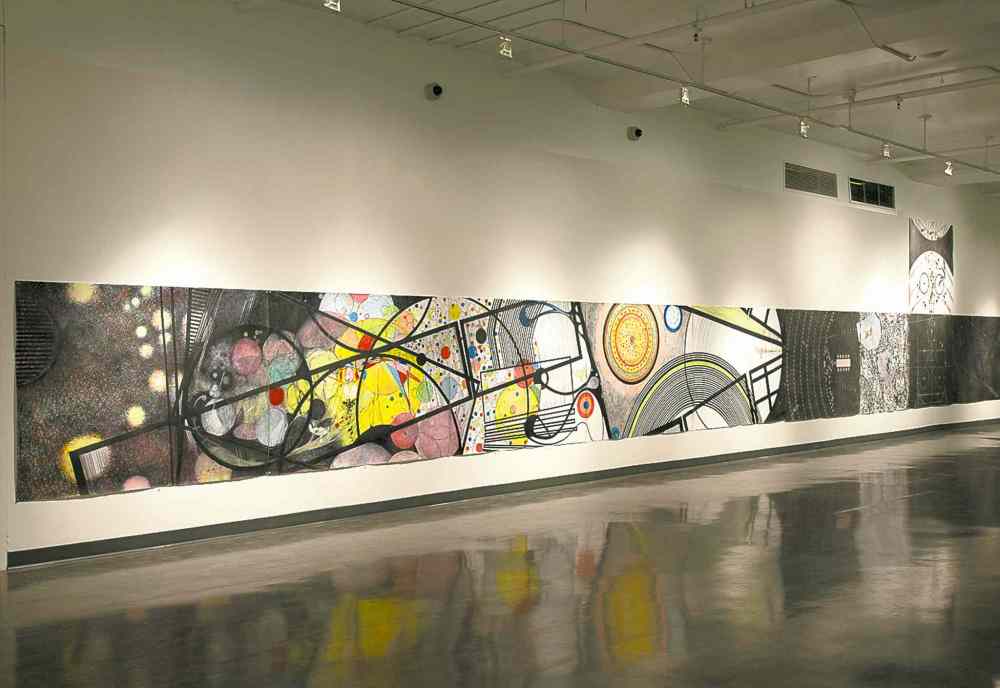
He makes massive drawings, often up to five metres long, that contain large areas of pure graphite as well as miniscule details like helicopters, birds and marching soldiers. Smith places these details in formations and patterns that borrow from meteorological maps, radar screens and blueprints. The drawings have a uniquely intense presence, especially where tiny human figures seem subject to the whims of powerful weather.
Smith’s work has been interpreted as expressing fear of totalitarianism, as being about the relationship between order and chaos, and even as religious drawings for a secular age. Several critics have compared the work to panoramic cave paintings and others have mentioned the effects of globalization.
“I’ve always considered that once in the public sphere — someone, somehow, and from some inner bias, will pick up on any one of the nuances and formulate a subjective interpretation. Every piece of writing and every review has been beneficial, or at the very least has offered greater scope to how my work is perceived,” says Smith.
A professional, studied interpretation can often inform the direction an artist will take in his or her work. But besides influencing the artist, a good critic or curator can help guide interpretation when the work is difficult. In writing art criticism, they attempt to collect and arrange the thoughts and ideas that come to mind when confronted by a work of art. For those who want to engage with art and look from all angles and perspectives, reading the interpretations of art critics is essential.
But in her 1966 essay Against Interpretation, celebrity intellect Susan Sontag wrote, “interpretation is the revenge of the intellectual upon art.”
The main point of her essay is that in over-analyzing a work we are in danger of missing its real impact.
“Real art has the capacity to make us nervous. By reducing the work of art to its content and then interpreting that, one tames the work of art. Interpretation makes art manageable, comfortable,” said Sontag.
Perhaps Sontag would have approved of Smith’s sister, who, when viewing his large drawings for the first time, did not necessarily think about what the content might mean, but rather allowed herself to feel. According to Smith, his sister was completely surprised by the work, finding it dark and depressing. Perhaps his sister’s sensitivity to all those tiny figures swimming around in immense seas of inky graphite is the most deeply felt interpretation of all.

Even his children’s interpretations matter to Smith, who regularly asks his kids, aged 11 and 13, what they think.
“They have told me that they have never found the work unsettling. I remember asking them that in particular. The work to them was more mysterious and thought-provoking and even maybe a little magical,” he says.
Gone are the days when a work of art is regarded as housing a cryptic message or a singular meaning. Varied interpretations, even if contradictory, only add to our experience of the work. Good art provokes dialogue and even disagreement. Our analytical minds, however, would do well to remember Sontag. In terms of interpreting art, some of us may need to think less and feel more.
Sarah Swan is a Winnipeg artist and writer. She will host Art Talk/Art Walk at the Free Press News Café on Friday in a discussion of aboriginal art. Guests this month include artist Doug Smith. Call 204-697-7069 for tickets to the event.



