Playwright’s domestic outlook is outdated, but his dialogue still sparkles
Snap, crackle, pop
Advertisement
Read this article for free:
or
Already have an account? Log in here »
To continue reading, please subscribe:

Digital Subscription
One year of digital access for only $205*
- Enjoy unlimited reading on winnipegfreepress.com
- Read the E-Edition, our digital replica newspaper
- Access News Break, our award-winning app
- Play interactive puzzles
*First annual payment billed as $205.00 + GST for one year. This annual subscription will automatically renew at $233.00 + GST every 52 weeks (10% off the regular annual price of $259.35). Offer available to new and qualified returning subscribers only. Cancel any time.
To continue reading, please subscribe:
Add Free Press access to your Brandon Sun subscription for only an additional
$1 for the first 4 weeks*
- Enjoy unlimited reading on winnipegfreepress.com
- Read the E-Edition, our digital replica newspaper
- Access News Break, our award-winning app
- Play interactive puzzles
*Your next Brandon Sun subscription payment will increase by $1.00 and you will be charged $17.95 plus GST for four weeks. After four weeks, your payment will increase to $24.95 plus GST every four weeks.
Read unlimited articles for free today:
or
Already have an account? Log in here »
Hey there, time traveller!
This article was published 30/01/2015 (4263 days ago), so information in it may no longer be current.
Noël Coward’s vintage rom-com Private Lives turns back the clock to a more glamorous time that includes the English playwright’s jovial attitude toward domestic violence.
The RMTC Warehouse’s contribution to CowardFest, which opened smartly Thursday, suggests that you can’t enjoy the work’s sparkling, sophisticated comedy, haute couture fashion or luxurious digs without owning the fact its male lead is a wife-beater and proud of it.
“Certain women should be struck regularly, like gongs,” Elyot Chase says matter-of-factly to his ex-wife and victim, Amanda Payne.
And he has worse things to say.
The irony is that part of the second act was almost censored in Britain in 1930 — not for the marital warring, but for the couple’s love-making, which was seen as too steamy for proper society.
From a contemporary perspective, the viewer can chuckle at such puritanism, yet shudder as Coward attempts to make casual domestic violence entertaining.
So much for that famous British reserve. Couples back then had to keep a stiff — fat — upper lip.
That said, Coward and his duelling lovers get at timeless truths as they swat verbal volleys full of still-effervescent humour back and forth. The play’s sober subtext makes a convincing case for the necessity and the impossibility of love. As the world faced the Great Depression, the idea that life is too serious to be taken seriously would have been welcomed by many.
Elyot and Amanda are deliriously wilful divorcees who can’t live together or apart. They split five years before after a tempestuous three-year marriage, but unexpectedly find themselves in adjoining rooms of a French hotel, where they are honeymooning with new spouses.
In theatre’s second most famous balcony scene, the two quickly rekindle their smouldering passions while overlooking the water (which is represented by cheap garbage-bag plastic, falling well below the expectations of Warehouse patrons).
In minutes, Elyot is ready to ditch his naive, insecure, young bride Sibyl, and Amanda her earnest, stodgy husband Victor. Neither has shown much affection for their dull new spouses and the sound of an orchestra playing Someday I’ll Find You inspires them to run off to her chic apartment in Paris.
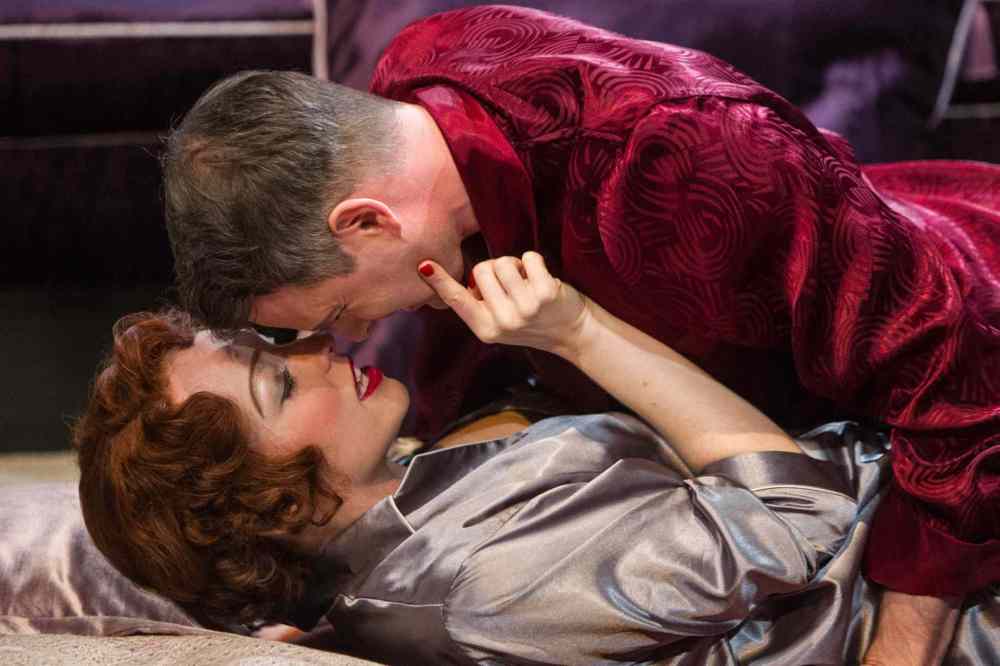
The pivotal and sharp second act tests the talents of Winnipeg actors Eric Blais and Laura Olafson, as they pivot from lovebirds to vicious opponents in the ageless battle of the sexes. The former has never been better as the suave, rascally Elyot, a man whose uncertainties are barely hidden by a champagne sheen. Olafson, swathed in slinky satiny gowns, is his equal in the way she switches from worldly modern woman to pouting paramour in a blink.
They hurl themselves at each other and the furniture, taunting and tormenting as only soulmates can. Their chemistry generates sexual heat that intensifies into physical harm. Love hurts, as Amanda breaks a phonograph record over his head and he responds with a hard slap.
The final act in the two-hour evening brings the jilted honeymooners back to their spouses’ love nest. Tracey Penner (who sings a lovely Coward classic, The Last Time I Saw Paris, while playing the grand piano) attracts more sympathy for her Sibyl, who can come across as a ditsy ninny. The way she flaps her hands as she cries is a fine bit of comic business.
Graham Ashmore’s pompous Victor offers plenty to loathe and laugh at. His blustering challenge to fight Elyot is hilariously delayed while he precisely folds up the sleeves of his shirt.
The cast is rounded out by Jane Testar playing a French maid, a role that seems unnecessary.
Krista Jackson directs a pristine, well-paced production that can be easily enjoyed, thanks to clean and defined diction from her cast. She makes an interesting comment on the play with the inclusion of a last-second action.
Private Lives, like its creator, still has a talent to amuse.
kevin.prokosh@freepress.mb.ca