Anxieties about the body unfold in artist’s eerie, beautiful fabric portraits
Advertisement
Read this article for free:
or
Already have an account? Log in here »
To continue reading, please subscribe:

Digital Subscription
One year of digital access for only $205*
- Enjoy unlimited reading on winnipegfreepress.com
- Read the E-Edition, our digital replica newspaper
- Access News Break, our award-winning app
- Play interactive puzzles
*First annual payment billed as $205.00 + GST for one year. This annual subscription will automatically renew at $233.00 + GST every 52 weeks (10% off the regular annual price of $259.35). Offer available to new and qualified returning subscribers only. Cancel any time.
To continue reading, please subscribe:
Add Free Press access to your Brandon Sun subscription for only an additional
$1 for the first 4 weeks*
- Enjoy unlimited reading on winnipegfreepress.com
- Read the E-Edition, our digital replica newspaper
- Access News Break, our award-winning app
- Play interactive puzzles
*Your next Brandon Sun subscription payment will increase by $1.00 and you will be charged $17.95 plus GST for four weeks. After four weeks, your payment will increase to $24.95 plus GST every four weeks.
Read unlimited articles for free today:
or
Already have an account? Log in here »
Hey there, time traveller!
This article was published 28/05/2015 (4088 days ago), so information in it may no longer be current.
We usually talk about “body image” in terms of self-esteem and cultural expectations, of insecurities fuelled by mass media and the unattainable standards to which women’s bodies in particular are held.
It’s possible to read Hannah Doucet’s photo- and fabric-based portraits along similar lines, but Present Absence, the Winnipeg artist’s confident and clearly articulated exhibition at C Space, also skims the surface of deeper, existential anxieties.
The recent BFA grad’s newest works begin with faceless, high-contrast studio portraits — backs of heads, bare torsos and various limbs on white backdrops — which she’s printed on lengths of luxe-looking polyester knit fabric. These, in turn, are draped and gathered, smoothed and folded, re-photographed and layered into haphazard sculptural installations. The distorted images that result are surprising, sometimes gently and sometimes viscerally unsettling.
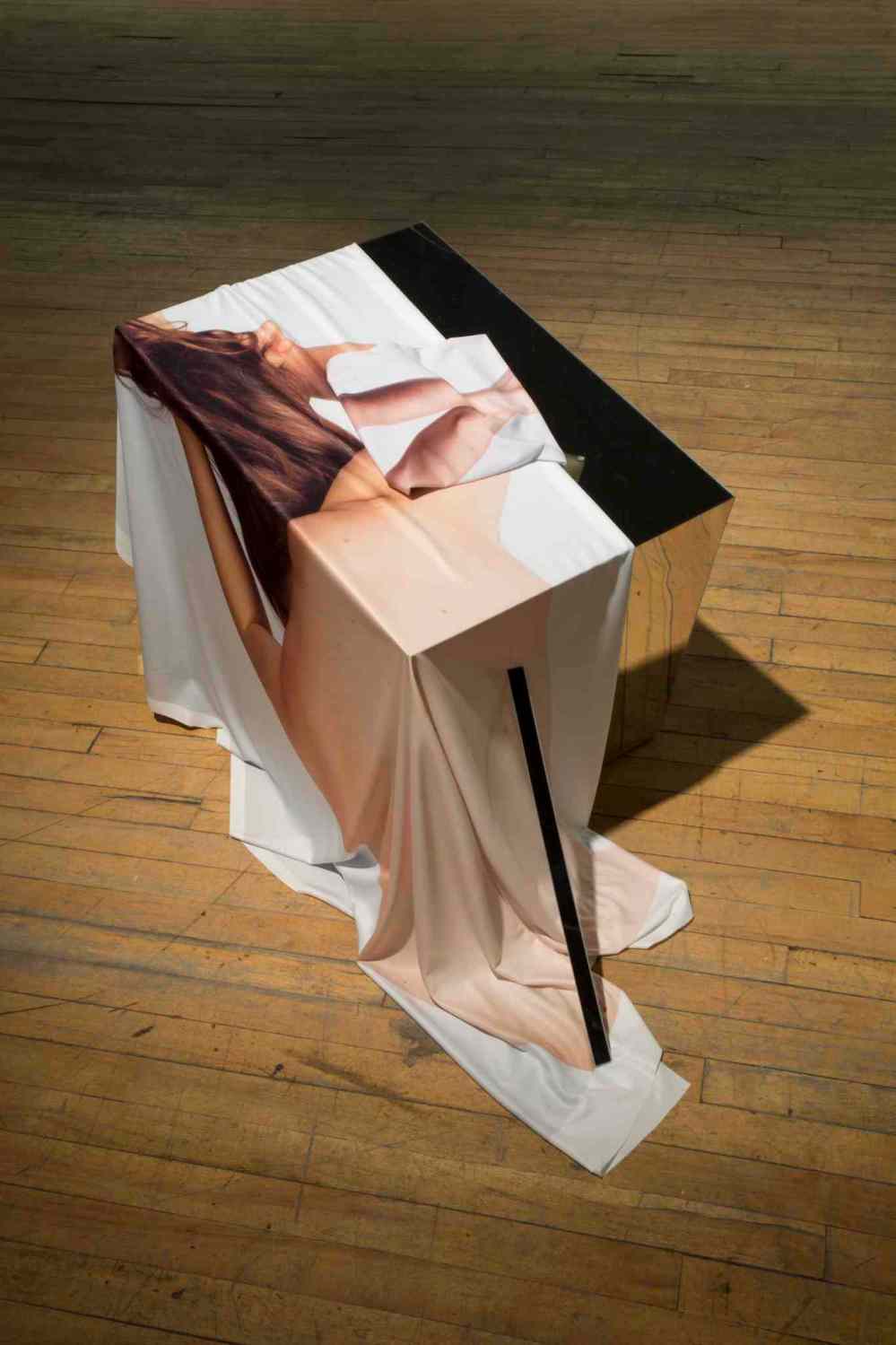
The evocatively titled I Never Recognized Her Except in Fragments recalls a kind of abstracted and partially demolished retail display. Mirrored surfaces — plinths, columns, loose sheets and thin strips — pile up and lean against one another. On top of these, some of the printed textiles are neatly folded, laid out as if for perusal and purchase, while others appear cast off, hanging limply over corners and gathering dirt in tangles on the gallery floor.
The piece highlights Doucet’s ambivalent embrace of fashion photography and commercial esthetics, framing the body as a mutable, disposable commodity. The mirrored structures are the exhibition’s most resolutely solid, sculptural components, but their surfaces dissolve into multifaceted mirages that endlessly reiterate the surrounding environment, occasionally capturing fragments of our own reflections.
“Body image” encompasses more than just culturally mediated beliefs about appearance and perception: it’s central to how we understand our existence in the world, and it’s by no means fixed or stable. Forged in infancy and continually revised, the maps of ourselves we carry in our conscious minds and muscle memories tell us where “we” end and everything else begins, and they inform our reactions to other bodies. Challenges to this carefully maintained image (disorientation, injury, encounters with bodies perceived as “different,” the onslaught of impossible media representations) are on some level experienced as trauma. It’s this primordial, psychologically fraught territory that Doucet’s work so deftly navigates.

The subjects of several prints are veiled completely, Halloween-ghost-like, in photos of their surroundings (a sunny field, a bedroom scene), at once obliterated and made more conspicuous by their camouflage. In the series Undulating Surfaces, fabric portraits are manipulated and re-photographed, creating uncanny illusions of warped, abject and sometimes nearly illegible female bodies. The works’ irrefutable loveliness and precise execution both magnify and muffle any incipient pangs of body-horror.
Inserting Stillness, a nearly but not completely motionless video portrait, maximizes these unnerving contradictions. We watch Doucet’s model (actually two models, though this takes a moment to sort out) silently hold her pose, breathing and trembling slightly. Almost imperceptibly the image stills, then begins to move again. The first faint ripples might be a breeze or a heartbeat, but the distortions soon grow more intrusive and unseemly. After some minutes, Doucet’s hands come into view: her movements are deliberate but gentle, smoothing out the image once again. After another pause, the image jolts back to “life” and the sequence repeats.
Doucet accomplishes a tremendous amount with a limited palette, and Present Absence makes a powerful first introduction to an emerging talent. Your chances to catch the show are limited, however: the volunteer-run gallery will be open Thursday, May 28, from noon to 3 p.m. and Friday, May 29, from 7 to 9 p.m.
Steven Leyden Cochrane is a Winnipeg-based artist and writer.
Art review
Hannah Doucet
- Present Absence
- C Space, 318 – Ross Ave.
- Until May 29
Related Articles
The real problem: a fixation with the female body
Advertisement Advertise With Us
Advertisement Advertise With Us
History
Updated on Thursday, May 28, 2015 10:15 AM CDT: Changes headline, adds photo