Director deals with lots of moving parts in complicated, ambitious work
Challenge accepted

Advertisement
Read this article for free:
or
Already have an account? Log in here »
To continue reading, please subscribe:

Digital Subscription
One year of digital access for only $205*
- Enjoy unlimited reading on winnipegfreepress.com
- Read the E-Edition, our digital replica newspaper
- Access News Break, our award-winning app
- Play interactive puzzles
*First annual payment billed as $205.00 + GST for one year. This annual subscription will automatically renew at $233.00 + GST every 52 weeks (10% off the regular annual price of $259.35). Offer available to new and qualified returning subscribers only. Cancel any time.
To continue reading, please subscribe:
Add Free Press access to your Brandon Sun subscription for only an additional
$1 for the first 4 weeks*
- Enjoy unlimited reading on winnipegfreepress.com
- Read the E-Edition, our digital replica newspaper
- Access News Break, our award-winning app
- Play interactive puzzles
*Your next Brandon Sun subscription payment will increase by $1.00 and you will be charged $17.95 plus GST for four weeks. After four weeks, your payment will increase to $24.95 plus GST every four weeks.
Read unlimited articles for free today:
or
Already have an account? Log in here »
Hey there, time traveller!
This article was published 24/02/2016 (3865 days ago), so information in it may no longer be current.
Twelve actors.
Twenty-four characters.
Twenty-four years.
Thirty-nine scenes.
Three hours.
Two hemispheres.
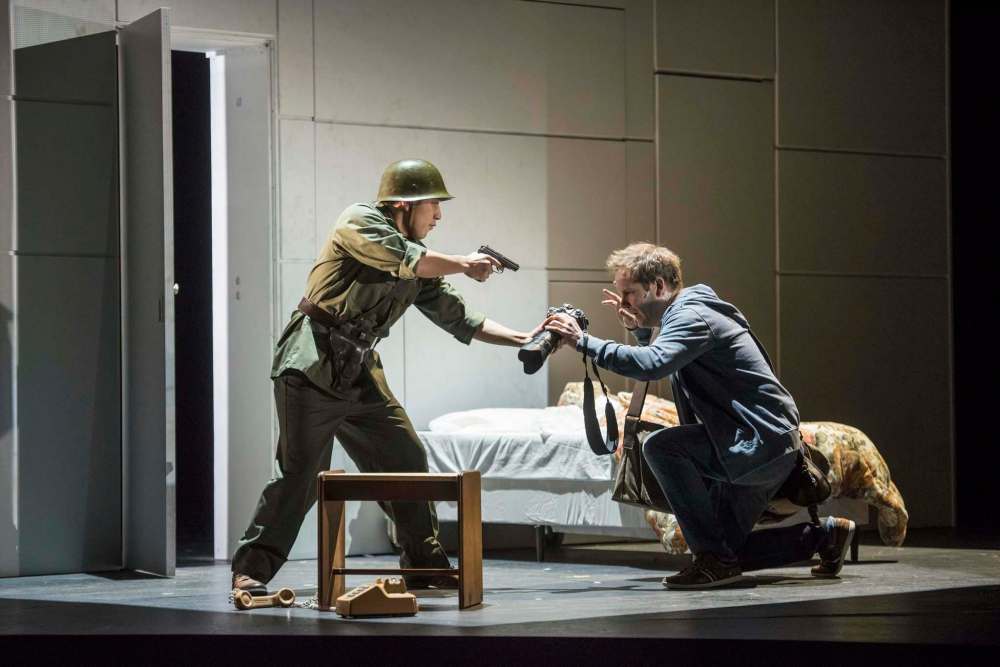
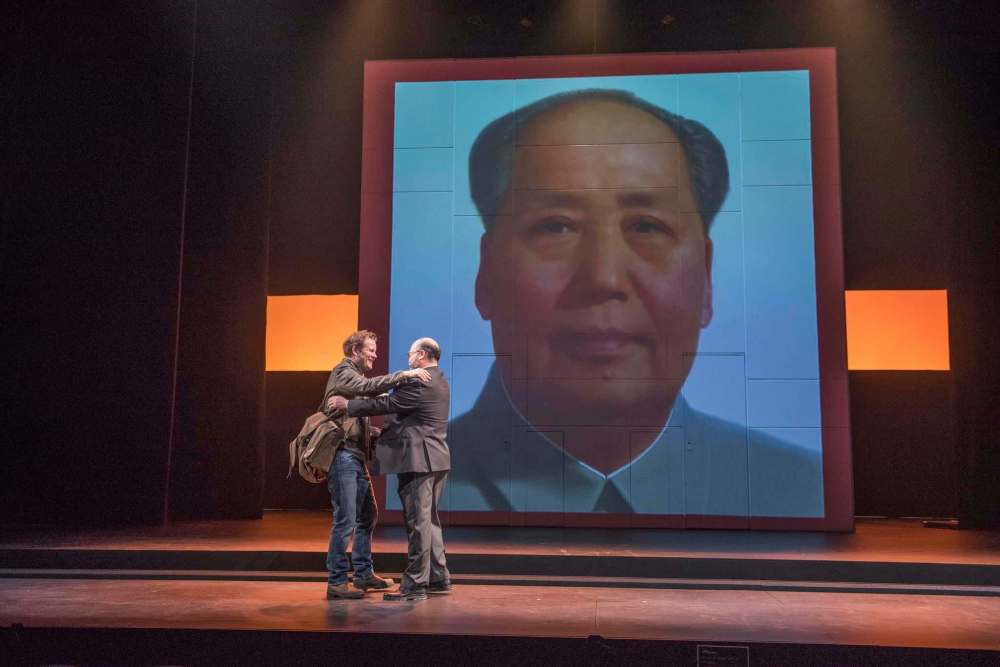
No matter how you tally it, the 2013 Lucy Kirkwood-penned drama Chimerica adds up to a big, challenging production, especially when you factor in dialogue in English and Mandarin Chinese and projected video elements courtesy of Winnipeg filmmaker Deco Dawson.
“It’s technically very ambitious but we’re all very excited about what we’re making,” says Toronto-based director Chris Abraham, no stranger to complex and challenging plays. (The artistic director of Toronto’s Crow’s Theatre, Abraham also directed the touring production of Annabel Soutar’s Seeds now playing at Prairie Theatre Exchange, a smaller but still dense work involving actors playing multiple roles, complicated video tech and real history.)
“Day by day, step by step, you take each of those 39 scenes one step in front of the other and then you get to the end,” he says.
Most complex of all is the history behind the play.
The dramatic pivot point of Chimerica is an event that took place on June 5, 1989, the day after hundreds — possibly thousands — of students were massacred in Tiananmen Square in Beijing, the culmination of unprecedented, months-long pro-democracy protests by university students. Fictionalized rookie journalist Joe Schofield (Evan Buliung) shoots a picture of a lone protestor stopping a tank. (The real photo that inspired this event was one of the most important symbolic images of political defiance in the 20th century.)
Twenty years later, Joe receives a tip that the “Tank Man” is still alive and living in the United States, inspiring a desperate search. Concurrently, in Beijing, one of Joe’s sources feels the brunt of the Chinese government’s power after launching a small protest of his own.
“I was still a kid when that happened,” says Abraham, 41, of the Tiananmen massacre. “But I remember it.”
Directing Chimerica, a co-production of RMTC and the Canadian Stage Company, necessitated deeper research into the subject for Abraham.
“It was an eye-opener for me,” he says. “When I read the play, I was tremendously excited by what it was as a story and a piece of theatre, but also the opportunity to spend some time thinking about China’s emergence as a superpower, its history. It’s a place in the world that I didn’t know a lot about a year-and-a-half ago when I started looking at the play.”
He and the cast benefited further from encounters with witnesses to that chapter in history.
“We were very lucky in our process to have some great source material, but also, we were able to speak in our first week of rehearsal with two journalists who covered the Tiananmen protest: Jan Wong and Patrick Brown.
“Jan ended up writing about it in a book but also covered it for the Globe and Mail and Patrick Brown was there as a correspondent for the CBC,” Abraham says. “They gave us a tremendously interesting perspective of their time in China on the day itself and in the aftermath.”
More personal background came from the play’s designated Mandarin coach, Yuan Liu, “who taught our actors how to speak Mandarin in a very short period of time.
“She had a tremendous personal account of what happened to her family during the Cultural Revolution and then the legacy of China’s transition on her life, personally,” Abraham says. “So we had these three very important first-hand experiences, as a company, to inform how we think about that moment.”
•••
When the play premièred on the London stage in 2013, one rhapsodic critic described the play’s “filmic quality,” an element that may have made Abraham an ideal choice, given a resumé that includes a directing credit for the 2004 feature film I Claudia.
“The play is definitely imagined as a piece of theatre, but I think the kind of play it is definitely owes something to the world of cinema,” Abraham says. “It has its own chimerical identity as a kind of cinematic theatrical experience.
“I think in theatre, we’re used to the kinds of techniques and tropes from the cinema moving their way onto our stages. We’ve become a very visual culture in terms of how we see and process stories,” he says. “And I think audiences are, by and large, pretty sophisticated. I think that has informed all of our theatre culture, not just this play.”

As in cinema, “the technology behind it can be enormous,” Abraham says. “This show is a monster in the sense that there’s a lot of people involved, there’s a lot of creative energies at work in solving the creative landscape of the show.
“But that makes it hugely exciting,” he says. “Technically, it’s probably the most ambitious show that I’ve done. But we’re having a ball.”
Following its RMTC run, Chimerica will travel to Toronto to play at the Bluma Appel Theatre from March 29 to April 17.
randall.king@freepress.mb.ca
@FreepKing
Our newsroom depends on a growing audience of readers to power our journalism. If you are not a paid reader, please consider becoming a subscriber.
Our newsroom depends on its audience of readers to power our journalism. Thank you for your support.
Theatre preview
Chimerica
Royal Manitoba Theatre Centre
To March 19
Tickets $26-$89 at 204-942-6537 or www.royalmtc.ca
Our newsroom depends on a growing audience of readers to power our journalism. If you are not a paid reader, please consider becoming a subscriber.
Our newsroom depends on its audience of readers to power our journalism. Thank you for your support.
Advertisement Advertise With Us
Advertisement Advertise With Us