Class war fought one floor at a time
Retro thriller set in skyscraper recalls '70s

Advertisement
Read this article for free:
or
Already have an account? Log in here »
To continue reading, please subscribe:

Digital Subscription
One year of digital access for only $205*
- Enjoy unlimited reading on winnipegfreepress.com
- Read the E-Edition, our digital replica newspaper
- Access News Break, our award-winning app
- Play interactive puzzles
*First annual payment billed as $205.00 + GST for one year. This annual subscription will automatically renew at $233.00 + GST every 52 weeks (10% off the regular annual price of $259.35). Offer available to new and qualified returning subscribers only. Cancel any time.
To continue reading, please subscribe:
Add Free Press access to your Brandon Sun subscription for only an additional
$1 for the first 4 weeks*
- Enjoy unlimited reading on winnipegfreepress.com
- Read the E-Edition, our digital replica newspaper
- Access News Break, our award-winning app
- Play interactive puzzles
*Your next Brandon Sun subscription payment will increase by $1.00 and you will be charged $17.95 plus GST for four weeks. After four weeks, your payment will increase to $24.95 plus GST every four weeks.
Read unlimited articles for free today:
or
Already have an account? Log in here »
Hey there, time traveller!
This article was published 27/05/2016 (3731 days ago), so information in it may no longer be current.
Brutalist architecture is named not for its association with brutal cement institutional buildings of, say, prisons (or a certain Public Safety Building). The root of the word — brut — is the French word for raw, as in raw concrete. Its unyielding, hard-edged utilitarian look made it popular in the 1960s and ’70s for government buildings… and high-rise apartments.
High-Rise, director Ben Wheatley’s adaptation of a 1975 J.G. Ballard novel, does ramble a bit, but it effectively connects the dots between brutalism and brutal social constructs with its titular structure, a monstrous, self-contained apartment complex that makes it unnecessary for its inhabitants to ever have to leave home.
Taking occupancy on the 25th floor is Dr. Robert Laing (Tom Hiddleston), a physician recovering from a personal tragedy. He embraces the patriarchal philosophy behind the towering phallic symbol in which he lives, going as far as to befriend its prickly upper-crust architect Anthony Royal (the patrician Jeremy Irons is well-cast). Royal lives in an idyllic penthouse, complete with its own horse pasture.
But the building is perhaps too much a model of a stratified class system. The residents of the lower floors suffer power outages and service failures. They can access some amenities, such as a swimming pool, only when the wealthier occupants of the upper floors aren’t using them.
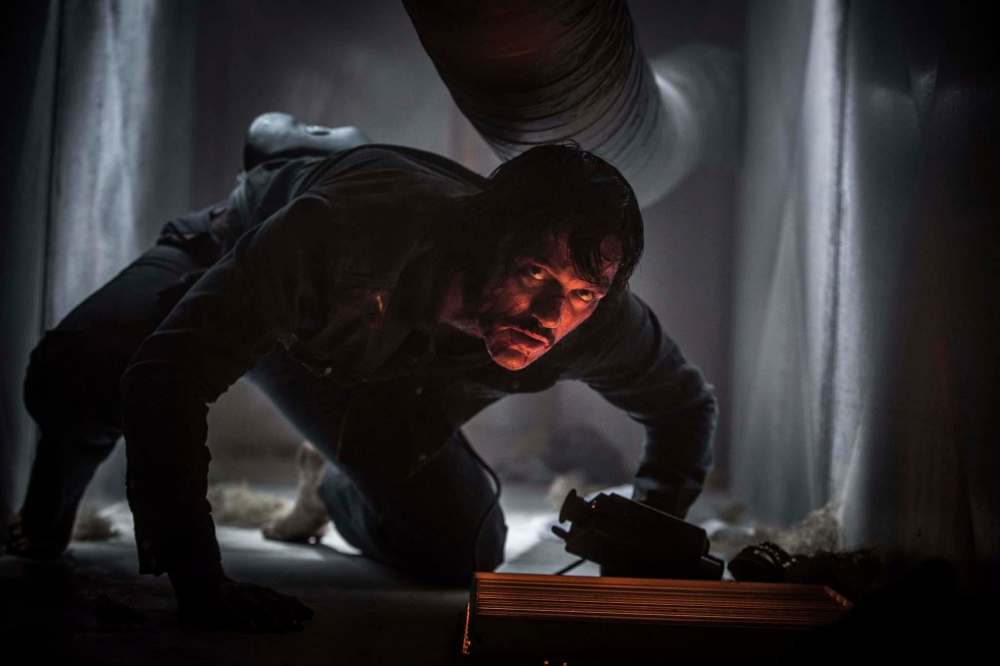
Before long, battle lines are drawn, with a de facto revolutionary leader — a documentary filmmaker named Wilder (Luke Evans) — rising while the privileged denizens up top start to close ranks. Caught in the middle, Laing suffers an emotional breakdown coincident with an ever-spiralling social breakdown. The beginning of the film, in which Laing is seen spit-roasting someone’s pet dog on a balcony, offers a preview of where it all will lead.
The film has future-apocalyptic implications, but director Wheatley anchors the film in ’70s style that feels queasily accurate, encompassing everything from Wilder’s rock-star hairstyle and the cold, hard esthetic of Royal’s modernist dwelling.
Wheatley goes one better, deliberately invoking the dynamics of ’70s cinema, especially in its protagonist.
No man of action, Laing is damaged and baffled, suffering existential crisis and reminiscent of the kind of character played by Al Pacino, Dustin Hoffman or Jack Nicholson, before Rocky/Rambo hijacked the Hollywood hero for his own reactionary purposes.

In this regard, one must admire Hiddleston for eschewing the more conventional hero parts that are doubtless his for the taking these days. He dares to be unsympathetic.
In short, for all the radical intentions of High-Rise, its pleasures are decidedly nostalgic for anyone who wistfully recalls the Hollywood renaissance of the 1970s. Following the interesting precedents of his films Kill List and Sightseers, Wheatley proves once again to be a filmmaker worthy of attention.
randall.king@freepress.mb.ca Twitter: @FreepKing
Our newsroom depends on a growing audience of readers to power our journalism. If you are not a paid reader, please consider becoming a subscriber.
Our newsroom depends on its audience of readers to power our journalism. Thank you for your support.
Movie Review
High-Rise
- Starring Tom Hiddleston and Luke Evans
- Bandwidth Theatre
- 14A
- 119 minutes
- 3 1/2 stars out of five
Other voices
It could take decades for critics and audiences to appreciate whatever genius lurks behind the chaos, but for the time being, it seems like little more than madness.
— Peter Debruge, Variety
A trash wallow in sex, nudity, violence, cruelty to animals and the skewering of contemporary society.
— Rex Reed, New York Observer
If its message about elitism, isolation, the decadence of capitalism and the phoney pursuits of the bourgeoisie still rings true — well, sure, what else is new?
— Steven Rea, Philadelphia Inquirer
A stubborn, incoherent wreck of a movie, and I mean that as fairly high praise. You won’t follow everything that happens, but you may feel weirdly at home.
— Justin Chang, Los Angeles Times
Our newsroom depends on a growing audience of readers to power our journalism. If you are not a paid reader, please consider becoming a subscriber.
Our newsroom depends on its audience of readers to power our journalism. Thank you for your support.
Advertisement Advertise With Us
Advertisement Advertise With Us