The beauty of brainstorming
Collaborations between craft artists and neuroscientists show promising results at HSC
Advertisement
Read this article for free:
or
Already have an account? Log in here »
To continue reading, please subscribe:

Digital Subscription
One year of digital access for only $205*
- Enjoy unlimited reading on winnipegfreepress.com
- Read the E-Edition, our digital replica newspaper
- Access News Break, our award-winning app
- Play interactive puzzles
*First annual payment billed as $205.00 + GST for one year. This annual subscription will automatically renew at $233.00 + GST every 52 weeks (10% off the regular annual price of $259.35). Offer available to new and qualified returning subscribers only. Cancel any time.
To continue reading, please subscribe:
Add Free Press access to your Brandon Sun subscription for only an additional
$1 for the first 4 weeks*
- Enjoy unlimited reading on winnipegfreepress.com
- Read the E-Edition, our digital replica newspaper
- Access News Break, our award-winning app
- Play interactive puzzles
*Your next Brandon Sun subscription payment will increase by $1.00 and you will be charged $17.95 plus GST for four weeks. After four weeks, your payment will increase to $24.95 plus GST every four weeks.
Read unlimited articles for free today:
or
Already have an account? Log in here »
Hey there, time traveller!
This article was published 23/03/2017 (3479 days ago), so information in it may no longer be current.
In today’s art world, “fine art,” craft and illustration all bleed into one another, though we can still tease them apart.
Art doesn’t need to be useful to have value, for instance, while craft is rooted in traditions of functional object-making. Illustration clarifies an existing text or concept, while art, in theory, stands alone.
Fine, but the boundaries are squishy and interesting things happen when they break down.
But what about art and something further afield, such as neuroscience? It turns out even here there are vital if unexamined connections. After all, when we talk about science in terms of “discovery,” we risk overlooking the profoundly creative, even artistic work that scientists do — conceiving hypotheses, crafting and conducting experiments, framing their findings for a wider audience.
Neurocraft, an ambitious co-production of the Manitoba Neuroscience Network and Manitoba Craft Council, brought together nine craft-based artists and nine neuroscientists to exchange ideas and collaborate on new work. The goal was to offer the public new ways of engaging with neurological research — not to “illustrate” it, but to reimagine it in different and perhaps more accessible forms.
Two years after their first meetings, the results are on display at the HSC’s John Buhler Research Centre. As experiments go, some of Neurocraft’s findings prove inconsequential, but others suggest deep and generative connections between brain science, craft and contemporary art.
Many of the artists were inspired by complex and beautiful structures in the brain itself. Artist ash alberg weaves conductive thread and blinking LEDs, such as flashing neurons, into tapestries riddled with little bones. A handmade book by Ann Stinner renders fragile neural networks in layers of starched and mangled cheesecloth, while Peter Tittenberger and Gaëtanne Sylvester both riff on brain structures in fanciful mixed-media ceramic sculptures.
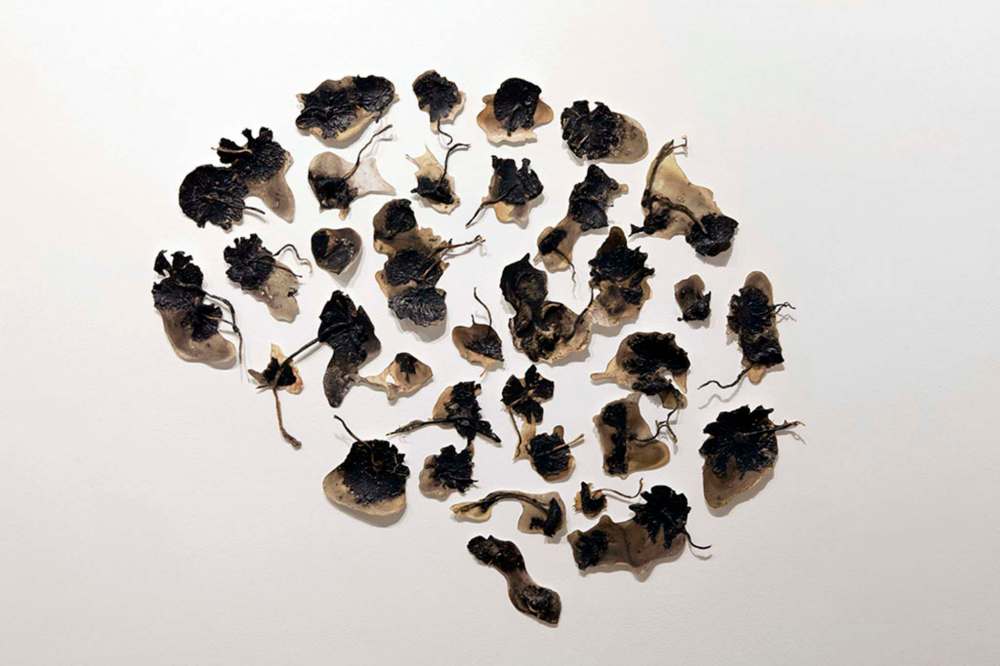
Moved, after witnessing an autopsy, by the brain’s meaty physicality, Heather Komus chose to render it in pressed, dried mushrooms, striking a delightfully morbid, wacky note. Tangles of yarn, meanwhile, echo the brain’s seemingly impassable pathways in videos by Chantel Mierau.
For others, an interest in neuroscience speaks to personal loss.
In Michelle Wilson’s Wait, cradles of red thread hold two ceramic brains, one large, one small, in tenuous balance, evoking the fragile interconnectedness and weighted anticipation of pregnancy. For Each Thought about Losing Them, a velvet cushion embellished with a nearly abstract fetal ultrasound, lists “recording of a heartbeat, fear and grief” as materials alongside fabric, thread and beads.

Lesley Nakonechny’s Alzheimer’s Portraits employ reduction printing, where a single block is carved away in stages and printed in overlapping colours, to moving effect. Nakonechny hacks away at an image of her grandfather until just pale blue fragments remain. She prints each layer separately, never recovering the complete picture.
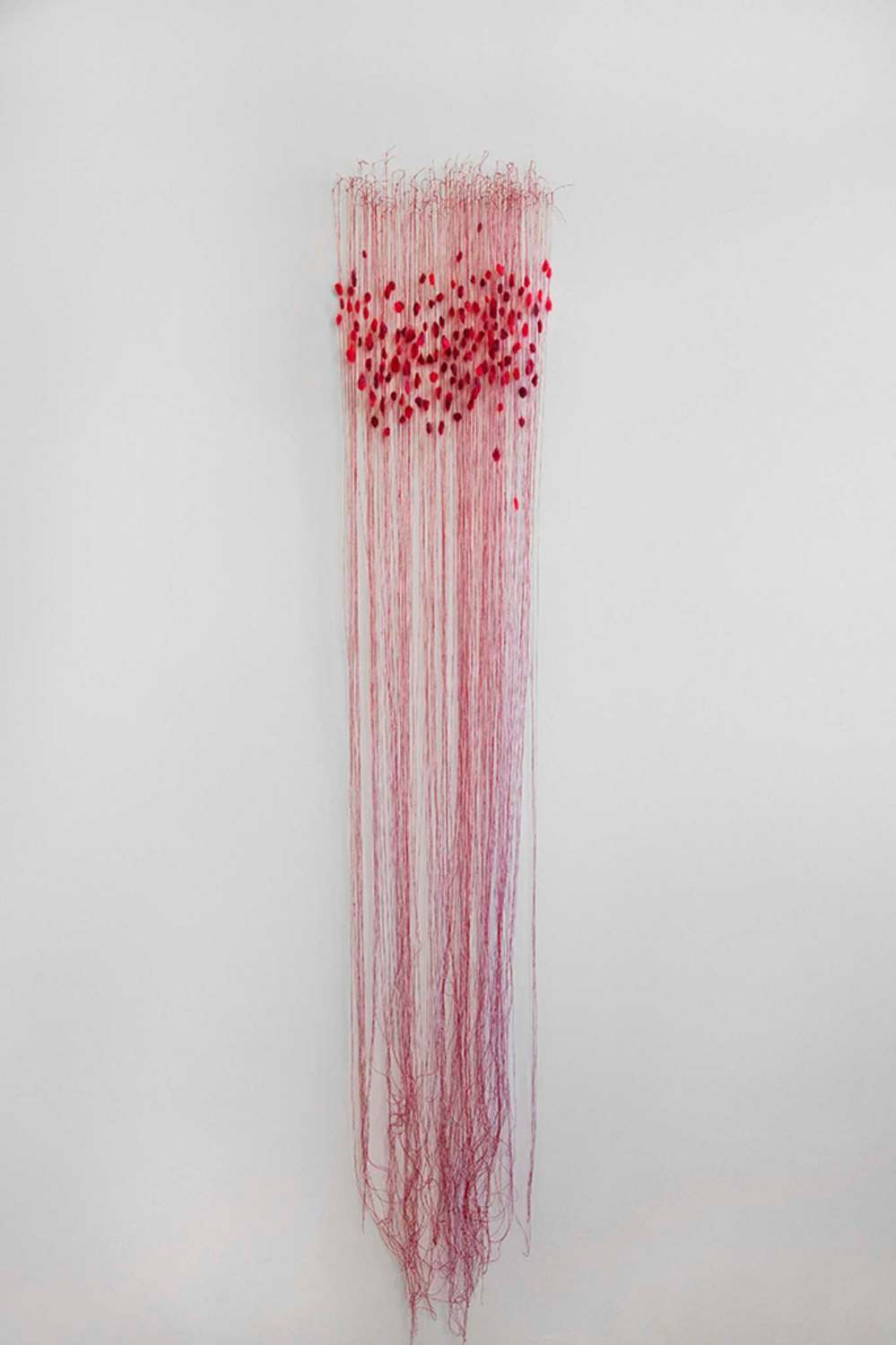
Works by Dana Kletke are as startling as they are elegant and enigmatic. Lengths of blood-red yarn flow down one side of a freestanding wall. Near eye level, each comes undone briefly in a puff of wool roving. Titled Blood Clots, the piece poignantly recalls her mother’s recent stroke. On the other side, two exquisite pencil drawings of what only barely reveal themselves to be stacked washcloths elusively document a daily routine, evincing tenderness, loss and tension even before the images resolve.
A spirited, comprehensive and often lyrical essay by curator Seema Goel draws tighter connections between traditional craft and cutting-edge neuroscience, highlighting shared concerns with pattern-formation, plasticity and muscle memory, among others. If anything, Goel’s essay does a more convincing job of this than the works themselves, which can seem to engage with the science superficially at times.
That said, the scope and ambition of the project remain impressive, as do the artists’ diversity, skill and personal insights. As boundary-defying experiments go, Neurocraft is one worth repeating, and the exhibition certainly is worth a visit before it closes next week.
Steven Leyden Cochrane is a Winnipeg-based artist, writer and educator.