Glenn Close and The Wife: invisible no more

Advertisement
Read this article for free:
or
Already have an account? Log in here »
To continue reading, please subscribe:

Digital Subscription
One year of digital access for only $205*
- Enjoy unlimited reading on winnipegfreepress.com
- Read the E-Edition, our digital replica newspaper
- Access News Break, our award-winning app
- Play interactive puzzles
*First annual payment billed as $205.00 + GST for one year. This annual subscription will automatically renew at $233.00 + GST every 52 weeks (10% off the regular annual price of $259.35). Offer available to new and qualified returning subscribers only. Cancel any time.
To continue reading, please subscribe:
Add Free Press access to your Brandon Sun subscription for only an additional
$1 for the first 4 weeks*
- Enjoy unlimited reading on winnipegfreepress.com
- Read the E-Edition, our digital replica newspaper
- Access News Break, our award-winning app
- Play interactive puzzles
*Your next Brandon Sun subscription payment will increase by $1.00 and you will be charged $17.95 plus GST for four weeks. After four weeks, your payment will increase to $24.95 plus GST every four weeks.
Read unlimited articles for free today:
or
Already have an account? Log in here »
Hey there, time traveller!
This article was published 26/01/2019 (2806 days ago), so information in it may no longer be current.
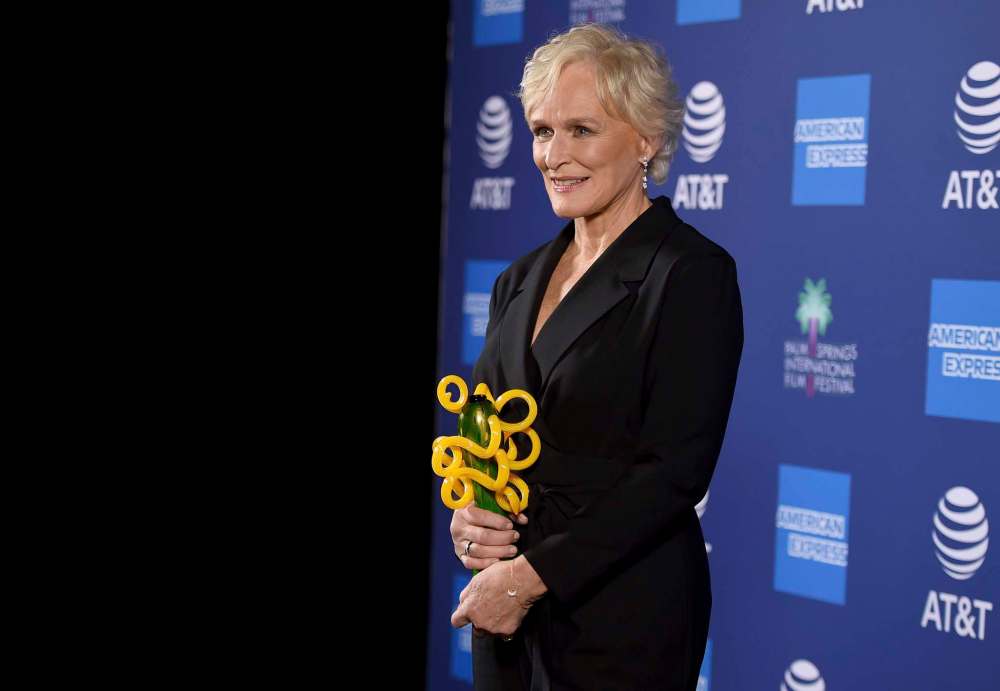
It feels perfect, somehow, that Glenn Close should snag an Academy Award nomination for a performance about an overlooked, underestimated older woman.
Close has been nominated six times before, once for an operatically intense role in the insanely zeitgeisty 1980s blockbuster Fatal Attraction, but it’s a quiet performance in a small, little-seen film that might finally seal the deal for the 71-year-old Close. She’s already won a Golden Globe for her work in The Wife, and oddsmakers have her as a strong favourite to follow up with an Oscar.
In this adaptation of the 2003 Meg Wolitzer novel, Close plays Joan Castleman, whose husband Joe Castleman (Jonathan Pryce) has just been nominated for the Nobel Prize in literature. As the wife of The Great Man, she tends to his genius, soothing his anxieties and burnishing his vanity. She brushes crumbs out of his beard before photoshoots and reminds him to take his pills.
She is condescended to by many of his peers and pushed aside by his adoring fans. At literary events, Joan is introduced as an afterthought, her name misremembered. (“Nice to meet you, Jean.”) The self-effacing Joan remains serene and elegant in the face of Joe’s insecure egotism, his world-devouring appetites, his many affairs.
Still, there’s that slightly tight smile when Joe announces to an assembled company that “my wife doesn’t write, thank God.” As we see in flashbacks (in which the young Joan is played by Close’s real-life daughter, Annie Starke), Joan was an English major at a woman’s college in the 1950s, and Joe was her married professor, telling Joan that her writing showed promise.
Joan’s almost preternatural poise covers over a lot, it turns out, and Close gets a helluva third-act twist.
Close’s Oscar nom is even more impressive because her performance comes out of a not-so-great film. The Wife is handsome and feeling, but very uneven. There are perfect scenes — those between Close and Pryce and between Close and Christian Slater, who plays Nathaniel Bone, Joe’s insinuating would-be biographer. And then there’s almost everything else.
Just as Joan holds it all together — her family, her husband’s career, her own turbulent emotions — Close holds this film together. Pryce is good — and the scenes between Joe and Joan depend on them being well matched — but the film’s power, subtlety and depth of meaning come primarily from Close.
Close even helped get the project off the ground. (“It was called The Wife,” she’s joked. “I think that’s why it took 14 years to get made.”) This kind of behind-the-scenes work has become a trend in recent film and prestige TV: If older women want good roles, it seems, they must birth them into being.
Close’s work in The Wife seems made for the #MeToo movement and its reconsideration of power, representation and whose stories get told. Reflecting Hollywood hierarchies, the Best Actress category has often favoured dewy ingenues, while Best Actor skews toward grizzled veterans.
Close’s nomination goes against this tendency, as underlined by two of her other nominations: Best Actress Defying Age and Ageism from the Alliance of Woman Film Journalists (a little niche, perhaps, but necessary) and The Invisible Woman Award from the Women Film Critics Circle.
The idea of the invisible woman runs through The Wife. “Don’t ever think that you can get their attention,” a female novelist tells the young Joan. “The men, the ones who decide who gets to be taken seriously.” Wolitzer, who has called herself “a 30-year overnight success,” has written and spoken about the way stories about men are considered universal while female-driven narratives are often sidelined as “women’s fiction.”
Those tensions are there in The Wife, but the story is never reduced to male vs. female, or even Joe vs. Joan.
Joe, at one point, speaks dismissively about a story by another writer: “The blowhard husband, the stoic wife with the repressed rage. It’s such a cliché.” There’s nothing cliched about The Wife, and again, this is mostly thanks to Close. “Don’t paint me as a victim,” Joan tells Nathaniel. “I’m more interesting than that.”
Close is more interesting than that. With her stern bone structure — revealed even more by age — and her precise gestures, she crafts a performance that is rich in irony and small, telling details. Her work conveys not just the fraught current state of Joe and Joan’s marriage, but its full 40-year history, with the complexities and emotional contradictions that take decades to build up. There’s a knock-out extended scene with Pryce that goes from comfortable domestic routine to full-on screaming match to sudden shared familial joy, with each stage absolutely lived-in and believable.
Joan’s public face often seems impassive, with Close at her most mask-like, but her private face, which the audience sees, registers quick currents of deep feeling. And when you find out how the story ends, you’ll realize that Close’s performance is even more layered than you first thought.
Bring on that Oscar.
Studying at the University of Winnipeg and later Toronto’s York University, Alison Gillmor planned to become an art historian. She ended up catching the journalism bug when she started as visual arts reviewer at the Winnipeg Free Press in 1992.
Our newsroom depends on a growing audience of readers to power our journalism. If you are not a paid reader, please consider becoming a subscriber.
Our newsroom depends on its audience of readers to power our journalism. Thank you for your support.
Studying at the University of Winnipeg and later Toronto’s York University, Alison Gillmor planned to become an art historian. She ended up catching the journalism bug when she started as visual arts reviewer at the Winnipeg Free Press in 1992.
Our newsroom depends on a growing audience of readers to power our journalism. If you are not a paid reader, please consider becoming a subscriber.
Our newsroom depends on its audience of readers to power our journalism. Thank you for your support.
Advertisement Advertise With Us
Advertisement Advertise With Us