


Transit, roads and city council’s priorities
Advertisement
Read this article for free:
or
Already have an account? Log in here »
To continue reading, please subscribe:

Digital Subscription
One year of digital access for only $205*
- Enjoy unlimited reading on winnipegfreepress.com
- Read the E-Edition, our digital replica newspaper
- Access News Break, our award-winning app
- Play interactive puzzles
*First annual payment billed as $205.00 + GST for one year. This annual subscription will automatically renew at $233.00 + GST every 52 weeks (10% off the regular annual price of $259.35). Offer available to new and qualified returning subscribers only. Cancel any time.
To continue reading, please subscribe:
Add Free Press access to your Brandon Sun subscription for only an additional
$1 for the first 4 weeks*
- Enjoy unlimited reading on winnipegfreepress.com
- Read the E-Edition, our digital replica newspaper
- Access News Break, our award-winning app
- Play interactive puzzles
*Your next Brandon Sun subscription payment will increase by $1.00 and you will be charged $17.95 plus GST for four weeks. After four weeks, your payment will increase to $24.95 plus GST every four weeks.
Read unlimited articles for free today:
or
Already have an account? Log in here »
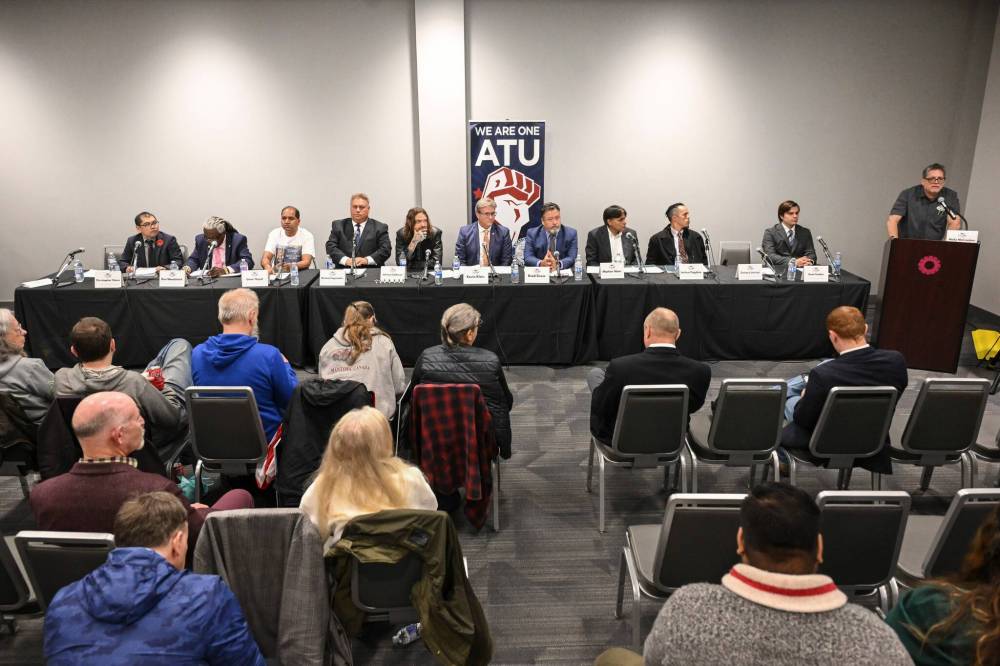
Did any of you happen to notice that the week of Sept. 14 marked an interesting confluence of events in Winnipeg? First up was the mayoral debate on public transit. Second was an announcement that the city would be undertaking a survey to determine whether their citizens’ “transportation needs” are being met.
The debate on our public bus system, from which our current Mayor Scott Gillingham was tellingly absent, focused primarily on safety rather than the efficiency of the system.
Which, on one level, is no great surprise.
Mike Sudoma / Free Press
Ten out of 14 mayoral candidates attended the mayoral debate held by the Amalgamated Transit Union at Union Centre on Sept. 14.
After all unlawful incidents on buses and at transit stops have increased by 280 per cent compared to levels recorded around 2016. Moreover, the candidates were primarily speaking to the bus drivers’ union that organized the event, and bus drivers are often the victims of violent episodes.
That said, it’s a bit of a puzzle why more time wasn’t spent on a detailed discussion of how the new transit system might be improved, not just to retain regular riders but to attract hundreds, possibly thousands, of new ones.
I mean, given the current state of our carbon-addicted culture, getting drivers out of their cars and on to an efficient, and yes, safe public transit system should be the goal, right?
So, colour me frustrated when I then discover that city council, in its wisdom, is now doing a survey to improve the world for people who drive cars. At least, that’s how it sounds after reading the statements of councillors such as Janice Lukes and Jeff Browaty in a recent Free Press article (Road map to future, Sept. 16).
Their interest appears to be focused on things such as congested intersections and whether or not the Chief Peguis extension should take precedence over the replacement of the Arlington Bridge.
This, when the chief aim of the survey should be to see whether or not the city’s commitment to a mode shift — that is, getting people out of their carbon-belching cars and onto buses, bikes and their feet has been in any way successful. This is information that’s critical to make evidence-based choices on how to reach the goals laid out in the city’s Transit Master Plan and Pedestrian and Cycling Strategy.
Because, after all, reducing traffic emissions should be the order of the day, right?
Well, maybe not, given that the survey will quiz Winnipeggers on how many cars they have, what routes they drive and what complaints they have about rush-hour traffic jams caused by thousands of cars that are mostly empty, save for the person in the drivers’ seat.
This instead of a survey that will tally up the bitter complaints of bus riders, and the concerns of cyclists, who, in some areas, contend with a haphazard network of bike paths squeezed onto the furthest edges of three- to five-lane roads designed for automobiles going 50 to 60 km/h. Bike paths which sometimes abruptly end only to reappear half a block down (in my neck of the woods, anyway) because, heaven forbid the city actually takes up more road space for bikes and pedestrians and a little less for traffic.
Better to cut down trees and cut into boulevards than piss off a car and its driver.
I can almost see one particular councillor waving the survey results, shouting, “Look! Here’s the evidence! Winnipeg is a car city. Public transit sucks and bike lanes are a pain in the butt, so let’s spend more money on high-speed roads!”
OK, OK, maybe I am overstating the case. Maybe I’m unduly cynical about the motivations of a mayor and council who, despite the evidence and significant public opposition, ram through projects such as the widening of Kenaston Boulevard and the Chief Peguis Trail extension. A council that also rolled out a new, more flexible bus system too quickly, without a sufficient number of buses and drivers to ensure efficiency or the designated bus lanes needed to guarantee a speedy ride.

A council that has failed to restore the 50-50 cost share deal with the province that would help put more buses on the road, then denigrates a citizens’ coalition that is actually trying to help them improve the system by doing some evidence-based research.
Yup, that’s right, there is a Transportation and Land Use Coalition right here in River City, which has teams of people riding public transit to assess what works, what doesn’t and how it can be improved.
So, will council engage with that coalition — or even better, consider collaborating with it — to accrue the evidence needed to improve public transit and active transportation? Will they spend the money needed to improve the speed and efficiency of public transit?
I don’t know. If I were you, I’d ask them.
Erna Buffie is a Winnipeg writer. Check out the TLUC @ https://www.anatomyofapothole.ca/
Related Articles
Gillingham talks trash, pledges big bin boost



Advertisement Advertise With Us
Advertisement Advertise With Us