Forever Bicycles sculpture rolls on after 3 years at Forks

Advertisement
Read this article for free:
or
Already have an account? Log in here »
To continue reading, please subscribe:

Digital Subscription
One year of digital access for only $205*
- Enjoy unlimited reading on winnipegfreepress.com
- Read the E-Edition, our digital replica newspaper
- Access News Break, our award-winning app
- Play interactive puzzles
*First annual payment billed as $205.00 + GST for one year. This annual subscription will automatically renew at $233.00 + GST every 52 weeks (10% off the regular annual price of $259.35). Offer available to new and qualified returning subscribers only. Cancel any time.
To continue reading, please subscribe:
Add Free Press access to your Brandon Sun subscription for only an additional
$1 for the first 4 weeks*
- Enjoy unlimited reading on winnipegfreepress.com
- Read the E-Edition, our digital replica newspaper
- Access News Break, our award-winning app
- Play interactive puzzles
*Your next Brandon Sun subscription payment will increase by $1.00 and you will be charged $17.95 plus GST for four weeks. After four weeks, your payment will increase to $24.95 plus GST every four weeks.
Read unlimited articles for free today:
or
Already have an account? Log in here »
Hey there, time traveller!
This article was published 22/10/2022 (1429 days ago), so information in it may no longer be current.
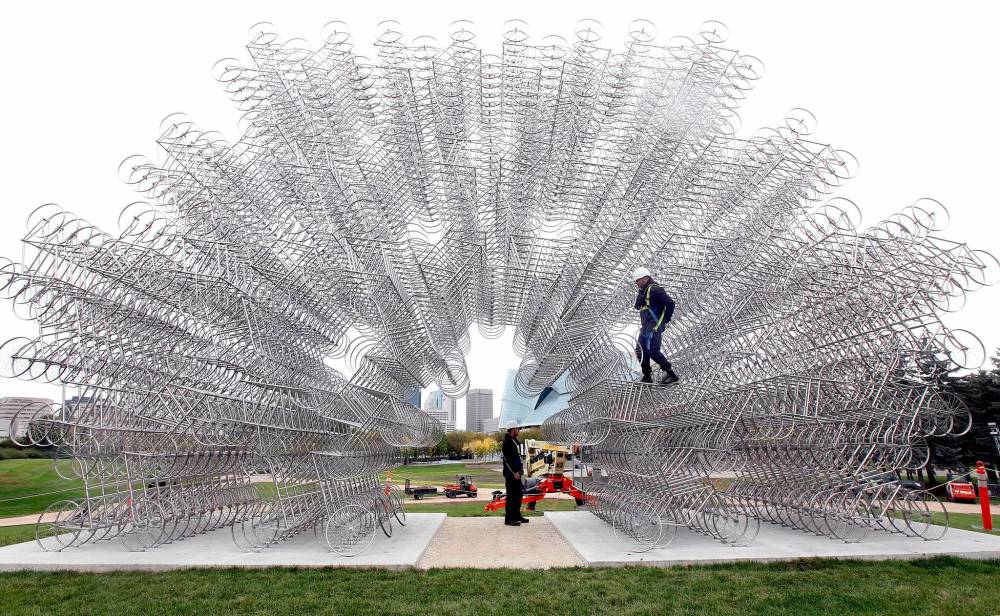
Set against the backdrop of the Canadian Museum for Human Rights, Chinese dissident artist Ai WeiWei’s Forever Bicycles sculpture, composed of 1,245 bikes locked into place with bolts and bars, has been a firm fixture at The Forks for the past 37 months.
Based on the original 2003 artwork by Ai, which was constructed with 42 bicycles produced by Shanghai-based company Yong Jiu (Forever), the site-specific installation is rebuilt differently each time it moves locations, sometimes with as few as four bicycles and up to as many as 3,144, all in different configurations.
This week the area surrounding the artwork will be fenced off as a team of specialists begins disassembling the sculpture in preparation for it to leave the city it’s called home for more than three years.

“We were lucky to have it for such a long time,” says Jenna Khan, communications specialist at The Forks. “We want to let the public know they have a few weeks left to say goodbye to it.”
Michelle Holigroski, a research biologist who works at a lab downtown, has seen the bikes more than 100 times since they’ve been here.
“The first time I saw the installation was early in its time here — in the fall of 2019 — at Nuit Blanche. I was overwhelmed by the sheer size of it. It was lit up at night which made it look like a large, beautiful crystal. Upon further inspection of the details, you could see all of the individual bikes it is comprised of. I also love biking, so this has special meaning for me.”
Holigroski wasn’t aware of who Ai WeiWei was before the installation arrived in Winnipeg but seeing Forever Bicycles has sparked an interest in his other work. She says it was “powerful” to learn what the artwork was about and how bicycles were financially out of reach for many in China, including Ai’s family.
Originally on loan for two years, courtesy of the artist, Lisson Gallery and Neugerriemschneider gallery, Berlin, Forever Bicycles inadvertently became a symbol of the importance of art in public spaces when, six months into its arrival, Manitoba declared a state of emergency in response to the rising rate of COVID-19 infections.
Buildings were ordered to be shuttered, school playgrounds were considered off-limits and gatherings limited to 10 people.
With most places shut down, open-air spots, including the CN Field behind The Inn at The Forks, where the installation stands, swiftly became gathering places.
“The timing of this piece coming to Winnipeg was something that ended up being very special. Although you certainly cannot plan for a pandemic, having the Forever Bicycles here through the course of the restrictions, when there weren’t many ways to access art in person, it was a space for people to visit,” Khan says.
Holigroski started commuting to work by bike when the pandemic started, as she felt it was safer than taking a bus. Because work was deemed essential — she was still needed onsite at her lab — she became a regular visitor. Seeing the sculpture looming against the skies is something she will miss, she says.
“Visiting this artwork was my mental-health reset button. I’m so grateful for the opportunity to see this incredible piece of artwork with a powerful message about human rights… I’m sad to see it go, but grateful that it was here for three years,” she says.
Matthew Aitken, who lives a “healthy walk” from The Forks, says it is one of his son’s favourite places to go. Aitken, the president of the Canadian Union of Postal Workers (Winnipeg), is a great admirer of Ai’s work, and says he takes out-of-town visitors to view the structure.
“It’s a real honour for Winnipeg to have such a prominent and compelling piece in our city for so many years. I would take people to The Forks to see the piece. It felt very cool to say ‘Hey, look what Winnipeg has’… it’s not a bragging, but it is really nice thing to show in our city.”
PHIL HOSSACK / WINNIPEG FREE PRESS FILES
Three years ago, art installation technicians installed a 30-foot bicycle sculpture, Forever Bicycles, by artist Ai Weiwei. The piece at The Forks consists of 1,254 bicycles, which are being disassembled this week
Like Holigroski, Aitken too will miss the sculpture but accepts that the piece has to move on.
“It’s too bad, but that fact that it’s been travelling the world and it can change into different forms and it can look different, I think that’s a pretty cool aspect of this particular piece of art. An object of movement is static in the piece of art, but the piece of art also moves — I think that’s a nice comment… I would love to see it in another location,” he says.
While the importance of public art in easily accessible spaces may have become more apparent during the pandemic, it’s not new discourse at The Forks. And while there is no indication yet as to what will occupy the space once the installation has been deconstructed and shipped back to the lender, Clare MacKay, chief communities officer for The Forks, is quick to point out the existing pieces of art, both permanent and temporary, are immensely popular with the estimated four million visitors The Forks gets annually.
“We are in the process of refining our public art policy and adding more resources to the area. There are things we didn’t have to think about then which are now our responsibility,” MacKay says

Chi-kishkayhitamihk si te li neu Biizon (Education is the New Bison) by Val Vint, Tanisi keke totamak… Ka cis teneme toyak (What can we do, to respect each other) by KC Adams and The Eighth and Final Fire by Jamie Isaac are recent public art installations that were commissioned by the Winnipeg Foundation for The Forks, as part of the foundation’s ongoing Green Spaces Strategy.
MacKay also mentions Pirate Wheel, a bronze sculpture by artist Barry Flanagan currently on loan to The Forks.
“It features a gigantic hare and is behind Manitoba Children’s Museum. And we will soon by joined by the warming huts,” she says, referring to the annual competition where designers are invited to create shelters for those seeking respite from the cold.
While there is still time to view Forever Bicycles, the public will no longer be able to get up close, as fences will be erected to facilitate the dismantling. A team of installation specialists will be removing the pieces professionally and the space should be clear by the second week of November.
av.kitching@winnipegfreepress.com
AV Kitching is an arts and life writer at the Free Press. She has been a journalist for more than two decades and has worked across three continents writing about people, travel, food, and fashion. Read more about AV.
Every piece of reporting AV produces is reviewed by an editing team before it is posted online or published in print — part of the Free Press‘s tradition, since 1872, of producing reliable independent journalism. Read more about Free Press’s history and mandate, and learn how our newsroom operates.
Our newsroom depends on a growing audience of readers to power our journalism. If you are not a paid reader, please consider becoming a subscriber.
Our newsroom depends on its audience of readers to power our journalism. Thank you for your support.
AV Kitching is an arts and life writer at the Free Press. She has been a journalist for more than two decades and has worked across three continents writing about people, travel, food, and fashion. Read more about AV.
Every piece of reporting AV produces is reviewed by an editing team before it is posted online or published in print — part of the Free Press‘s tradition, since 1872, of producing reliable independent journalism. Read more about Free Press’s history and mandate, and learn how our newsroom operates.
Our newsroom depends on a growing audience of readers to power our journalism. If you are not a paid reader, please consider becoming a subscriber.
Our newsroom depends on its audience of readers to power our journalism. Thank you for your support.
Advertisement Advertise With Us
Advertisement Advertise With Us