Riding Hokusai’s wave

Advertisement
Read this article for free:
or
Already have an account? Log in here »
To continue reading, please subscribe:

Digital Subscription
One year of digital access for only $205*
- Enjoy unlimited reading on winnipegfreepress.com
- Read the E-Edition, our digital replica newspaper
- Access News Break, our award-winning app
- Play interactive puzzles
*First annual payment billed as $205.00 + GST for one year. This annual subscription will automatically renew at $233.00 + GST every 52 weeks (10% off the regular annual price of $259.35). Offer available to new and qualified returning subscribers only. Cancel any time.
To continue reading, please subscribe:
Add Free Press access to your Brandon Sun subscription for only an additional
$1 for the first 4 weeks*
- Enjoy unlimited reading on winnipegfreepress.com
- Read the E-Edition, our digital replica newspaper
- Access News Break, our award-winning app
- Play interactive puzzles
*Your next Brandon Sun subscription payment will increase by $1.00 and you will be charged $17.95 plus GST for four weeks. After four weeks, your payment will increase to $24.95 plus GST every four weeks.
Read unlimited articles for free today:
or
Already have an account? Log in here »
Hey there, time traveller!
This article was published 25/03/2023 (1227 days ago), so information in it may no longer be current.
You know that thing where once you notice something, you start noticing it everywhere?
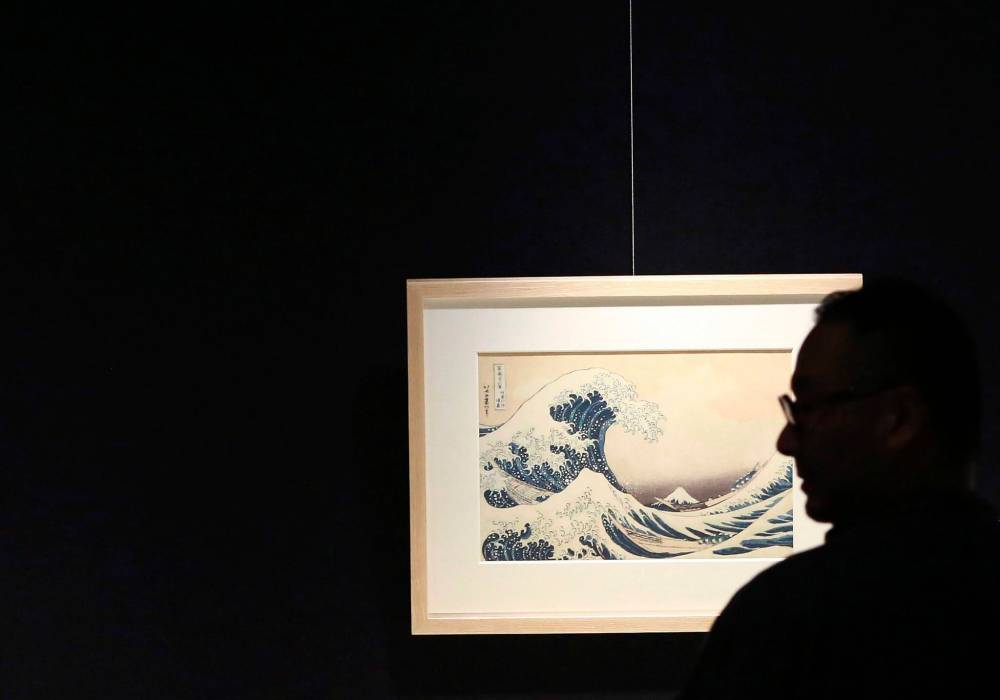
I’ve been having it lately with Hokusai’s The Great Wave off Kanagawa.
This Japanese woodblock print, from 1831, is among the world’s most reproduced images, so I’ve probably seen it before and so have you (probably). But seeing isn’t necessarily the same thing as noticing, and it feels like Hokusai’s wave — at once frothy and foreboding, rendered in blues that range from seafoam to midnight, capped by a curling, claw-like spume — is following me around.
Eugene Hoshiko / The Associated Press
The Great Wave off Kanagawa, Katsushika Hokusai’s most well-known work, continues to be noticed.
I first noticed it as part of the cover design for Tomorrow, and Tomorrow, and Tomorrow, the gorgeous 2022 novel by Gabrielle Zevin. Hokusai’s wave is central to the novel, which is about game designers, yes, but it’s also about making art, finding inspiration, and borrowing old ideas to create new ones.
I read that book in January. Not long after, I flipped the square on my page-a-day calendar by Liz + Mollie — a.k.a. Liz Fosslein and Mollie West Duffy, whose truth-bomb illustrations about work, burnout, and hustle culture have been a lifeline, particularly during the pandemic — and there it was again: this time reimagined as Hokusai’s Wave of Anxiety. I have that one tacked up on my cubicle wall.
I noticed it a third time, on my phone. The emoji for “wave” bears a striking resemblance to Hokusai’s.
Then a fourth, in the curvature of this weird blue neck stretcher thing I was Instagram influenced into buying during the pandemic in an attempt to correct my Body By Laptop. (That one’s a bit abstract, maybe, but I like the idea that its curl is the result of some product designer once seeing Hokusai’s print and it getting stuck in their brain).
There’s some debate about whether Hokusai was depicting a tsunami, or just a really big wave. Mount Fuji is visible in the background, but made tiny by the water. Three boats are held in the wave’s bracket, the harrowing moment before it would crash down on them.
If that’s not a metaphor for how the last three years have felt, I don’t know what is. The pandemic was, at one point, even measured in waves — waves that would crest, then recede, then crest again. And, if you were lucky, your boat would make it.
Anxiety is often measured in waves. So is pain. But sometimes you can ride a wave, like a thrill-seeking surfer who purposefully seeks them out. Catching a wave is good fortune, success; to ride its crest is to be right at the height. Waves can be destructive. They can also be beautiful.

This sensation of noticing once, then noticing everywhere has a term: frequency illusion, or the Baader-Meinhof phenomenon. Our brains are hardwired to seek patterns; it’s one of the things that helps us learn.
Hokusai’s wave is obviously not literally following me around; it just feels like it is. That’s the thing about enduring, inspiring artworks — they are borrowed, riffed on, and suffused with new meaning because they continue to be noticed.
I’m curious: what are some things you started seeing everywhere after seeing them for the first time?
This column first appeared in Jen Zoratti’s newsletter, Next, a weekly look at a post-pandemic future. Sign up at: wfp.to/jennext
jen.zoratti@freepress.mb.ca
Jen Zoratti is a columnist and feature writer working in the Arts & Life department, as well as the author of the weekly newsletter NEXT. A National Newspaper Award finalist for arts and entertainment writing, Jen is a graduate of the Creative Communications program at RRC Polytech and was a music writer before joining the Free Press in 2013. Read more about Jen.
Every piece of reporting Jen produces is reviewed by an editing team before it is posted online or published in print – part of the Free Press‘s tradition, since 1872, of producing reliable independent journalism. Read more about Free Press’s history and mandate, and learn how our newsroom operates.
Our newsroom depends on a growing audience of readers to power our journalism. If you are not a paid reader, please consider becoming a subscriber.
Our newsroom depends on its audience of readers to power our journalism. Thank you for your support.
Jen Zoratti is a columnist and feature writer working in the Arts & Life department, as well as the author of the weekly newsletter NEXT. A National Newspaper Award finalist for arts and entertainment writing, Jen is a graduate of the Creative Communications program at RRC Polytech and was a music writer before joining the Free Press in 2013. Read more about Jen.
Every piece of reporting Jen produces is reviewed by an editing team before it is posted online or published in print – part of the Free Press‘s tradition, since 1872, of producing reliable independent journalism. Read more about Free Press’s history and mandate, and learn how our newsroom operates.
Our newsroom depends on a growing audience of readers to power our journalism. If you are not a paid reader, please consider becoming a subscriber.
Our newsroom depends on its audience of readers to power our journalism. Thank you for your support.
Advertisement Advertise With Us
Advertisement Advertise With Us