Head-spinning horror defines Friedkin’s legacy

Advertisement
Read this article for free:
or
Already have an account? Log in here »
To continue reading, please subscribe:

Digital Subscription
One year of digital access for only $205*
- Enjoy unlimited reading on winnipegfreepress.com
- Read the E-Edition, our digital replica newspaper
- Access News Break, our award-winning app
- Play interactive puzzles
*First annual payment billed as $205.00 + GST for one year. This annual subscription will automatically renew at $233.00 + GST every 52 weeks (10% off the regular annual price of $259.35). Offer available to new and qualified returning subscribers only. Cancel any time.
To continue reading, please subscribe:
Add Free Press access to your Brandon Sun subscription for only an additional
$1 for the first 4 weeks*
- Enjoy unlimited reading on winnipegfreepress.com
- Read the E-Edition, our digital replica newspaper
- Access News Break, our award-winning app
- Play interactive puzzles
*Your next Brandon Sun subscription payment will increase by $1.00 and you will be charged $17.95 plus GST for four weeks. After four weeks, your payment will increase to $24.95 plus GST every four weeks.
Read unlimited articles for free today:
or
Already have an account? Log in here »
Hey there, time traveller!
This article was published 12/08/2023 (1116 days ago), so information in it may no longer be current.
Director William Friedkin died last week at age 87. In the 1970s, he helped define New Hollywood cinema with grim, gritty films like The French Connection. In 1980, he released the controversial crime flick Cruising. More recently, he made a late-career return with the intense, ultra-violent Killer Joe.
For me, though, and millions of other superfans, Friedkin’s legacy will be The Exorcist. It’s not just the film itself that has, um, possessed the popular imagination. It was also the reaction to the film, which turned out to be a pop-culture phenomenon on its own.
The Exorcist opened the day after Christmas, 1973 and immediately became a sensation, with moviegoers lining up, sometimes for more than six hours, for sold-out showings. There were soon media reports of viewers weeping and fainting, hyperventilating and vomiting. One theatre manager complained they had to keep plumbers on hand to deal with the mess in the bathrooms. The Toronto Star reported the movie “was keeping the ambulances busy.”
The outlines of the story are deceptively simple. Regan (Linda Blair), a 12-year-old girl living in an upscale D.C. neighbourhood, seems to be overtaken by some evil and unknowable force. Receiving no answers from modern medicine, her desperate mother, Chris (Ellen Burstyn), seeks out a priest, Father Karras (Jason Miller), a man who is undergoing his own crisis of faith.
The Exorcist is often called the greatest horror film ever made, perhaps because Friedkin said he “never had any concept of it as a horror film.” William Peter Blatty adapted the script from his 1971 novel, and the two men tussled — productively — over the project.
Blatty was a devout Christian, and Friedkin described himself as an agnostic, and together, they gave the devil his due. Rejecting the standard tropes of the spooky story, they instead made an oddly realistic drama about the inevitability of human suffering and the mystery of faith.
It’s the movie’s graphic second half that has become notorious. The blasphemy, obscenity and outright pukey grossness shocked ’70s audiences, and even in these desensitized times, its sudden eruptions of violence are unsettling.
But for me, it’s the slow, cool, controlled dread of the first hour that really grips. Fear is here, in an open window and a rush of cold air, in a soundscape of rasping, whispering, scuttling noises. But Friedkin is less concerned with the supernatural and more concerned with ordinary, everyday human horror, with the social and psychological spectres of poverty and sickness, isolation and disconnection, guilt and regret.
Unusual, ambiguous, the film has always provoked divided responses. It came out during the traumas of Watergate and Vietnam, during widespread unrest amid demands for civil rights and women’s liberation. These were polarizing times, and commentators couldn’t quite decide whether The Exorcist was politically transgressive or reactionary. Was it a countercultural outrage? (“America is Going to the Devil,” wailed one panicked headline.) Or was it using a painted devil to scare people back to the traditional order?
Likewise with religion. Initially condemned by a number of religious organizations for its undeniably nasty content, the movie was seen by others as a powerful confirmation of the need for faith. (After all, there were reports of people were going straight from the theatre to the nearest church.)

Gender theorists have also wrangled over the film. Some feminist critics suggest the female characters are “demonized” in more ways than one — Chris as the divorced working mother, Regan as a girl on the brink of puberty who transforms into a raging, filthy-mouthed mess. In this view, the film is a backlash against second-wave feminism, with its putrescent exorcism scenes expressing a primal fear of uncontrolled female sexuality.
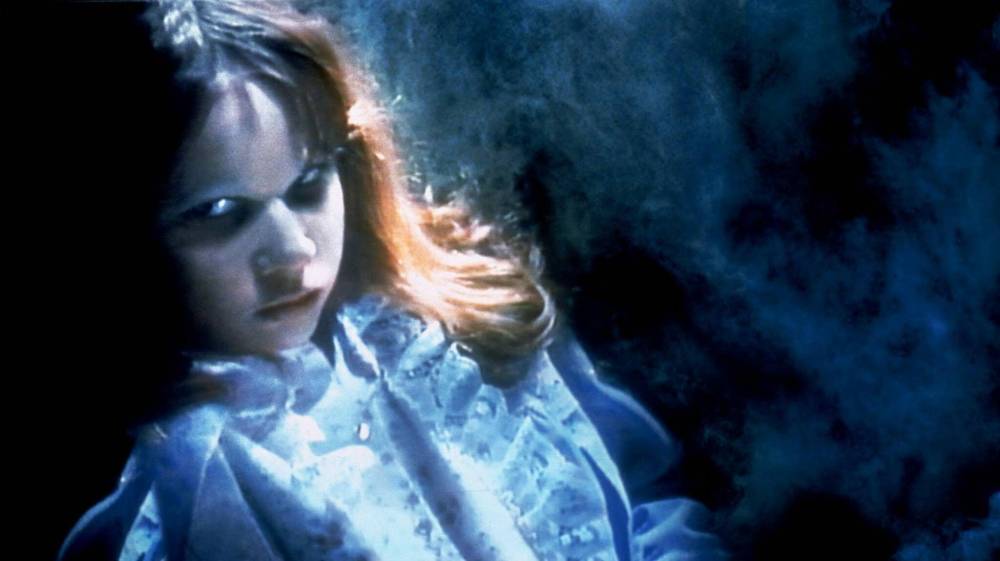
Regan (Linda Blair), a 12-year-old girl living in an upscale D.C. neighbourhood, seems to be overtaken by some evil and unknowable force. (Warner Bros. / Associated Press files)
Others view it a kind of deranged woman’s picture, pointing to its close mother-daughter bond and its deeply sympathetic depiction of a woman fighting to save her child. They argue that, as with many horror films, the story sides with the woman who is not believed, the woman whose pain and fears are categorized, minimized and dismissed by the male establishment.
Kind of like Regan, the film contains a multitude. It’s a blockbuster hit and a work of critical acclaim. It’s a morally serious drama and a spectacular freak-out. It’s a story about God and Satan that manages to terrify even non-believers.
Its meanings and intents are complicated, even contradictory. Maybe that’s why, after 50 years, The Exorcist is still scaring us.
alison.gillmor@freepress.mb.ca
Studying at the University of Winnipeg and later Toronto’s York University, Alison Gillmor planned to become an art historian. She ended up catching the journalism bug when she started as visual arts reviewer at the Winnipeg Free Press in 1992.
Our newsroom depends on a growing audience of readers to power our journalism. If you are not a paid reader, please consider becoming a subscriber.
Our newsroom depends on its audience of readers to power our journalism. Thank you for your support.
Studying at the University of Winnipeg and later Toronto’s York University, Alison Gillmor planned to become an art historian. She ended up catching the journalism bug when she started as visual arts reviewer at the Winnipeg Free Press in 1992.
Our newsroom depends on a growing audience of readers to power our journalism. If you are not a paid reader, please consider becoming a subscriber.
Our newsroom depends on its audience of readers to power our journalism. Thank you for your support.
Advertisement Advertise With Us
Advertisement Advertise With Us