The business end of art Acclaim is one thing for painters, ceramicists, but after death, a studio crammed with work is no sweet hereafter
Read this article for free:
or
Already have an account? Log in here »
To continue reading, please subscribe:
Digital Subscription
One year of digital access for only $1.44 a week*
- Enjoy unlimited reading on winnipegfreepress.com
- Read the E-Edition, our digital replica newspaper
- Access News Break, our award-winning app
- Play interactive puzzles
*Billed as $5.77 plus GST every four weeks. After 52 weeks, price increases to the regular rate of $19.95 plus GST every four weeks. Offer available to new and qualified returning subscribers only. Cancel any time.
To continue reading, please subscribe:
Add Free Press access to your Brandon Sun subscription for only an additional
$1 for the first 4 weeks*
- Enjoy unlimited reading on winnipegfreepress.com
- Read the E-Edition, our digital replica newspaper
- Access News Break, our award-winning app
- Play interactive puzzles
*Your next Brandon Sun subscription payment will increase by $1.00 and you will be charged $17.95 plus GST for four weeks. After four weeks, your payment will increase to $24.95 plus GST every four weeks.
Read unlimited articles for free today:
or
Already have an account? Log in here »
Hey there, time traveller!
This article was published 16/02/2024 (978 days ago), so information in it may no longer be current.
The concrete floor is covered in paint. Some of the splatter is a byproduct of a decades-long art career. Other swaths are embellishments to liven up the large garage studio, with brushstrokes that match the abstract paintings stacked high along the walls.
Don Reichert was an artist who delighted in scale. He drew inspiration from the environment and wanted viewers to feel immersed in his massive expressionist landscapes.
In death, however, that sense of scale has become a burden.
“There aren’t very many collectors for works of that stature,” Reichert’s son Ernie says, looking up at an 8-by-14 foot painting wrapped in plastic.
Reichert was a celebrated Winnipeg artist and a professor emeritus with the University of Manitoba’s School of Art. He died suddenly in 2013 at the age of 81.
For the last decade, his family has been trying to figure out what to do with the small warehouse of work he left behind.
It’s an end-of-life conundrum faced by many creators and an issue that’s becoming more pressing for an aging generation of professional artists. Settling an estate — let alone one filled with personally and culturally significant visual artwork — is rarely a simple task.
WAYNE GLOWACKI / FREE PRESS FILES Don Reichert, here with photographic art of the Redwood Bridge in 2006, continued creating until his sudden death in 2013. He didn’t leave behind a will with instructions for his work.
Riechert continued creating until the very end. While he didn’t leave behind a will with detailed instructions regarding his work, he was planning for the future in a roundabout way.
“He deliberately started to scale down later in his life,” Ernie says of his dad’s transition to smaller canvases and digital photography. “And he really tried not to acknowledge all of this because it became overwhelming.”
The backyard Winnipeg studio contains an estimated 4,000 individual paintings and sketches, roughly half of which have been painstakingly catalogued by Ernie and his wife, Andrea, over the last 10 years.
While both have professional curatorial experience — he’s a former archeologist and staffer with the Canadian Museum for Human Rights and she’s the curator of the Manitoba Crafts Museum and Library — this is a project complicated by emotion, practicality and capacity.
“It’s already taken a lot longer because we’re doing this off the sides of our desks,” Andrea says. “But we’re running out of time.”
The family is preparing to sell the property, creating a hard deadline to disperse the collection. But first, they need to know what’s in the collection.
The couple — along with assistance from their teenage daughter — has spent months photographing, identifying and plugging information about each artwork into a spreadsheet, which will eventually be turned into a website for potential buyers to peruse.
Along the way, Ernie and his three siblings have been deciding which of the many meaningful pieces should remain in the family, which should be sold and which should be donated to art galleries.
“There’s been limited uptake,” Andrea says of the latter.
Reichert stopped exhibiting in the ’90s and it’s been hard to find an audience for his work posthumously. Several years ago, the family sent a number of pieces to national auction houses to get a sense of the market. The results — both in price and quantity sold — were disappointing.
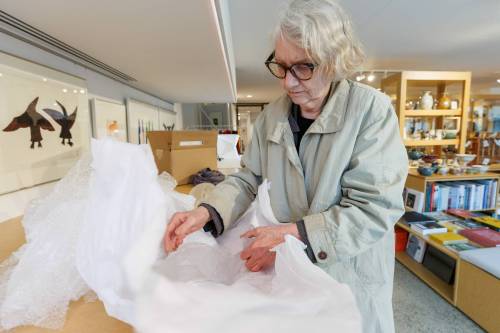
RUTH BONNEVILLE / FREE PRESS Trying to do justice to Don Reichert’s 4,000 artworks is challenging even for professional curators Ernie Reichert and Andrea Reichert, the late artist’s son and daughter-in-law.
In life, Reichert was more comfortable with a paintbrush than a sales pitch. Self-promotion didn’t align with his humble, self-effacing personality and he struggled to find lasting representation throughout his career. Combined with a high creative drive, it’s the reason Reichert’s family has an outbuilding filled to the rafters with museum-quality paintings.
But poor sales don’t make a life’s work worthless.
“We feel his work is important,” Ernie says. “The people who knew his work thought it was important; his contribution to western Canadian art is important and is still kind of being defined.”
Art historian and former senator Pat Bovey sees estate management as a cornerstone of the preservation of Canadian art and, by extension, Canadian culture.
“This is really important legacy work,” she says. “Our creators, our artists, they’re the ones who portray who we are, the history of our time, the sensibility of our place.”
Bovey became interested in the nuances of artist estates after witnessing an unceremonious auction of Maxwell Bates’ effects, an event she describes as “one of the saddest times” of her professional career.
Bates was a Canadian expressionist painter and his artwork was set to be donated to the Art Gallery of Greater Victoria, where Bovey was director at the time, by way of his wife’s will. A discrepancy in the document and a family dispute saw the paintings sold at auction instead.
“It was a two-day wake; it was terrible,” Bovey says, adding that she has since made it her mission to educate artists on the importance of estate planning. “The dotting of Is and crossing of Ts is really important and many of us put that off.”
“This is really important legacy work,” she says. “Our creators, our artists, they’re the ones who portray who we are, the history of our time, the sensibility of our place.”– Art historian Pat Bovey
During speaking engagements, she prods artists to read up on tax and copyright law. (In 2023, the Copyright Act was extended to 70 years after the death of an artist, giving estates a longer period to benefit from royalty revenue.)
Bovey also opines on the value of appointing an executor to deal specifically with the artistic components of an estate.
“The same way writers often have a literary executor in addition to their regular executor,” she says. “It would behoove them to have somebody who knows how the art world works.”
Bovey is currently working on a book about Don Reichert’s life and visual experiments. It has the potential to drum up renewed interest in the late artist, but its publication is a long way off.
For the remaining Reicherts, time is of the essence. They plan on hosting a studio sale in the near future and will continue approaching galleries.
While the retrofitted garage isn’t an ideal holding place for the paintings — it has experienced flooding in the past and is susceptible to temperature fluctuations, dust and sunlight that can degrade canvas — finding another storage solution would be prohibitively expensive.
“It just has to go,” Andrea says.
And if all 4,000 pieces don’t go?
“There’s sort of a running joke that it just disappears — we throw it in the river or it gets burned or whatever,” Ernie says. “This is a thing my mom seriously entertains; this is not what she wanted to see happen for her family.”
Destroying artwork may seem like an extreme measure, but pieces of Robert Archambeau’s estate could be facing a similar fate.
“In the end, the family is overloaded with pots already,” executor Alan Lacovetsky says. “So, it’s been suggested that if push comes to shove, they may need to be smashed, but that’s a very drastic step and no one wants to do that.”
Archambeau was an acclaimed local ceramicist who died in 2022 at the age of 89. He and Reichert were colleagues at the University of Manitoba and longtime collaborators with neighbouring studios in Bissett.
The pair shared a similar work ethic and Archambeau also continued making pottery until his death, leading to a stockpile of more than 1,000 vases, jars, teapots and other earthenware vessels.
MARC GALLANT / FREE PRESS FILES Archambeau, in 2001, is on the level of the Group of Seven, says his executor.
Where they differed was in connections and prominence at the time of their passing.
Within the last 20 years, Archambeau had been the focus of two major retrospectives at the Winnipeg Art Gallery-Qaumajuq and had received several high-profile awards, including the Governor General’s Award in Visual and Media Arts.
“His name, in terms of ceramics, it’ll go down in history,” says Lacovetsky, who likens Archambeau’s artistic legacy in North America to that of the Group of Seven. “There’s a handful of artists who pioneered and popularized pottery and working with clay and he’s one of those people.”
MIKAELA MACKENZIE / FREE PRESS ShopWAG is hosting a sale of work by the late ceramicist Robert Archambeau.
Lacovetsky is a fellow ceramic artist and a former student of Archambeau. They had a close working relationship and several years ago Archambeau asked his protégé to “look after” his wife, Meridel, when he died — by which he meant help her offload the pottery and many collectibles he had accumulated over his lifetime. Again, there were no formal instructions.
With studios in Winnipeg and Bissett both “chock-a-block full” of items, it was a tall task but one Lacovetsky has revelled in. The process has allowed him to honour a friend and formative mentor while furthering his education.
“I know his work inside and out,” he says. “But I’ve become even more aware … just by handling some of the pieces.”
As an executor, Lacovetsky has leveraged his knowledge and industry connections. Together with other Archambeau scholars, such as former WAG curator Helen Delacretaz, he’s had success placing pieces in the collections of public institutions locally, nationally and internationally.
He’s also tapped into some creative sales opportunities.
Lacovetsky helped establish an award and endowment fund at the Manitoba Craft Council supported by a donation from the estate. Last fall, the council hosted a fundraiser at which attendees were given a small Archambeau ceramic in exchange for a $150 ticket. The event pulled double duty: moving pottery while adding to the artist’s legacy fund. The first Robert and Meridel Archambeau Award is set to be given to a local craftsperson later this year.
The WAG is aiming for triple duty.
MIKAELA MACKENZIE / FREE PRESS Over years of exhibiting his work, Winnipeg Art Gallery director Stephen Borys became good friends with Robert Archambeau. He is now working on a book about his art. 
Over years of exhibiting his work, gallery director and chief executive officer Stephen Borys became good friends with Archambeau. Toward the end of his life, the artist had three specific requests: to help his family relocate as much artwork as possible; to create a world-class collection of his ceramics at the WAG; and to publish a definitive book on his life and work.
“I pledged to do my best to help him,” Borys says.
After Archambeau’s death, Borys took a roadtrip to Bissett — a former mining town 230 kilometers northeast of Winnipeg — with Lacovetsky and WAG retail operations manager Sherri van Went. The trio spent a several days sorting through garages and sheds filled floor to ceiling with pottery to find pieces worthy of the gallery’s permanent collection and others that could be marketed in the gift shop.
Sherri van Went photo After the artist’s death, Winnipeg Art Gallery director Stephen Borys took a roadtrip with ceramicist Alan Lacovetsky and WAG retail operations manager Sherri van Went (not seen) to take a pilgrimage to Robert Archambeau’s lakeside studio in Bissett.
The sale of Archambeau’s work through ShopWAG is an anomaly. The boutique typically only works with living artists and van Went doesn’t expect estates to become a regular source of inventory. In this case, money earned through recurring pottery sales will be funnelled into the book project, which Borys is spearheading.
Preparing the pieces for sale has been abnormal in other ways for van Went, who worked with Archambeau when he was alive.
“He’d sit with me and talk about each piece and tell me details about the kind of glaze or where it was sitting in the kiln … so that I could label them properly and price them,” she says, adding that Lacovetsky offered guidance this time around. “It was really great to have his expertise in the absence of Robert.”
Each sale, hosted in-person and online, will feature 20 to 30 vessels encompassing different categories of work, such as carved vases, lidded jars and tableware. The first sale launched last November and included a variety of his popular teapots, ranging from $500 to $700. The next release is slated for later this month.
Beyond the grasp of buyers, the WAG now has 37 Archambeau originals in its permanent holdings, described by the gallery as the “largest and best representative collection of his oeuvre” in the world.
Related Articles
WAG director appointed to help preserve Canada’s cultural property
All acquisitions, whether purchased or donated, go through a careful vetting process that involves a professional appraisal and presentation to the WAG’s quarterly Works of Art Committee meeting.
Work is only added if it fits the gallery’s mandate — which prioritizes contemporary Canadian and Inuit art, as well as historic European art — and if there’s room in the budget for its conservation and storage.
“When works come in in large numbers, we just don’t have the capacity,” Borys says. “The cost of acquisitions is not insignificant … and we have finite storage.”
The institution is the largest civic gallery in Manitoba and holds more than 28,000 pieces of artwork in trust in its public collection. The gallery is approached nearly every month with major estate offerings from local collectors.
RUTH BONNEVILLE / FREE PRESS Andrea Reichert and family are detailing artworks for potential buyers.
“Our curators could work full-time just on answering public queries about proposed donations,” Borys says, adding that appraising precious heirlooms is delicate business. “Maybe it has great sentimentality or great meaning, but it doesn’t always translate to value.”
The WAG is also a magnet for donations because it’s able to issue tax receipts for 100 per cent of an artwork’s appraised value. The gallery is one of seven designated institutions in Manitoba able to submit artwork for certification with the Canadian Cultural Property Export Review Board — a government body that encourages the transfer of privately owned artifacts to public collections via tax incentives. (Borys was named to the board on Thursday as its sole Prairie representative.)
When donated artwork is deemed cultural property it also becomes exempt from capital gains tax, which can make the system susceptible to abuse and the WAG’s stringent collections policy all the more important, according to Borys.
Due to the financial and physical limitations, public galleries and museums will never be able to take in all the work made by the roughly 21,000 full-time visual artists working in Canada today (according to census data).
It’s also not what they were designed to do.
Yet for creators and their kin, the accumulation of art comes with daunting implications.
“It’s always a serious liability — to an artist, to an artist’s estate, to their descendants — to have such a large (collection),” Borys says. “You can’t simply flood the market with it and there’s a value to them, there’s insurance issues, storage … and when the artist is no longer here, it’s left to others to take care of it in a respectful, careful way.”
MIKE DEAL / FREE PRESS A sale of glass artist Ione Thorkelsson's work at ShopWAG was a solid success.
Ione Thorkelsson is doing the caretaking ahead of time.
The esteemed Manitoba artist has been making blown glass vases and luminous sculptures out of her home studio near Roseisle for more than 50 years.
After taking inventory of her large personal archive, she and her partner decided to start paring down the collection to avoid passing the work onto their children.
“I don’t want to stop making,” Thorkelsson, 76, says. “(But) I’ve been at it a long time and we’re at an age where we’re realizing that we have too much stuff.”
MIKE DEAL / FREE PRESS Glass artist Ione Thorkelsson, who is doing her own legacy caretaking ahead of time.
The pair run the glass studio together; she’s the creator and he’s the business manager. It was his idea to pitch the WAG on a series of retrospective sales spanning different eras of her career.
Through the gallery gift shop, they sold more than 200 pieces over five different events last year — the success of which inspired the format for the current Robert Archambeau sales at ShopWAG.
While it was difficult to get rid of favourite and meaningful creations, the in-person sales were positive send-offs.
“Lots of people came just to say hello,” Thorkelsson says. “It was a celebration.”
But the job isn’t done. She still has 30 or so large cast-glass sculptures to find homes for — a process that is proving more challenging than private market sales.
“It’s much more complicated than I ever anticipated,” Thorkelsson says.
Unlike donations made through an estate, work donated to galleries and museums by a living artist is considered a disposition of property and therefore must be valued and treated as income for tax purposes.
“I don’t want it to cost me money,” Thorkelsson says. “I could get a tax deduction, but I don’t make enough money for it to be very useful to me.”
MIKE DEAL / FREE PRESS Glass artist Ione Thorkelsson (right) is being proactive. Here she drops off a few of her pieces to WAG retail operations manager Sherri van Went for one of her retrospective sales.
In 2016, the median income for artists in Manitoba was $23,300 per year.
The term “starving artist” was part of the impetus for the creation of the Manitoba Legal Clinic for the Arts, launched last fall and staffed by University of Manitoba law students offering free legal advice for creative workers who otherwise can’t afford a lawyer. While copyright and intellectual property are common themes for clients, estate planning is also on the radar.
“If they don’t have access to a lawyer, they probably don’t have a will or the suite of services you usually get legacy-wise,” says instructor and clinic co-founder Nick Slonosky, adding that the program is mutually beneficial for law students.
“Not all lawyers know a lot about how artists’ estates should be dealt with if putting a will together or the complexities after the fact.”
When a person dies, a final income tax return must be filed with Revenue Canada, which requires tallying the value of an estate.
“It’s very easy to do if you have a house or a car or investments,” Slonosky says. “But how do you value a lifetime worth of art? You could say it’s worth nothing, but it isn’t.”
Creating a detailed inventory of artwork — including titles, synopses and current market value — can be hugely beneficial for heirs, he says.
“If you incentivize people to buy art from living artists, that can make a profound difference, rather than relying on some imaginary market down the road”– Art dealer Shaun Mayberry
Since mediums and priorities vary widely within the field, Slonosky recommends artists get individualized advice about the stipulations within their wills. Too much detail can limit options for executors and too little can leave survivors overwhelmed.
Either way, a document of some form is advised.
“It’s the last time anybody’s going to be really interested in what you have to say,” Slonosky says. “So give it some thought.”
The challenges associated with managing an art estate is one of the reasons Shaun Mayberry is a proponent of celebrating artists while they’re alive. Extending the tax benefits for private collectors and public institutions to work created by living artists is one way to do that, says the local art dealer and partner with Mayberry Fine Art.
“If you incentivize people to buy art from living artists, that can make a profound difference, rather than relying on some imaginary market down the road,” he says. “That would create legacies in the long term.”
In lieu of sweeping changes to Canadian tax laws, Mayberry says exhibitions remain a valuable venue for creating interest in an artist’s work among potential collectors. However, landing exhibitions and selling pieces requires marketing — a skill that doesn’t come naturally for most creators, in his experience.
“Art costs money to buy and you’ve got to justify it,” he says. “You’re selling something that people don’t necessarily need.”
Mayberry Fine Art recently added a full-service estate operation to its business model. The venture is in response to the increasing transfer of possessions and valuable goods from older to younger generations. It includes a new Winnipeg warehouse where art collections can be appraised, stored and prepared for sale.
While the estate service is tailored to the needs of private art collectors and not individual artists, both parties can benefit from dealing with a mass of artwork before it’s too late.
“It can be very difficult to make a market after the fact,” Mayberry says. “That takes a lot of time and commitment and sometimes you’re trying to convince people to celebrate something that wasn’t necessarily celebrated in its lifetime.”
eva.wasney@winnipegfreepress.com
X:@evawasney

Eva Wasney covers environmental issues in Manitoba for The Narwhal in partnership with the Winnipeg Free Press. Read more about Eva.
Every piece of reporting Eva produces is reviewed by an editing team before it is posted online or published in print — part of the Free Press‘s tradition, since 1872, of producing reliable independent journalism. Read more about Free Press’s history and mandate, and learn how our newsroom operates.
Our newsroom depends on a growing audience of readers to power our journalism. If you are not a paid reader, please consider becoming a subscriber.
Our newsroom depends on its audience of readers to power our journalism. Thank you for your support.
History
Updated on Friday, February 16, 2024 1:20 PM CST: Changes tile photo