Animation, intimate conversations illuminate short film

Advertisement
Read this article for free:
or
Already have an account? Log in here »
To continue reading, please subscribe:

Digital Subscription
One year of digital access for only $205*
- Enjoy unlimited reading on winnipegfreepress.com
- Read the E-Edition, our digital replica newspaper
- Access News Break, our award-winning app
- Play interactive puzzles
*First annual payment billed as $205.00 + GST for one year. This annual subscription will automatically renew at $233.00 + GST every 52 weeks (10% off the regular annual price of $259.35). Offer available to new and qualified returning subscribers only. Cancel any time.
To continue reading, please subscribe:
Add Free Press access to your Brandon Sun subscription for only an additional
$1 for the first 4 weeks*
- Enjoy unlimited reading on winnipegfreepress.com
- Read the E-Edition, our digital replica newspaper
- Access News Break, our award-winning app
- Play interactive puzzles
*Your next Brandon Sun subscription payment will increase by $1.00 and you will be charged $17.95 plus GST for four weeks. After four weeks, your payment will increase to $24.95 plus GST every four weeks.
Read unlimited articles for free today:
or
Already have an account? Log in here »
Hey there, time traveller!
This article was published 26/07/2024 (812 days ago), so information in it may no longer be current.
Edith Almadi never expected to be a movie star.
When she showed up to Misericordia Health Centre’s weekly arts program a decade ago, she had only planned to draw for a short while, taking cues from program leaders Natalie Baird and Toby Gillies to create imagery — flora, fauna, sunshine and moonglow — as a form of engagement and personal entertainment.
With all volunteer programs, participants come and go, but Almadi stuck around, returning week after week to share not only her artwork, but insights into her life, with Baird and Gillies.
The artists in residence and the 91-year-old artistic resident formed a surprisingly potent bond. At some point, Baird and Gillies began interviewing Almadi to better understand her.
“We just found her fascinating,” says Gillies.
“Her open nature and willingness to share kept drawing us back,” adds Baird. “We got to know Edith through the drawings she made in the program, which are sort of like drawings as conversation.”
After a few interviews with hard-to-hear audio, the duo hooked Almadi up to a Lavalier microphone in 2019.
With her Hungarian accent and gentle timbre imbuing Almadi’s answers with a sense of worldly understanding and refreshing logic, Gillies and Baird began to hear their friend’s stories in a new light — coloured by the realities of the pandemic, but also by Almadi’s personal travails.
As the pandemic began in 2020, and as Almadi dealt with the death of her son, Gillies and Baird recognized the universality of Almadi’s story while Almadi herself began to describe her artwork through the language of grief.
With Almadi’s blessing, Gillies and Baird pitched an animated film based on Almadi’s vision of the world to the National Film Board of Canada. To their delight, the first-time professional filmmakers got the green light.
The seven-minute film — Don’t Let the Sun Catch You Crying — is centred on Almadi’s illustrative style of drawing, speaking and understanding.
“The kind of animation we wanted to create was to build a world around Edith’s drawings,” says Baird, who worked with Gillies on about 8,000 drawings over the course of 14 months.
“Every frame in the film, we all worked on together. I’d draw a piece of it and Toby would draw the rest and vice versa.”
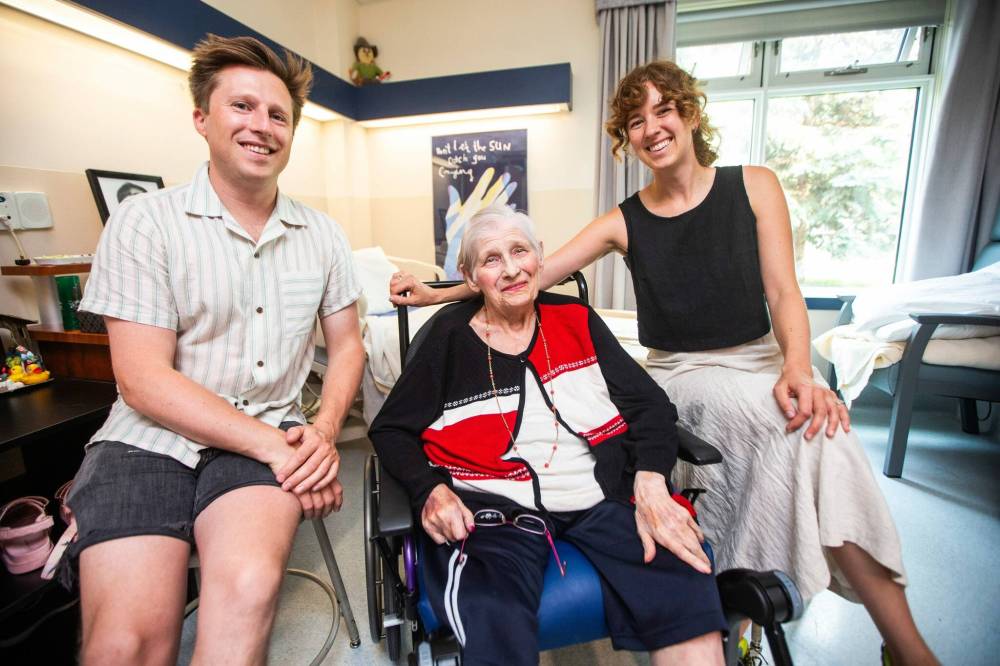
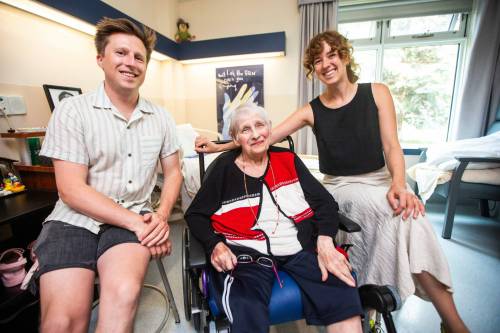
MIKAELA MACKENZIE / FREE PRESS
From left: Toby Gillies, Edith Almadi, and Natalie Baird are co-creators of Don’t Let the Sun Catch You Crying, an animated short film screening today at the Gimli Film Festival.
With a combination of watercolour and digitally-coloured drawings, the imagery swells with a loose viscosity, echoed gently by Almadi’s meditative sentences, which follow a free-flowing grammar liberated from expectation and traditional structure.
“This is just a memory,” she says. “I feel very, very much alive. I feel myself, very odd, I don’t know really what I mean with it, but I feel life — I feel to be alive, and not my age, no.”
“She’s able to hold the experience of losing her son with the enjoyment of seeing the sun through her window,” says Baird. “She has this incredible capacity to see both. In the film, she says, ‘As long as there is sun, there is morning, as long as there is moon there is night.’ Those things are present all the time, and they need each other to exist.”
From four hours of audio and several more of video recorded throughout the pandemic with the assistance of the personal care home team, the filmmakers chose to include the things Almadi said most often.
“We showed her every version of the script and the film, and in some cases, took video of her reaction because I think we needed validation that we were going in the right direction,” Baird says.
The film — scored by Gilad Carroll and Sam Sarty of Winnipeg shoegaze band Living Hour and local composer Andy Rudolph, who designed the sound with Kelsey Braun — resists sharing details about Almadi’s biography. Instead, the viewer meets Almadi exactly where she’s at.
“We wanted the film to feel like we’re entering into her world, imagination and experience. We wanted people to be carried away into her mind, to see themselves or someone they know within that,” says Gillies.
Baird and Gillies both dealt with the deaths of parents and grandparents as the filmmaking process went on.
“The most interesting thing was to have four years to talk together about grief and find universality between the three of us,” says Baird.
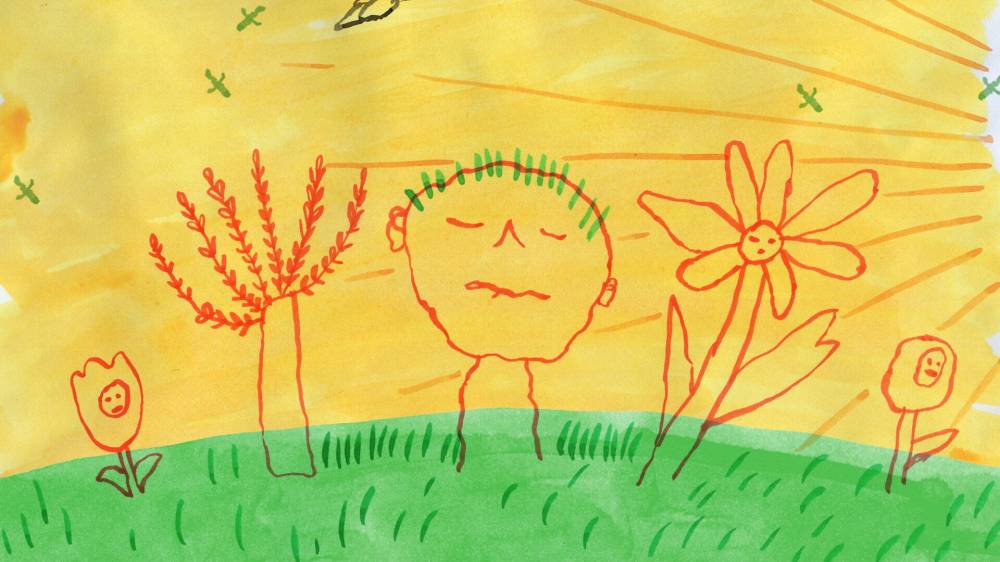
NATIONAL FILM BOARD OF CANADA STILL
A scene from Don’t Let the Sun Catch You Crying based on Almadi’s illustrative drawing style.
“My mother died just as the film was being released,” says Gillies. “I always knew what the film was about — feeling like you’re with someone only by having a thought of them. I saw Edith doing that the whole time, but not until my mother passed did I realize how good that can feel. I knew intellectually what the film was about, but now I really feel it in a different way.”

So far, the film has been an official selection at DOXA, the largest documentary film festival in Canada, the Ottawa International Animation Festival, and the LINOLEUM Contemporary Animation and Media Art Festival.
It screens at the Gimli International Film Festival today.
But the most memorable screening came this spring at the Misericordia Health Centre, where residents got to watch the film with students from nearby Mulvey School.
They rolled out a red carpet for Edith Almadi.
ben.waldman@winnipegfreepress.com
Ben Waldman is a National Newspaper Award-nominated reporter on the Arts & Life desk at the Free Press. Born and raised in Winnipeg, Ben completed three internships with the Free Press while earning his degree at Ryerson University’s (now Toronto Metropolitan University’s) School of Journalism before joining the newsroom full-time in 2019. Read more about Ben.
Every piece of reporting Ben produces is reviewed by an editing team before it is posted online or published in print — part of the Free Press‘s tradition, since 1872, of producing reliable independent journalism. Read more about Free Press’s history and mandate, and learn how our newsroom operates.
Our newsroom depends on a growing audience of readers to power our journalism. If you are not a paid reader, please consider becoming a subscriber.
Our newsroom depends on its audience of readers to power our journalism. Thank you for your support.
Movie preview
Don’t Let the Sun Catch You Crying
Gimli International Film Festival
• Today, 9 p.m.
• Shorts Program 1: Ties That Bind
• Gimli Lutheran Church Theatre
Tickets $15 at gimlifilm.com
Ben Waldman is a National Newspaper Award-nominated reporter on the Arts & Life desk at the Free Press. Born and raised in Winnipeg, Ben completed three internships with the Free Press while earning his degree at Ryerson University’s (now Toronto Metropolitan University’s) School of Journalism before joining the newsroom full-time in 2019. Read more about Ben.
Every piece of reporting Ben produces is reviewed by an editing team before it is posted online or published in print — part of the Free Press‘s tradition, since 1872, of producing reliable independent journalism. Read more about Free Press’s history and mandate, and learn how our newsroom operates.
Our newsroom depends on a growing audience of readers to power our journalism. If you are not a paid reader, please consider becoming a subscriber.
Our newsroom depends on its audience of readers to power our journalism. Thank you for your support.
Advertisement Advertise With Us
Advertisement Advertise With Us
History
Updated on Friday, July 26, 2024 8:13 AM CDT: Fixes typo in hed
Updated on Monday, July 29, 2024 11:52 AM CDT: Adds YouTube video.