Keeping the green glorious Golf course maintenance as much art as science for dedicated team
Read this article for free:
or
Already have an account? Log in here »
To continue reading, please subscribe:

Digital Subscription
One year of digital access for only $205*
- Enjoy unlimited reading on winnipegfreepress.com
- Read the E-Edition, our digital replica newspaper
- Access News Break, our award-winning app
- Play interactive puzzles
*First annual payment billed as $205.00 + GST for one year. This annual subscription will automatically renew at $233.00 + GST every 52 weeks (10% off the regular annual price of $259.35). Offer available to new and qualified returning subscribers only. Cancel any time.
To continue reading, please subscribe:
Add Free Press access to your Brandon Sun subscription for only an additional
$1 for the first 4 weeks*
- Enjoy unlimited reading on winnipegfreepress.com
- Read the E-Edition, our digital replica newspaper
- Access News Break, our award-winning app
- Play interactive puzzles
*Your next Brandon Sun subscription payment will increase by $1.00 and you will be charged $17.95 plus GST for four weeks. After four weeks, your payment will increase to $24.95 plus GST every four weeks.
Read unlimited articles for free today:
or
Already have an account? Log in here »
It’s 4:15 a.m. and but for the chirps of early birds, all is silent and still.
The majority of Winnipeggers are still fast asleep when Braydon Gilbert, 41, makes the 10–minute drive from his home to St. Charles Country Club, a 27-hole golf course hemmed in by a bend in the meandering Assiniboine River.
It seems far too early for a round of golf, but Gilbert isn’t going to play; he’s on his way to lead his team — composed of seven year-round senior staff and 31 seasonal employees — in the serious business of maintaining the manicured lawns on the 240-acre property in west Winnipeg nestled between the neighbourhoods of Westwood and Woodhaven.
Ruth Bonneville / Free Press Braydon Gilbert, St. Charles Country Club superintendent and greenskeeper, leads a dedicated team in keeping the greens at the club their most verdant.
During golf season, which runs from late April to mid-October, Gilbert and his senior team gather for their daily huddle at 4:45 a.m. to go through the day’s schedule.
“That’s when we fine-tune what our plan is for the day and tweak it if we need to, based on the weather,” he says. “I usually spend the first four to five hours of the morning out on the course with the staff, keeping an eye on what’s going on and helping out with some tasks.”
One of those tasks is making sure the grass is mowed before club members start trickling in at 7 a.m.
Gilbert’s daily mandate, among other things, is to ensure the millions of living organisms on the greens remain at just over a tenth of an inch.
It’s a measurement most people would be hard pressed to see without a microscope.
At a golf course, grass is more than just ground cover; it’s a precisely engineered, living patchwork of different types, lengths and varieties.
Grass type is selected based on key criteria, including the ability to withstand the local climate, and there are often two to three different botanical varieties planted across the course to suit the demands of the game.
“Grass types are divided into two categories: cool-season grass grown in northern climates and warm-season grass, typically used in climates like Florida. Here we use creeping bentgrass on our putting greens, tees and fairways,” Gilbert explains.
Three ways to a better lawn
Getting results in your own garden comes down to mastering the fundamentals and avoiding a couple of common mistakes. As golf superintendent Braydon Gilbert says, “focus on the basics.”
Getting results in your own garden comes down to mastering the fundamentals and avoiding a couple of common mistakes. As golf superintendent Braydon Gilbert says, “focus on the basics.”
1. Double your mowing frequency.
“Mow twice a week instead of once and you’ll get a little bit better density.”
2. Fertilize twice a year.
“A good time of year is right around the end of May or start of June, and then again right at the end of summer to get things growing in after any summer stress.”
3. Don’t cut too short before winter
“The biggest thing I see a lot of people do, especially around here, that I would advise against is mowing their lawn really, really short before winter. You don’t want to be going into winter really long, but don’t go too short either.”
The 240,000-square-foot of putting greens are mowed daily to ensure each blade length measures slightly above 2.54 millimetres.
This constant grooming forces a major shift in how the plant behaves. Unable to shoot upward, the grass adapts by spreading sideways.
It’s a horizontal canopy of tightly woven, super-packed grass, trimmed short to ensure a golf ball rolls smoothly and swiftly enough to interest and challenge golfers.
“When you mow turf more frequently, its natural response is to grow laterally and get more dense. Usually the ball stays on top of the turf, although occasionally, if there is a bit of a thinner area, it might touch the ground,” Gilbert says.
Tees and fairways are trimmed every three or four days at just under one centimetre (4/10 of an inch), while the remaining grass area, known as the rough, is Kentucky Bluegrass mowed at between five and 6.3 centimetres (two and 2 1/2 inches).
The steep faces of the sand bunkers have their own dedicated botanical resident: fine fescues, which require less grooming.
The mechanical infrastructure required to maintain this level of precision includes a fleet of around 60 pieces of specialized equipment, including ride-on and push mowers, backpack leaf blowers and string trimmers, all which come under the care of the equipment manager.
Ruth Bonneville / Free Press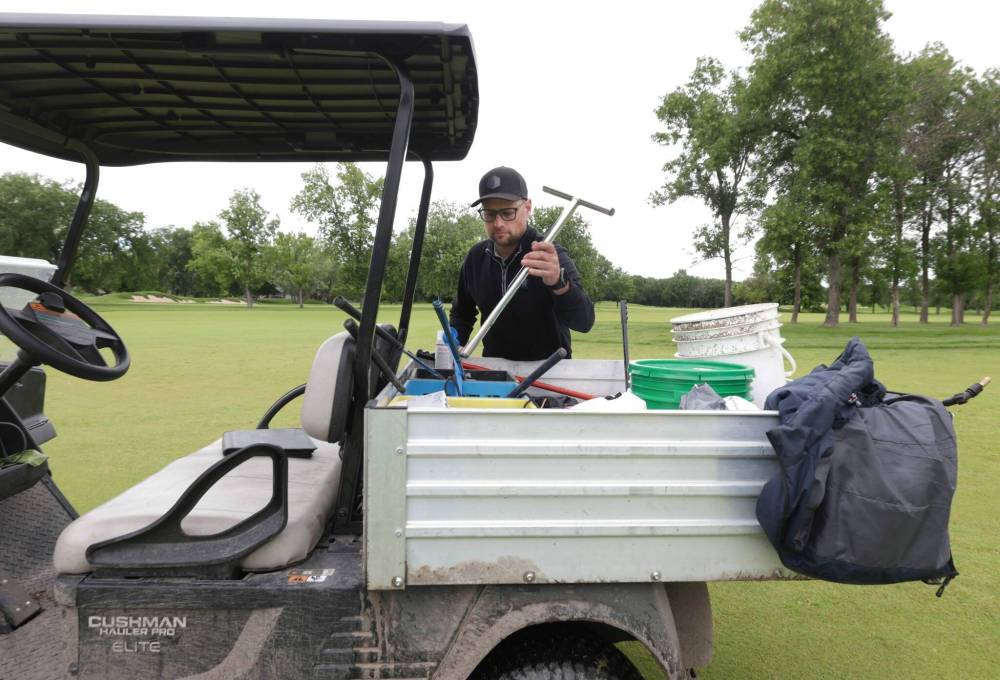
Turf is regularly fertilized. Staff apply granular pellets or liquid sprays packed with the “big three” nutrients: nitrogen, phosphorus and potassium. Once a year soil samples are sent to a lab for an annual checkup.
The entire operation is far more complicated than one might imagine.
“We’re taking a living thing, mowing it to an exact height and trying to keep it healthy, while also trying to create a good surface for people to play a game on.”
“The biggest thing that surprises people is how complex maintaining turf is,” Gilbert says. “We’re taking a living thing, mowing it to an exact height and trying to keep it healthy, while also trying to create a good surface for people to play a game on. It’s a pretty significant juggling act.”
And the hardest ball to keep in the air? The golfers themselves.
“I don’t mean this disrespectfully,” Gilbert continues with a laugh. “They’re here to play, of course. They don’t do it purposely but they’re walking on it, taking divots, making ball marks. Every time someone plays golf they damage the course.
“Making sure we can recover from that kind of activity is one of our biggest challenges.”
The other wild card Gilbert has to deal with is our climate.
Intensely hot days require moisture management. To conserve water, and keep out of the way of paying members, Gilbert runs a computerized irrigation system that kicks in after sunset when less water will be lost to evaporation.
But when the skies open and deliver swathes of rain, as they have done recently, then the city’s unique geography becomes a liability — Winnipeg’s ground is composed of heavy clay, which doesn’t drain as well as Gilbert would like.
Ruth Bonneville / Free Press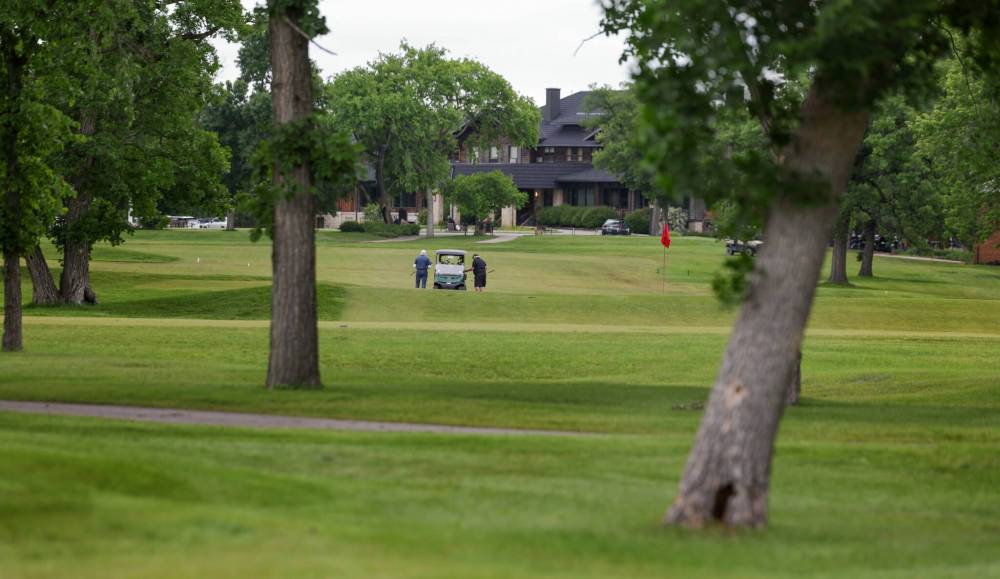
“You have to be careful with both mower and staff traffic, and golfer traffic when its really wet. You’re trying to route people around the golf course in a way that it doesn’t wear it out,” he says.
As the season begins to wind down in October, Gilbert and his team prep the turf for hibernation. Cutting heights are raised to give the grass a break, late-season nutrition is applied and, to increase insulation, a layer of sand is laid on vulnerable areas before being covered with a tarp.
Once winter sets in, Gilbert relies on a paradox: he needs the freezing cold to be accompanied by a heavy blanket of snow. Snow, counterintuitively, is a golf-course superintendent’s best friend.
“Snow is a pretty incredible insulator. If you get a foot of snow, temperatures can stay close to zero around the turf surface. That’s fine for the grass,” he explains.
However, while he can do everything right to set the golf course up to winter well, Mother Nature is still in charge.
“The worst-case scenario is a mid-winter melt followed by a sudden freeze.”
“The worst-case scenario is a mid-winter melt followed by a sudden freeze. If the temperature rises unexpectedly in February then plummets back into a hard freeze, that can be troublesome,” Gilbert says.
This total mastery over nature at his workplace is somewhat at odds with Gilbert’s own suburban yard, he admits.
“You definitely wouldn’t be able to judge my profession by my own lawn, I can tell you that. My wife and I take care of it together. It’s a team effort,” he says.
Ruth Bonneville / Free Press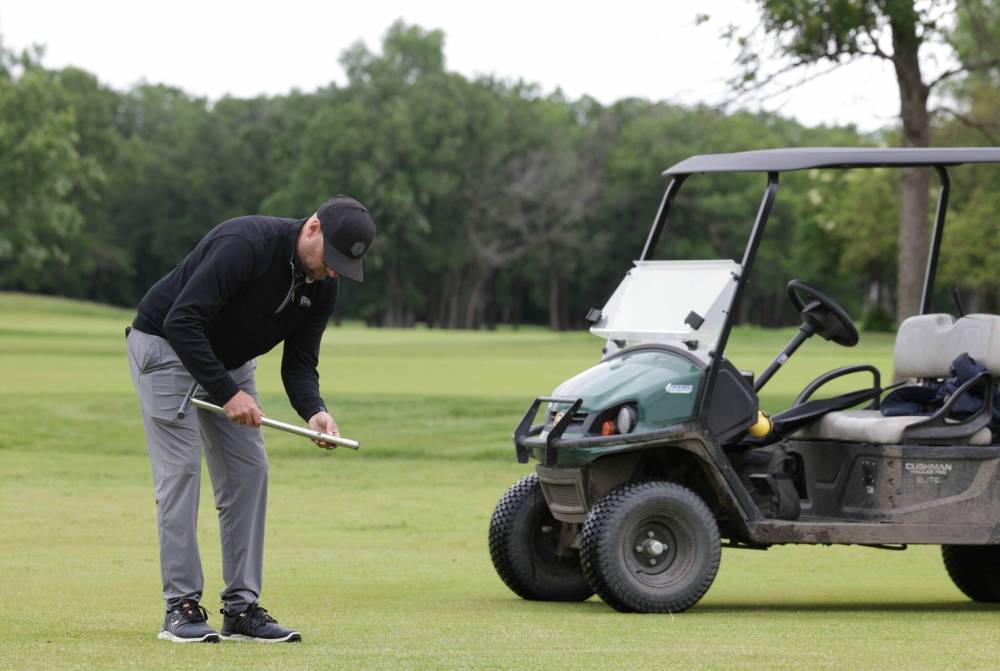
The Calgary native has been in the industry for 27 seasons, 14 of those as superintendent. His is a demanding career; early starts mean 9:30 p.m. bedtimes. He is constantly on the move, logging 15,000 steps a day when he’s using a cart and 25,000 when he decides he would rather walk the course.
The routine is gruelling and requires sacrifice. Six days a week, six months a year Gilbert has to strike the right work-life balance.
“It can certainly be challenging to balance everything. Sometimes I miss some weekend trips or other events, but I try very hard to make it to as much as possible,” he says, pointing out that in winter he can take some time off the job.
“You definitely wouldn’t be able to judge my profession by my own lawn, I can tell you that.”
He’s driven by a genuine passion for what he does. No two days are the same.
“It’s constantly changing, it’s very dynamic. That’s what keeps you on your toes,” he says.
“I love this job; I don’t know too many guys in the industry who don’t. We’re a small, tight-knit community and I think we’re all a little bit infatuated with it. You almost have to be to do it.”
winnipegfreepress.com/avkitching

AV Kitching is an arts and life writer at the Free Press. She has been a journalist for more than two decades and has worked across three continents writing about people, travel, food, and fashion. Read more about AV.
Every piece of reporting AV produces is reviewed by an editing team before it is posted online or published in print — part of the Free Press‘s tradition, since 1872, of producing reliable independent journalism. Read more about Free Press’s history and mandate, and learn how our newsroom operates.
Our newsroom depends on a growing audience of readers to power our journalism. If you are not a paid reader, please consider becoming a subscriber.
Our newsroom depends on its audience of readers to power our journalism. Thank you for your support.