Illuminating a new path L.A. architect's open, expansive and transparent design shines brilliant light on Qaumajuq's astonishing collection of Inuit art — and WAG's commitment to reconciliation
Read this article for free:
or
Already have an account? Log in here »
To continue reading, please subscribe:
Digital Subscription
One year of digital access for only $1.44 a week*
- Enjoy unlimited reading on winnipegfreepress.com
- Read the E-Edition, our digital replica newspaper
- Access News Break, our award-winning app
- Play interactive puzzles
*Billed as $5.77 plus GST every four weeks. After 52 weeks, price increases to the regular rate of $19.95 plus GST every four weeks. Offer available to new and qualified returning subscribers only. Cancel any time.
To continue reading, please subscribe:
Add Free Press access to your Brandon Sun subscription for only an additional
$1 for the first 4 weeks*
- Enjoy unlimited reading on winnipegfreepress.com
- Read the E-Edition, our digital replica newspaper
- Access News Break, our award-winning app
- Play interactive puzzles
*Your next Brandon Sun subscription payment will increase by $1.00 and you will be charged $17.95 plus GST for four weeks. After four weeks, your payment will increase to $24.95 plus GST every four weeks.
Read unlimited articles for free today:
or
Already have an account? Log in here »
Hey there, time traveller!
This article was published 19/03/2021 (2043 days ago), so information in it may no longer be current.
Qaumajuq, the name given to the new Inuit art centre by a circle of Indigenous language keepers, is an Inuktitut word meaning “it is bright, it is lit.” Light is the defining quality of this open, expansive structure, designed by Los Angeles-based Michael Maltzan Architecture.
There is the light that streams through an undulating, south-facing wall of glass, dissolving the division between interior and exterior, between the centre and the city streets.

There is the light that funnels through 22 adjustable skylights in the main gallery, flooding this high-ceilinged 8,000-square-foot exhibition space with natural illumination.
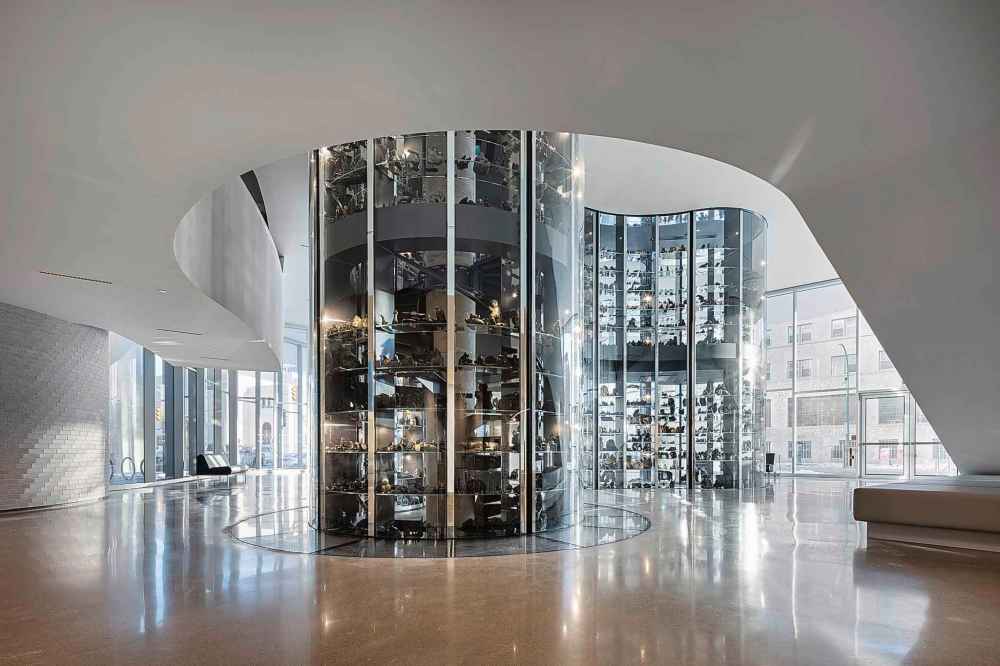
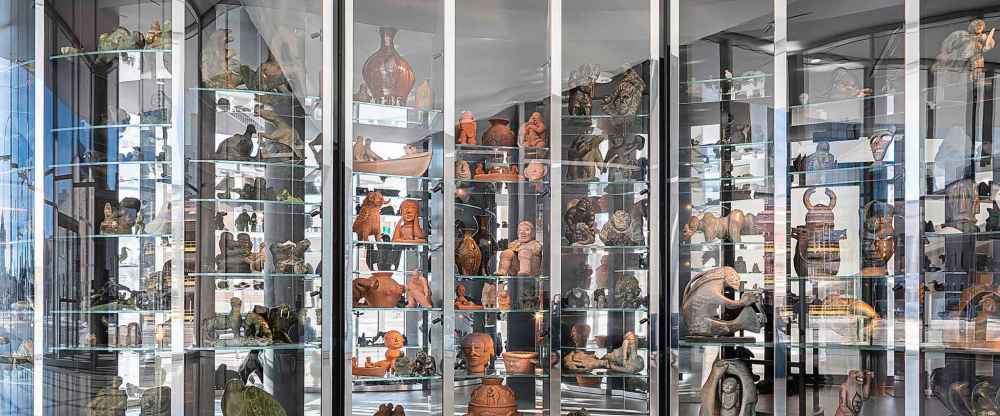
There is the light that moves through the curving glass walls of the new Visible Vault. Starting in the basement and rising up two levels, this transparent tower gives direct visual access to almost 5,000 carvings that might otherwise have been stowed in closed-off underground storage areas.
“The naming circle honed in on the light in Michael’s design,” says Stephen Borys, director and CEO of the Winnipeg Art Gallery, as he conducts an in-person walkthrough of the new building.

That sense of brightness, openness and visibility has an immediate esthetic effect. With its extensive use of glass, the structure interacts with the distinctive quality of northern prairie light as it shifts over the course of a day and through the changing seasons.

It’s also functional. Countering the older museum model of closed-in rooms with artificial lighting, the decision to illuminate the main gallery with natural light enhances viewer experience.
(Sunlight is thought to combat “museum fatigue,” the phenomenon of visitors becoming physically tired and mentally enervated as they move through big exhibitions.)
Just as importantly, light signals Qaumajuq’s commitment to transparency, as museums around the world try to find new ways to present and contextualize Indigenous art. As Borys suggests, “The light exposes what we are doing now. It helps to keep us honest and responsible.
“It uncovers rights and wrongs.”
Qaumajuq connects to the main Winnipeg Art Gallery, the late-modernist landmark designed by Gustavo da Roza, but it’s not just an addition. It’s a distinct structure in dialogue with the original, responding to but not replicating it.
The 1971 WAG structure, with its dynamic and dramatic angled faces, was built at a time when museums were often thought of as fortresses, protecting the precious objects they stored. Maltzan’s structure, with its open expanses of glass, reflects more recent trends in museum practice, as institutions look for new ways to bring in audiences and connect with their cities’ communities.
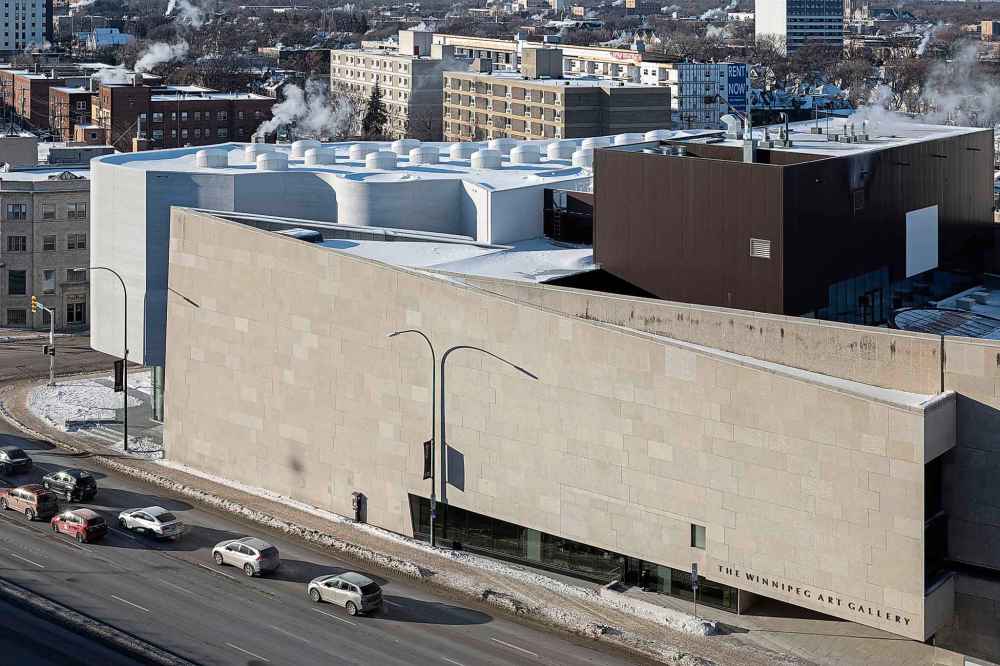
“For Michael, there’s Gus’s building and there’s his building, but it’s more than just two buildings side by side,” says Borys.
“Michael’s building respects and acknowledges Gus’s building. It fits in.”
There are sensitive echoes of the original. Qaumajuq’s entrance hall — given the Inuktitut name Ilavut, which means “our relatives” —soars to precisely the same height as the corresponding ceiling in Eckhardt Hall. The two structures connect on all levels, so that visitors can easily move between them, and this connection is reinforced by long vistas and by unexpected views, such as a window that frames a juncture between da Roza’s hard-edged lines of Tyndall stone and Maltzan’s curves of granite.
Along the Memorial Boulevard side, the newly renovated gallery shop is a transition between the two structures, with new angled windows cut into the original wall, drawing in passersby.
Tucked between the southern “wings” of the original WAG, Qaumajuq has a much smaller footprint than the main building, but it opens things up visually, with that welcoming ribbon of glass topped by organic waves of white granite bricks. With complex convex and concave lines and a refracting, subtly irregular surface, the granite wall suggests banks of snow carved by the wind.

The added 36,000 square feet of the new building means that curators can do more with the WAG-Qaumajuq’s Inuit art collection, the largest public collection of contemporary Inuit art in the world. But it’s not just about doing more: it’s about doing it differently. For Borys, Qaumajuq asks an important question: “How do you exhibit Inuit art now, when it’s been exhibited one way for such a long time?
“It’s about rethinking, reworking, and, as (WAG Indigenous Advisory Circle co-chair) Julie Nagam says, ‘unpacking’ the colonialist way art is presented in North America. It’s a way of responding to the TRC’s (Truth and Reconciliation Commission) calls to action,” he continues.
“It’s not a regime change but a rethinking of voices and representation.”
Along with a curving mezzanine gallery, designed to showcase more focused and intimate exhibitions, there’s the central gallery, called Qilak for the Inuktitut word for “sky,” with its soaring nine-metre-high ceilings. “Michael wanted to reference the space, the light and the scale of the North,” Borys explains.
The three-level tower of the Visible Vault is an engineering component, its steel frame helping to support the gallery levels. But there’s a spiritual dimension, as well.
“For Inuit elders, many of these objects are animate. When they’re taken from an underground vault and up into the light, they come alive,” Borys says.
Maltzan’s design looks out to the city and invites the city in. “For the first time the WAG and some of what we do is exposed,” says Borys. “People can see what’s going on, and I think that will increase accessibility.”
The new building “helps create a cultural campus, with layers of programming — research, study, teaching,” he says. “Art still leads, but there are other things happening.”
There’s the expanded gallery shop, a new main-floor café along with green space for gathering outside, and a steeped 85-seat theatre that can be completely open to the street or closed off with a custom-made curtain.

Borys is excited to see how people will interact with these new spaces, how they will respond to the art, and how Qaumajuq, as a cultural and communal centre, might evolve and change over time.
“The building is done,” Borys says. “But the reconciliation process is just beginning.”
alison.gillmor@freepress.mb.ca

Studying at the University of Winnipeg and later Toronto’s York University, Alison Gillmor planned to become an art historian. She ended up catching the journalism bug when she started as visual arts reviewer at the Winnipeg Free Press in 1992.
Our newsroom depends on a growing audience of readers to power our journalism. If you are not a paid reader, please consider becoming a subscriber.
Our newsroom depends on its audience of readers to power our journalism. Thank you for your support.


History
Updated on Friday, March 19, 2021 8:46 PM CDT: Fixes typo.