Jewish love story painted in bittersweet strokes

Advertisement
Read this article for free:
or
Already have an account? Log in here »
To continue reading, please subscribe:

Digital Subscription
One year of digital access for only $205*
- Enjoy unlimited reading on winnipegfreepress.com
- Read the E-Edition, our digital replica newspaper
- Access News Break, our award-winning app
- Play interactive puzzles
*First annual payment billed as $205.00 + GST for one year. This annual subscription will automatically renew at $233.00 + GST every 52 weeks (10% off the regular annual price of $259.35). Offer available to new and qualified returning subscribers only. Cancel any time.
To continue reading, please subscribe:
Add Free Press access to your Brandon Sun subscription for only an additional
$1 for the first 4 weeks*
- Enjoy unlimited reading on winnipegfreepress.com
- Read the E-Edition, our digital replica newspaper
- Access News Break, our award-winning app
- Play interactive puzzles
*Your next Brandon Sun subscription payment will increase by $1.00 and you will be charged $17.95 plus GST for four weeks. After four weeks, your payment will increase to $24.95 plus GST every four weeks.
Read unlimited articles for free today:
or
Already have an account? Log in here »
Hey there, time traveller!
This article was published 16/06/2022 (1556 days ago), so information in it may no longer be current.
At one point in Daniel Jamieson’s play The Flying Lovers of Vitebsk, artist Marc Chagall (Daniel Greenberg) is seen rebelling against the stodgy artists in his native Russian community of Vitebsk, saying that if he wants to paint green cows, he will paint green cows. (Chagall indeed took the green cow as his personal emblem.)
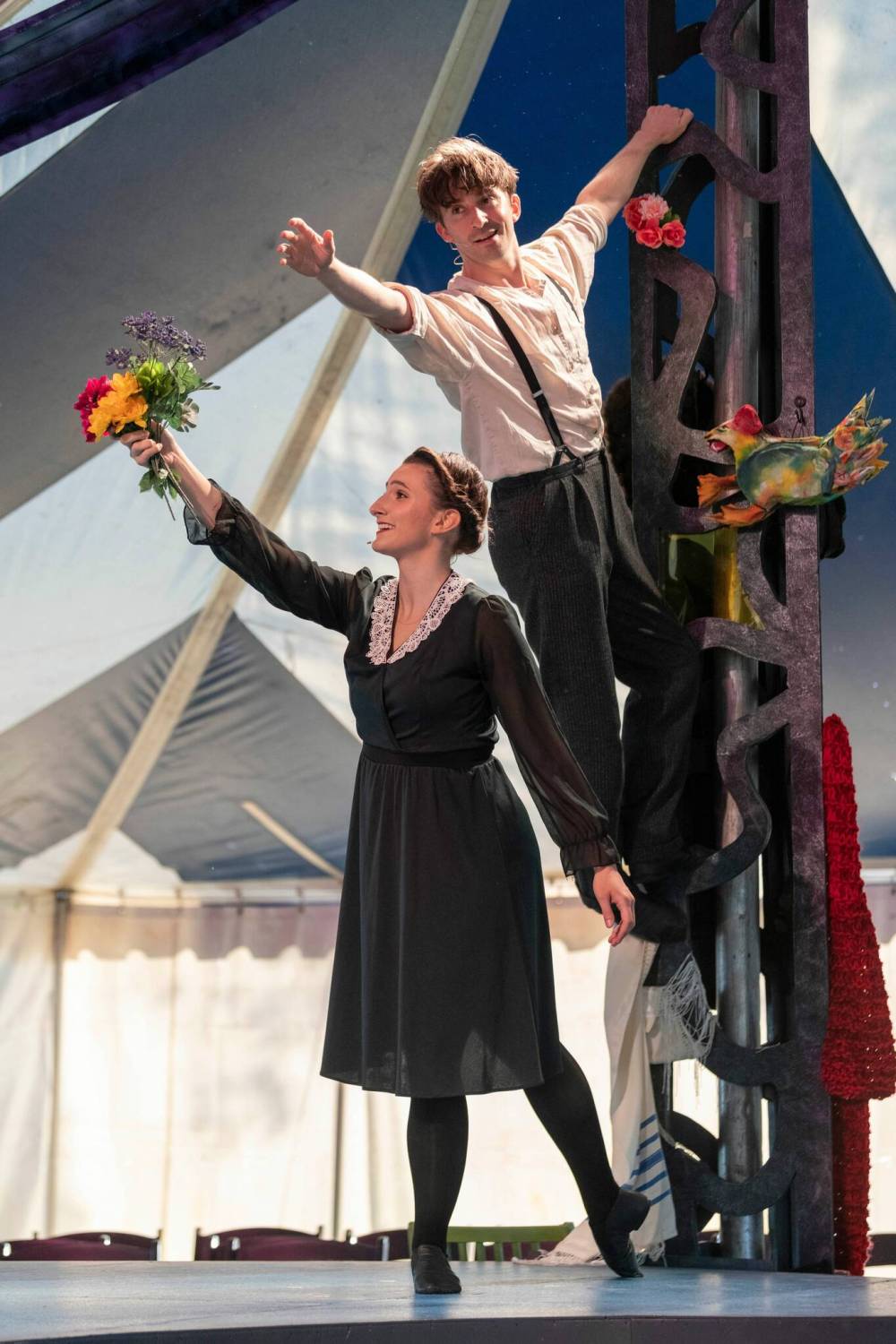
Directed by Ari Weinberg, Jamieson‘s play proceeds with the same kind of counter-intuitive insistence. The play does not project Chagall’s expressionist paintings onto the stage, as we might expect. (For that experience, head off to Beyond Van Gogh at the RBC Convention Centre in July.) Instead, this work, examining Chagall’s love affair with his wife Bella, emulates Chagall’s style through other means, his elegant curves and circles made manifest by a theatre-in-the-round presentation, or in the balletic dance moves between Marc and Bella (Isidora Kecman).
So, yes, the play assumes audience familiarity with the works of Chagall. At the same time, it follows its own rules when it comes to its obligations to convention. For example, this is a musical with only one substantial song over its 75-minute running time (without intermission). But a beautiful song it is, sung in English and Yiddish, written by English composer Ian Ross (not to be confused with the Winnipeg playwright of the same name).
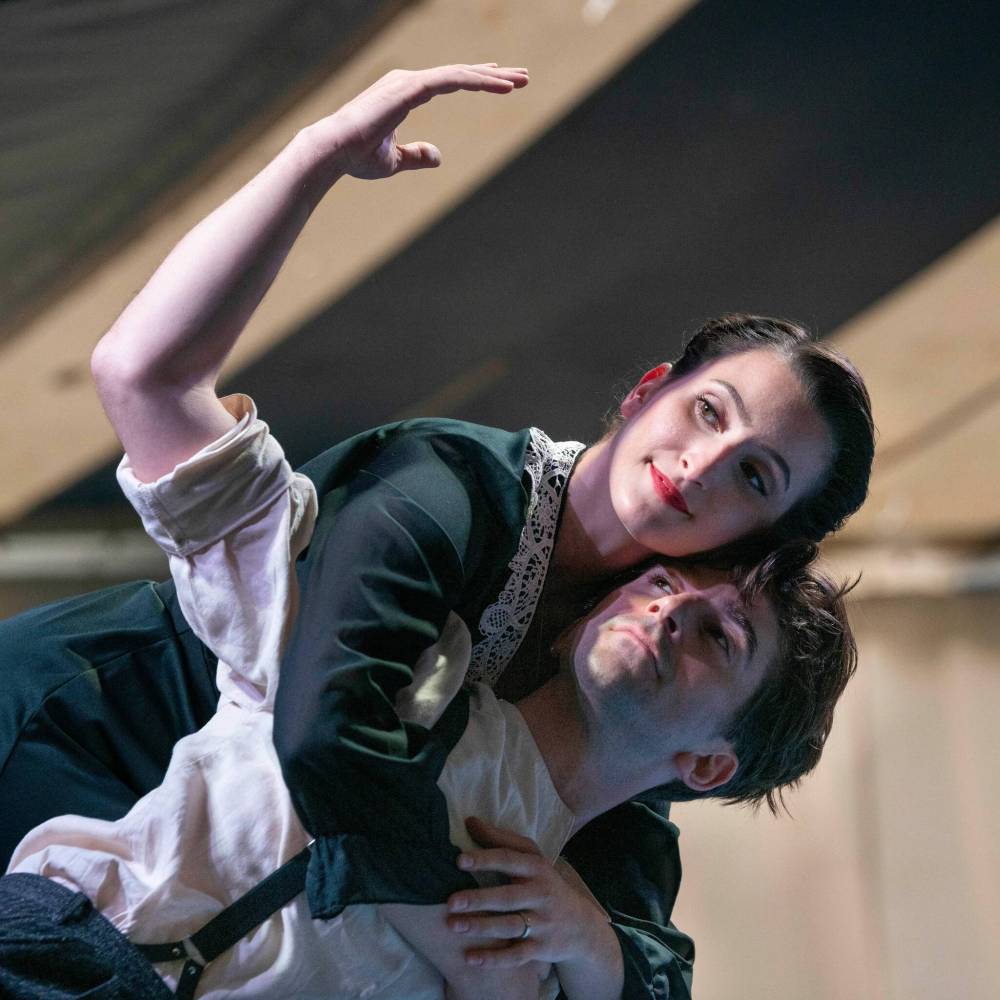
Bittersweet music permeates throughout, courtesy of music director Michael Doherty on keyboards and cellist Tayah Plett. And bittersweet is the proper tone for a story of Jewish lovers living through the early 20th century, encompassing the Russian Revolution and the Holocaust, with Marc and Bella on the move constantly. It is no wonder suitcases are an important design motif here, pressed into service as a cradle or a phone table or a dance floor.
But of course, eyes will mostly be on the performers, both arrestingly beautiful themselves. (Chagall, who died in 1985, would doubtless approve.)
While Chagall painted himself and Bella as transcendent, gravity-defying lovers, the truth was that they did have their share of earthly issues, notably Bella’s ambitions to be a writer, thwarted by Chagall’s focus on his own career.
Weinberg and choreographer Sarah Topham had their work cut out for them designing the play in the round in a tent locale outside the Asper Jewish Community Campus. While they succeed in meeting the logistic challenges, it feels like an attempt to make the material feel like light summer fare, and that has the effect of diminishing the gravity of the piece. It’s kind of like watching an art film at the drive-in.
Proof of vaccination is required to attend.
❏ ❏ ❏
On Wednesday morning, Weinberg announced via Facebook that he is leaving his job as artistic director of Winnipeg Jewish Theatre as of July 15 after stewarding the organization for seven years.
“I have accepted an exciting new dream position at a theatre company in Ontario,” Weinberg wrote.
“The past seven years have been filled with great creative fulfilment, tremendous joy, and a true sense of community.
“While I can’t disclose the full details just yet, it is bittersweet because I have loved my time in Winnipeg, being a part of these communities, and the friends I have made,” he said.
Twitter: @FreepKing
Our newsroom depends on a growing audience of readers to power our journalism. If you are not a paid reader, please consider becoming a subscriber.
Our newsroom depends on its audience of readers to power our journalism. Thank you for your support.
Theatre Review
The Flying Lovers of Vitebsk
By Daniel Jamieson
Winnipeg Jewish Theatre
To June 19
Tickets at wjt.ca
★★★ 1/2 stars out of five
Our newsroom depends on a growing audience of readers to power our journalism. If you are not a paid reader, please consider becoming a subscriber.
Our newsroom depends on its audience of readers to power our journalism. Thank you for your support.
Advertisement Advertise With Us
Advertisement Advertise With Us