The opposite of Instagram

Winnipeg's Pinhole Artist Collective goes back to basics to recapture some of photography's unruly charm

Advertisement

Advertise with us

I'll admit that I have a sentimental attachment to "traditional" (analog, film-based) photography, but I can't pretend the transition to digital hasn't been a positive one -- for the most part.

Read this article for free:


or

Already have an account? Log in here »

To continue reading, please subscribe:

Subscribe and receive a limited-edition Free Press branded hat or tote.

Digital Subscription

One year of digital access for only $205*

  • Enjoy unlimited reading on winnipegfreepress.com
  • Read the E-Edition, our digital replica newspaper
  • Access News Break, our award-winning app
  • Play interactive puzzles

*First annual payment billed as $205.00 + GST for one year. This annual subscription will automatically renew at $233.00 + GST every 52 weeks (10% off the regular annual price of $259.35). Offer available to new and qualified returning subscribers only. Cancel any time.

To continue reading, please subscribe:

Add Free Press access to your Brandon Sun subscription for only an additional

$1 for the first 4 weeks*

  • Enjoy unlimited reading on winnipegfreepress.com
  • Read the E-Edition, our digital replica newspaper
  • Access News Break, our award-winning app
  • Play interactive puzzles
Start now

*Your next Brandon Sun subscription payment will increase by $1.00 and you will be charged $17.95 plus GST for four weeks. After four weeks, your payment will increase to $24.95 plus GST every four weeks.

Opinion

Hey there, time traveller!
This article was published 24/01/2013 (4960 days ago), so information in it may no longer be current.

I’ll admit that I have a sentimental attachment to “traditional” (analog, film-based) photography, but I can’t pretend the transition to digital hasn’t been a positive one — for the most part.

My grandmother had a black-and-white darkroom in the attic of her house in upstate New York that we’d visit most summers, accessible by way of a three-metre ladder. I did my own black-and-white processing and printing through high school. I miss skulking around under the red and amber safelights, watching images materialize as if by magic in shallow, smelly chemical baths. I miss the post-vacation ritual of picking up the drugstore prints, tearing open the envelope in the back seat, uncertain and excited to see what turned out.

I think I last had film developed 10 years ago.

Submitted
Winnipeg’s Pinhole Artist Collective goes back to basics to recapture some of photography’s unruly charm. Pictured: Open, by Lori Fontaine.
Submitted Winnipeg’s Pinhole Artist Collective goes back to basics to recapture some of photography’s unruly charm. Pictured: Open, by Lori Fontaine.

Digital is cheap, immediate, leaves comparably little to either skill or chance, and perfectly suits the way most of us actually use photographs on a daily basis, and if you’re feeling nostalgic, there are apps and filters to add back in the scratches, light-leaks, and wonky colouring that digital SLRs and cellphone cams erased.

I can acknowledge the benefits of leaving film behind, but some things did get lost in the transition that Instagram can’t quite replace. In hopes of recovering them, the Pinhole Artists Collective — a rotating crew of notable Winnipeg photographers whose current exhibition at Platform Centre, be.still, coincides with the launch of their book, Collecting Light — return to some of photography’s earliest, most basic forms.

Any light-proof box with a hole on one side to serve a rudimentary lens can be a camera, whether it’s an oatmeal canister or a spare bedroom (I’ve done it with both because I make my own fun.) Light passes through the “lens” and lands on the opposite wall as a perfect, projected image of whatever’s outside. Put a piece of light-sensitive film or paper in its path, and you’ve made a photograph. It’s basic physics; it’s bonkers, and its simplicity and directness are what lend analog photography its unique, almost “magical” aura of authenticity.

Members of the collective use self-made “pinhole cameras” based on these principles to create lasting documents of the world around them. The images featured in the show are everyday scenes of buildings, plants and landscapes, but the idiosyncrasies of the crude devices used to make them yield surprising results. Buckles in the film result in funhouse-mirror distortions and reflections, while stray beams of light create streaks and haloes of vivid colour. Long exposure times and imperfect optics make for dreamlike blurring effects and stuttering double-exposures, and, for the most part, this is all well beyond the photographer’s control.

The exhibition is, in essence, a collection of happy and genuinely satisfying accidents, but the book features images that are even more surprising. “Solargraphs,” made with pinhole cameras wedged among tree branches or duct-taped to eavestroughs, “capture light” for weeks or even months. The exposures are so long that you see not just the trail of the sun as it passes, but an array of arcing bands that show its changing height in the sky across whole seasons.

Submitted
Winter, by William Eakin
Submitted Winter, by William Eakin

If all this just seems needlessly antiquated (to say nothing of inefficient), that’s fair enough. For the rest of us nerds, there’s a workshop to make our own solargraph cameras on Feb. 2 — and again in September to see how the pictures turn out.


Steven Leyden Cochrane is an Winnipeg-based artist, writer, and educator from Tampa, Fla.
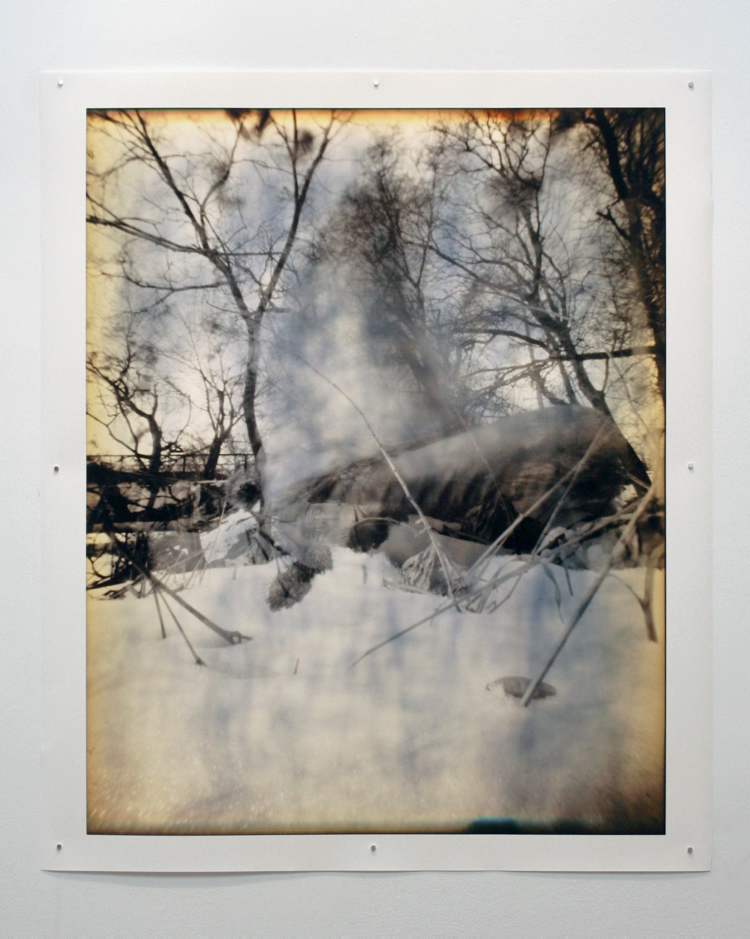
Submitted
Omand's Creek, by Sarah Crawley
Submitted Omand's Creek, by Sarah Crawley
Submitted
Ruins, by Jen Loewen
Submitted Ruins, by Jen Loewen
History

Updated on Friday, January 25, 2013 11:18 AM CST: Adds colour photographs.

Report Error Submit a Tip

More Stories

Executive exodus continues at Shared Health with three recent departures

Chris Kitching 5 minute read Preview

Executive exodus continues at Shared Health with three recent departures

Chris Kitching 5 minute read Updated: Yesterday at 10:15 AM CDT

Manitoba’s provincial health authority is looking for its fourth chief financial officer since 2023 and additional replacements after the recent departures of three executives.

Read
Updated: Yesterday at 10:15 AM CDT

‘We got attacked’: Carney says retaliatory tariffs on U.S. to take effect next month

Catherine Morrison and David Baxter, The Canadian Press 8 minute read Preview

‘We got attacked’: Carney says retaliatory tariffs on U.S. to take effect next month

Catherine Morrison and David Baxter, The Canadian Press 8 minute read Saturday, Aug. 22, 2026

OTTAWA - Prime Minister Mark Carney says retaliatory tariffs will hit the U.S. starting next month after Canada walked away from what he called a "bad deal."

The U.S. introduced new 50 per cent tariffs on billions of dollars in Canadian exports on Saturday after trade talks failed.

"We got attacked," Carney told reporters on Parliament Hill Saturday when asked about the escalating trade war.

Carney suspended talks with the United States late Friday and summoned his negotiators back to Ottawa.

Read
Saturday, Aug. 22, 2026

Downtown Rudy’s restaurant announces closure

1 minute read Yesterday at 1:55 PM CDT

A downtown eatery has announced its closure.

Rudy's Eat and Drink, located on the main floor of the Manitoba Hydro building at 375 Graham Ave., posted on social media that the restaurant would be closing after "one last hurrah" on Friday, Aug. 21.

"With heavy hearts it is time to announce that Rudy’s will officially be closing its doors after an incredible 15 years," the post reads.

The post gave no reason for the closure. Rudy's and other restaurants in the building expressed concerns after an assault and resulting lockdown at Hydro Place in late January.

The opposite of Instagram

By Steven Leyden Cochrane 4 minute read Preview

The opposite of Instagram

By Steven Leyden Cochrane 4 minute read Friday, Jan. 25, 2013

I'll admit that I have a sentimental attachment to "traditional" (analog, film-based) photography, but I can't pretend the transition to digital hasn't been a positive one -- for the most part.

My grandmother had a black-and-white darkroom in the attic of her house in upstate New York that we'd visit most summers, accessible by way of a three-metre ladder. I did my own black-and-white processing and printing through high school. I miss skulking around under the red and amber safelights, watching images materialize as if by magic in shallow, smelly chemical baths. I miss the post-vacation ritual of picking up the drugstore prints, tearing open the envelope in the back seat, uncertain and excited to see what turned out.

I think I last had film developed 10 years ago.

Digital is cheap, immediate, leaves comparably little to either skill or chance, and perfectly suits the way most of us actually use photographs on a daily basis, and if you're feeling nostalgic, there are apps and filters to add back in the scratches, light-leaks, and wonky colouring that digital SLRs and cellphone cams erased.

Read
Friday, Jan. 25, 2013

Results Canada fights for the political will to end global poverty

AV Kitching 9 minute read Preview

Results Canada fights for the political will to end global poverty

AV Kitching 9 minute read 6:00 AM CDT

Sitting at home on a wintry day in March last year, Japneet Singh listened intently as members of grassroots advocacy organization Results Canada began their online presentation on the prevalence of tuberculosis in rural India.

Singh knew all about the reality of the disease. Before he moved to Canada in 2013 he had seen family members affected by the bacterial infection which, in its active form, can damage the lungs, spine, brain and kidneys.

Despite being preventable and curable, TB persists among marginalized groups and is closely linked with those experiencing extreme poverty.

The highly infectious disease spreads quickly through transient populations facing housing insecurity and those living in overcrowded homes.

Read
6:00 AM CDT

Five Things: PM Carney explains why Canada left the U.S. negotiating table

David Baxter, The Canadian Press 5 minute read Preview

Five Things: PM Carney explains why Canada left the U.S. negotiating table

David Baxter, The Canadian Press 5 minute read Saturday, Aug. 22, 2026

OTTAWA - Canada is preparing to hit the U.S. with dollar-for-dollar tariffs in response to new 50 per cent duties on $28 billion worth of Canadian products that took effect when talks between the two nations collapsed as negotiations neared the finish line. 

Prime Minister Mark Carney was quiet publicly during the final days of negotiations, but now has now explained his rationale for telling the Canadian negotiating team, led by Canada-U.S. Trade Minister Dominic LeBlanc and chief negotiator Janice Charette, to leave the table.

Restrictions on further trade deals

"The U.S. Introduced at the last hours, in the last hours, efforts to restrict our ability to have other trade deals. You heard me say a moment ago, what we've accomplished in the past year, 20 new deals, economic and security partnerships, the prospect of doubling our market access because we believe in free trade. We're the partner of choice in many respects for countries around the world and the Americans wanted to restrict that. They had language that what they wanted to restrict that, unacceptable," Carney said during a press conference on Parliament Hill.

Read
Saturday, Aug. 22, 2026