Unflinchingly human, unfulfilled humanity
Compelling Jerusalem-set drama picks up the gruesome pieces after terror, but heart is mostly missing

Advertisement
Read this article for free:
or
Already have an account? Log in here »
To continue reading, please subscribe:

Digital Subscription
One year of digital access for only $205*
- Enjoy unlimited reading on winnipegfreepress.com
- Read the E-Edition, our digital replica newspaper
- Access News Break, our award-winning app
- Play interactive puzzles
*First annual payment billed as $205.00 + GST for one year. This annual subscription will automatically renew at $233.00 + GST every 52 weeks (10% off the regular annual price of $259.35). Offer available to new and qualified returning subscribers only. Cancel any time.
To continue reading, please subscribe:
Add Free Press access to your Brandon Sun subscription for only an additional
$1 for the first 4 weeks*
- Enjoy unlimited reading on winnipegfreepress.com
- Read the E-Edition, our digital replica newspaper
- Access News Break, our award-winning app
- Play interactive puzzles
*Your next Brandon Sun subscription payment will increase by $1.00 and you will be charged $17.95 plus GST for four weeks. After four weeks, your payment will increase to $24.95 plus GST every four weeks.
Read unlimited articles for free today:
or
Already have an account? Log in here »
Hey there, time traveller!
This article was published 01/04/2022 (1630 days ago), so information in it may no longer be current.
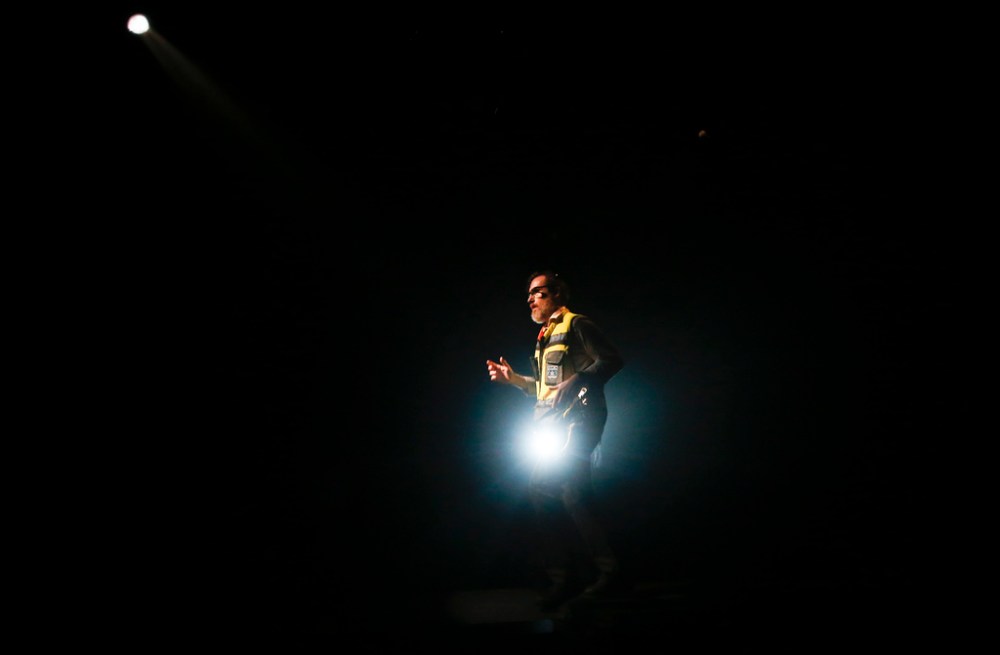
The Runner, the season-closing drama at the Tom Hendry Warehouse, grabs the audience’s senses before it even begins. A haze of theatrical smoke gives the room a post-disaster air and the stage is forebodingly shrouded in darkness.
When the lights go up, it’s to spotlight a solitary bearded man wearing a yarmulke and a fluorescent hazard vest, high above the floor. In the blackness, it takes a moment to realize the platform he’s on is a long treadmill; he slips out of the small pool of light as it moves him ever backward.
The man, Jacob (played by The Runner’s author, Toronto’s Christopher Morris), is a volunteer for ZAKA, the Orthodox Jewish first-responder organization (the full name is ZAKA, Identification, Extraction, Rescue — True Kindness) in Jerusalem. Its members rush to the scenes of terrorist attacks, bombings, disasters or accidents to provide first aid, but also to collect the viscera of Jewish bodies — every drop of blood, every scrap of skin — in order that they may be buried whole.

The “true kindness” element of the moniker refers to the fact that ensuring a proper burial for the dead is the ultimate mitzvah, a good deed for which it is impossible to be thanked by the recipient.
Jacob is disoriented, struggling to understand where he is. As he attempts to reconstruct events, walking slowly on the treadmill, he recalls a turning point, a mission where he chose to save the life of “an Arab girl,” as he calls her, rather than tending to the body of a dead Israeli soldier.
The girl, who had been shot in the back, may have killed the soldier, but Jacob followed his heart — and the Hippocratic oath — and put his efforts into helping the person he could save.
The fallout from this act — not one of kindness, but of simple humanity — finds Jacob questioning whether goodness is really an innate human quality, or if our tendencies toward tribalism and bigotry mean we’re truly barbarous at our cores.
As he attempts to answer that question, others are inevitably raised, and Jacob finds his own outlook shifting.
The one-man show, about 70 minutes without intermission, is undeniably gripping, but the dramatic, meticulous lighting by Bonnie Beecher, the frantic, unpredictable speed of the treadmill on Gillian Gallow’s set and Alexander MacSween’s minimal soundtrack — sharp stabs of strings — all effectively signal us to feel emotions that aren’t always borne out by the content.
The Runner is designed to make audiences think, but where it’s less successful is in making us feel. The issues it addresses — Islamophobia, antisemitism, Zionism, homophobia — are weighty and important, but presented with well-trodden truisms and two-sides-to-every-story balance. The stories Jacob recounts are both harrowing and thought-provoking, but while they feel freighted with import, they don’t connect in a personal way.

Where The Runner works best is not in the heightened moments of terror or horror (and be warned, these are often graphic and necessarily upsetting) but the quieter moments where Morris lets us see Jacob’s life, a sad, constrained existence with little real joy. The playwright/actor seamlessly slips into the skins of the secondary characters with subtle but distinct portrayals.
After the death of his father — movingly if briefly described — his family moved from London to Jerusalem, where his brother has embraced his birthright, living in a settlement within sight of Ramallah.
His mother, with whom Jacob lives, laments his lack of girlfriend and her subsequent lack of grandchildren; she’s blind to the fact that Jacob is never going to date any of the unsuitable women she finds for him. Their fraught relationship is nonetheless loving, and a moment when Jacob recalls rubbing her feet, swollen like cauliflowers, is very affecting.
The Runner’s momentum is compelling, but more of these small, intimate stories would make its heart beat more strongly.
jill.wilson@winnipegfreepress.com
Jill Wilson is the editor of the Arts & Life section. A born and bred Winnipegger, she graduated from the University of Winnipeg and worked at Stylus magazine, the Winnipeg Sun and Uptown before joining the Free Press in 2003. Read more about Jill.
Jill oversees the team that publishes news and analysis about art, entertainment and culture in Manitoba. It’s part of the Free Press‘s tradition, since 1872, of producing reliable independent journalism. Read more about Free Press’s history and mandate, and learn how our newsroom operates.
Our newsroom depends on a growing audience of readers to power our journalism. If you are not a paid reader, please consider becoming a subscriber.
Our newsroom depends on its audience of readers to power our journalism. Thank you for your support.
Theatre review
The Runner
RMTC Warehouse
To April 16
Tickets at royalmtc.ca
★★★1/2 out five
Jill Wilson is the editor of the Arts & Life section. A born and bred Winnipegger, she graduated from the University of Winnipeg and worked at Stylus magazine, the Winnipeg Sun and Uptown before joining the Free Press in 2003. Read more about Jill.
Jill oversees the team that publishes news and analysis about art, entertainment and culture in Manitoba. It’s part of the Free Press‘s tradition, since 1872, of producing reliable independent journalism. Read more about Free Press’s history and mandate, and learn how our newsroom operates.
Our newsroom depends on a growing audience of readers to power our journalism. If you are not a paid reader, please consider becoming a subscriber.
Our newsroom depends on its audience of readers to power our journalism. Thank you for your support.
Advertisement Advertise With Us
Advertisement Advertise With Us