Quarrington’s final book funny and pathetic, a fitting epitaph
Advertisement
Read this article for free:
or
Already have an account? Log in here »
To continue reading, please subscribe:

Digital Subscription
One year of digital access for only $205*
- Enjoy unlimited reading on winnipegfreepress.com
- Read the E-Edition, our digital replica newspaper
- Access News Break, our award-winning app
- Play interactive puzzles
*First annual payment billed as $205.00 + GST for one year. This annual subscription will automatically renew at $233.00 + GST every 52 weeks (10% off the regular annual price of $259.35). Offer available to new and qualified returning subscribers only. Cancel any time.
To continue reading, please subscribe:
Add Free Press access to your Brandon Sun subscription for only an additional
$1 for the first 4 weeks*
- Enjoy unlimited reading on winnipegfreepress.com
- Read the E-Edition, our digital replica newspaper
- Access News Break, our award-winning app
- Play interactive puzzles
*Your next Brandon Sun subscription payment will increase by $1.00 and you will be charged $17.95 plus GST for four weeks. After four weeks, your payment will increase to $24.95 plus GST every four weeks.
Read unlimited articles for free today:
or
Already have an account? Log in here »
Hey there, time traveller!
This article was published 29/05/2010 (5912 days ago), so information in it may no longer be current.
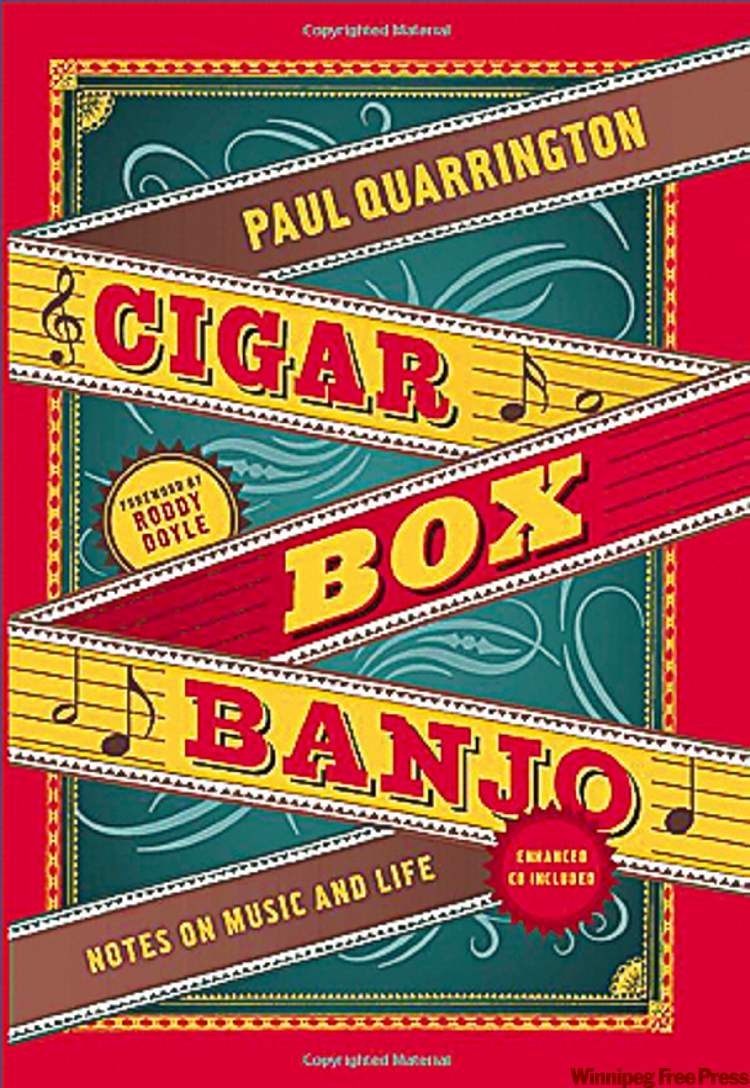
The Cigar Box Banjo
A Life in Music and Words
By Paul Quarrington

Greystone, 272 pages, $30
Paul Quarrington’s final outing is a delightful memoir and an uplifting epitaph. One can’t but hear Eric Idle whistling, and perhaps see him, suspended on a cross, as he and his Monty Python chums notoriously enjoined us always to look on the bright side.
As well as being a self-described overweight lout, Quarrington was a musician, novelist and filmmaker of no small talent.
Diagnosed in mid-2009 with advanced and incurable lung cancer, he turned the proverbial lemons thus served into lemonade (gin?), and wrote a last book that is at once funny and pathetic, entertaining and informing, a fitting epitaph to be sure. He died in January at age 56.
"Music," notes the introduction by Irish novelist Roddy Doyle, "is more important than oxygen," and this is rendered poignantly apt, as Quarrington relates his increasing reliance on the nurturing kinship and camaraderie of the former, while he becomes progressively starved of the latter.
Ultimately a guitarist and singer with Toronto’s Porkbelly Futures, Quarrington had music in his bones, as it were, and relates a childhood and adolescence redolent with music and mayhem.
An early collaboration with a young neighbour destined to grow up to be the pop star Dan Hill went nowhere, but others were more fruitful. A documentary on his musical life premieres at 6 p.m. today on Bravo!
Rich with an acerbic wit, The Cigar Box Banjo is a treat. Self-effacing and humble, and never maudlin or self-pitying, Quarrington peppers his pages with wonderful anecdotes of his musical coming of age, and the trials, tricks, and trauma that come with being a travelling band in a broad country, depending on drunken audiences and cantankerous bar owners for affirmation and sustenance.
Writing boldly in the first person, Quarrington has a wonderful proficiency with words. He describes being influenced, as were we all, by "Lennon’s surly self-centredness," and freely admits (celebrates) the fact that the work of musical poets from Dylan and Townes Van Zandt to Lou Reed shaped him into a "15-year-old hard-drinking, hard-smoking bluesman from Don Mills, Ontario."
Quarrington’s 1987 King Leary won the Stephen Leacock Medal for humour, and he notes that "in both professions, writing and music, a practitioner stands about as much chance of real success as does a sperm cell."
The going, that is, never was easy, but the life was rich, not least because of a dedication to a muse, literary and musical. Of rhythm, he writes, it "is elemental, something we have inside us like bile and marrow. The access can be a little problematic, since it is protected by self-consciousness and notions of seemliness."

If you’ve ever picked up a guitar, or still wish you might; or perhaps if you’ve thought about putting pen to paper (a fast-fading metaphor); or if you’re like the millions of us who worry that the next lump we discover, or the next bout of diarrhea we experience, might just turn out finally to be our initial encounter with the big C, you ought to read this book.
Medicine comes off rather poorly, probably appropriately. "You lose most control," Quarrington writes, "to the doctors… [who] spoke using statistics, and you know what Mark Twain said about statistics."
Although he notes that "there are few situations that are unremittingly negative," including being diagnosed with a terminal illness, lest this review leave too sanguine an impression of the late Mr. Quarrington, the final words belong to him: "In case there is any doubt on the matter, let me state categorically that I like it here. I enjoy the Earth and all its bounties. I like fishing. I like single malt. I especially like cooked pig in its many manifestations."
A Winnipeg doctor with literary and musical pretensions, Ted St. Godard still likes it here, too.