Richardson life recounted in selective biography
Advertisement
Read this article for free:
or
Already have an account? Log in here »
To continue reading, please subscribe:

Digital Subscription
One year of digital access for only $205*
- Enjoy unlimited reading on winnipegfreepress.com
- Read the E-Edition, our digital replica newspaper
- Access News Break, our award-winning app
- Play interactive puzzles
*First annual payment billed as $205.00 + GST for one year. This annual subscription will automatically renew at $233.00 + GST every 52 weeks (10% off the regular annual price of $259.35). Offer available to new and qualified returning subscribers only. Cancel any time.
To continue reading, please subscribe:
Add Free Press access to your Brandon Sun subscription for only an additional
$1 for the first 4 weeks*
- Enjoy unlimited reading on winnipegfreepress.com
- Read the E-Edition, our digital replica newspaper
- Access News Break, our award-winning app
- Play interactive puzzles
*Your next Brandon Sun subscription payment will increase by $1.00 and you will be charged $17.95 plus GST for four weeks. After four weeks, your payment will increase to $24.95 plus GST every four weeks.
Read unlimited articles for free today:
or
Already have an account? Log in here »
Hey there, time traveller!
This article was published 05/02/2011 (5702 days ago), so information in it may no longer be current.
Just Common Sense
The Life and Times of George Taylor Richardson
By Tim Higgins
Heartland Associates, 248 pages, $25 softcover
GEORGE Richardson, president and CEO of James Richardson & Sons from 1966 to 2000, deserves credit for some far-seeing corporate decisions.
Erecting the Richardson Building at Portage and Main kick-started other downtown Winnipeg projects in the 1960s.
As governor of the Hudson’s Bay Company, he moved corporate headquarters to Winnipeg, got Canadians to buy shares and installed the replica sailing ship the Nonsuch in the Manitoba Museum.
The Richardson family has donated millions of dollars to good causes, only a small number of which are mentioned in this book.
But this selective biography oversells George Richardson, while erasing from history important aspects of the story.
The fact that Richardson commissioned the book makes it suspect from the beginning, especially on the heels of the corporate history released in 2007 to celebrate the company’s 150th anniversary.
Tim Higgins is co-author, with Senator Sharon Carstairs, of Dancing Backwards: A Social History of Women in Canadian Politics and two other books.
He must be held responsible for the fawning tone that pervades the book.
Take this one typical page. Please.
“Not for the weak or the timid. .. creative, courageous leadership … George Taylor Richardson at the helm … steady, bold and innovative … nerves of steel … effective, often ingenious action.”
There is not a single example of Richardson making the wrong decision or reflecting on how things could have been different.
Nor is there a single account of the tensions that develop in a family firm over succession. While conceding the importance of such issues, Higgins never delivers the goods.
Richardson, of course, is the father of the firm’s current CEO, Hartley, and son of the man whose name graces Winnipeg’s airport.
When the time came to choose the successor to his strong-willed mother, Muriel Richardson, George was pitted against his older brother Jim.
What were the tensions between these two brothers, raised like Crown princes to know this day would come?
Richardson can carry on for entire pages about cattle feedlots and building docks at the lake. But he offers not a word of insight into his own thinking about the most pivotal moments of his career.
George and Jim briefly ran the company together, but George took control when Jim went into politics.
Jim’s entire career as a federal cabinet minister is dismissed in one paragraph that fails to mention his bringing the Royal Canadian Mint to Winnipeg.
Jim resigned from cabinet to protest official bilingualism.
He provided financial support, presumably with Richardson family money, for the quirky One Canada Foundation, which wanted to abolish French as an official language of Canada. Not in the book.
His sisters are also given short shrift, even though they remained board members of the family firm.
Agnes is not even acknowledged by her married name of Benidickson, much less her accomplishments as longtime chancellor of Queen’s University, following in their father’s footsteps.
Kathleen Richardson is briefly given credit for her support of the arts, but without mentioning her pivotal role in providing a new building for the Manitoba Theatre Centre in the 1960s.

The most glaring omission is the 1999 court case in which Winnipeg business owner Albert Cohen alleged — and was vindicated by a judge — that Richardson had welched on a handshake deal over the purchase of Tundra Oil and Gas.
Difficult issues must be included in a biography or autobiography, if only to give the subject’s side of the story.
By pretending it never happened, the author and his subject strike a fatal blow to their already-damaged credibility.
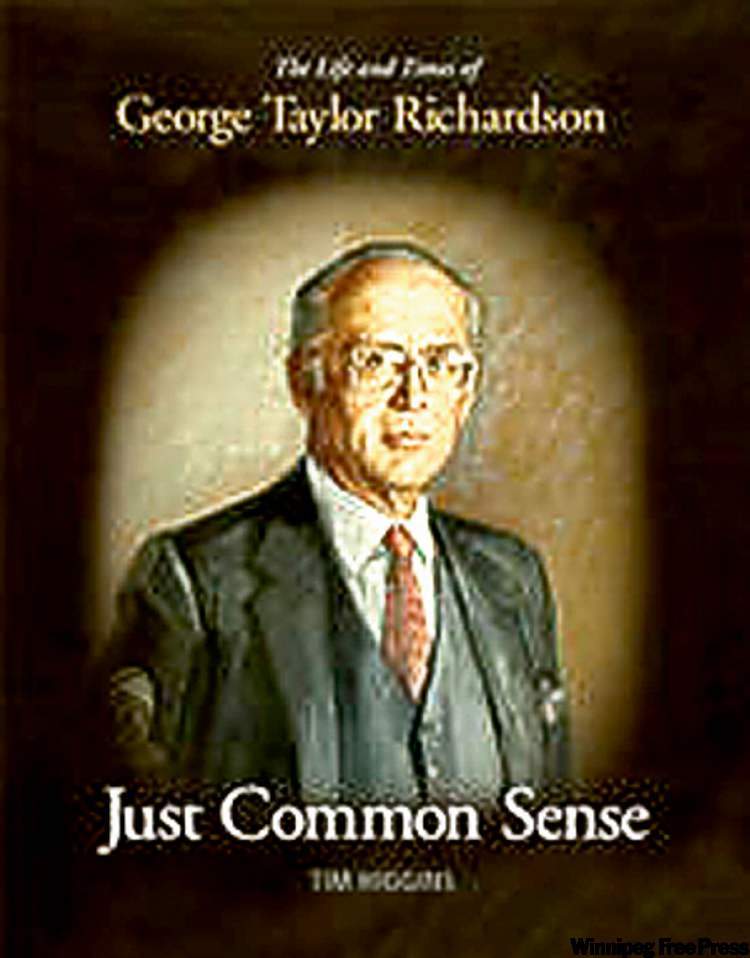
A portrait of Richardson in oils is the cover. The rest of the book is the coverup.
Donald Benham is a freelance book reviewer for the Winnipeg Free Press.