What the #%$&@, Mamet a political conservative
Advertisement
Read this article for free:
or
Already have an account? Log in here »
To continue reading, please subscribe:

Digital Subscription
One year of digital access for only $205*
- Enjoy unlimited reading on winnipegfreepress.com
- Read the E-Edition, our digital replica newspaper
- Access News Break, our award-winning app
- Play interactive puzzles
*First annual payment billed as $205.00 + GST for one year. This annual subscription will automatically renew at $233.00 + GST every 52 weeks (10% off the regular annual price of $259.35). Offer available to new and qualified returning subscribers only. Cancel any time.
To continue reading, please subscribe:
Add Free Press access to your Brandon Sun subscription for only an additional
$1 for the first 4 weeks*
- Enjoy unlimited reading on winnipegfreepress.com
- Read the E-Edition, our digital replica newspaper
- Access News Break, our award-winning app
- Play interactive puzzles
*Your next Brandon Sun subscription payment will increase by $1.00 and you will be charged $17.95 plus GST for four weeks. After four weeks, your payment will increase to $24.95 plus GST every four weeks.
Read unlimited articles for free today:
or
Already have an account? Log in here »
Hey there, time traveller!
This article was published 11/06/2011 (5579 days ago), so information in it may no longer be current.
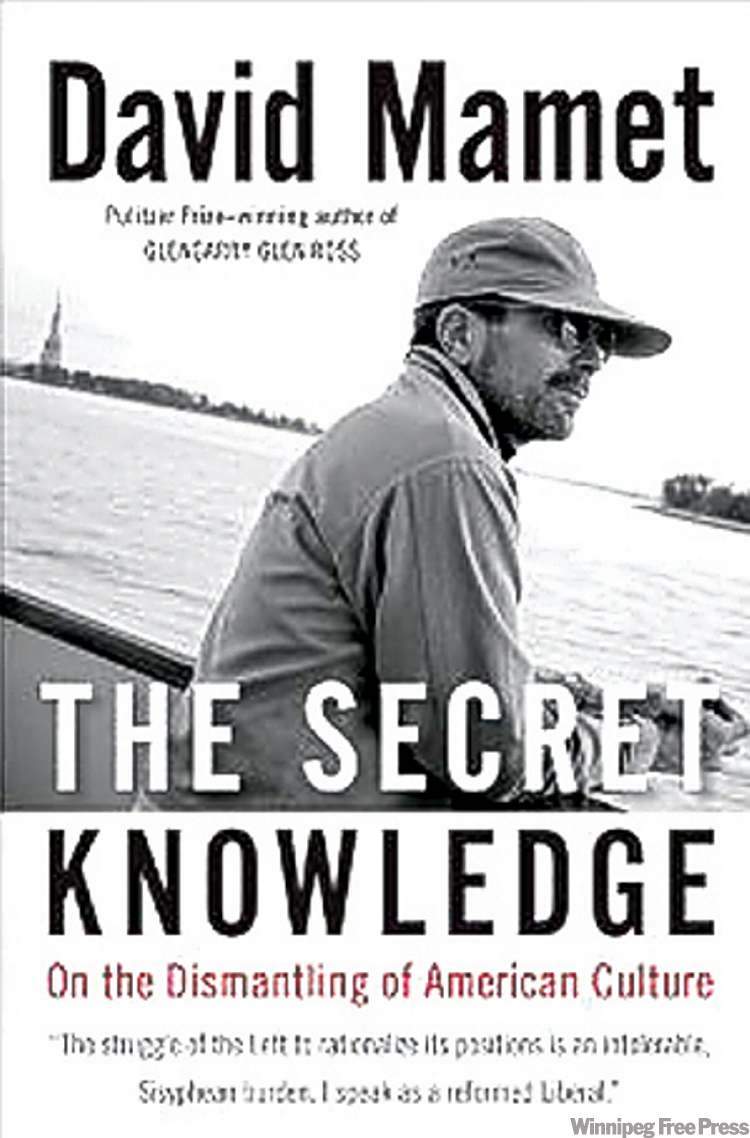
The Secret Knowledge
On the Dismantling of American Culture
By David Mamet
Sentinel, 223 pages, $32.50
IMAGINE Ann Coulter trading her little black dress for a five-o’clock shadow and renouncing her glib one-liners for tendentious aphorisms.
Yes, the American playwright David Mamet, who brilliantly (and profanely) dramatized the brutality of capitalism in such classics as American Buffalo and Glengarry Glen Ross, has become a political conservative.
In his new non-fiction book, The Secret Knowledge, a vigorously argued though humourless polemic, he portrays himself as the thinking man’s Bill O’Reilly.
“My revelation came upon reading Friedrich Hayek’s The Road to Serfdom,” Mamet writes. “He wrote that there are no solutions; there are only trade-offs — money spent on more crossing guards cannot be spent on books. Both are necessary, a choice must be made, and that this is the Tragic view of life.”
With the fervour of the convert, Mamet attacks the sacred cows of the left, from a liberal-arts education and affirmative action to big government and environmentalism.
He calls New York’s decision to allow an Islamic Centre to be built in the vicinity of Ground Zero “a cultural obscenity.”
He dismisses iconic feminist Gloria Steinem for being a hypocrite and defends Republican presidential wannabe Sarah Palin as salt of the earth, a one-time “commercial fisherman” who “actually worked with her hands.”
“For the Left loves ‘the workers’ only in the abstract,” he writes. “To find that they not only exist as individuals, but are willing to bet their subsistence upon their principles of hard work and thrift — this, to the Left, is an unanswerable indictment of Socialism, Globalism, and Statism.”
The Secret Knowledge is filled with stilted sentences of this sort. For a writer whose sharp and staccato dialogue has always struck a defiantly modern note, Mamet’s language here seems old-fashioned and formal.
Despite its being divided into 40 short chapters, the book is still a slog. Plowing through it takes patience and stamina.
Give Mamet his due. He makes many excellent points. But the skeptical reader feels less persuaded than assaulted.
Mamet, who also has a busy career as a Hollywood screenwriter and director, grew up Jewish in Chicago, where his father was a successful labour lawyer. As a young writer, he says, he never questioned left-lib tenets, even though he made his living by competing in the unregulated “free market.”
His rightward drift, he says, started eight years ago, when he was 60 and felt challenged by the rabbi of his reform synagogue in Los Angeles, the “first Republican” with whom he’d ever seriously conversed.
Like many North American Jewish neo-cons, from Norman Podhoretz to David Frum, Mamet’s intellectual position grows from his tribal instinct to support Israel. He is unapologetic about his identification not just with the lone democracy in the Middle East, but all Jews, “my people,” as he calls them in numerous instances.
Indeed, this book is a natural extension of his last non-fiction polemic, 2006’s The Wicked Son: Anti-Semitism, Self-Hatred and the Jews, which reads in parts like a press release from the Jewish Anti-Defamation League.
There, as here, Mamet is not preaching to the converted but spewing fire and brimstone at the infidel. It will be interesting to see if it changes the way his plays are written and received.
Morley Walker edits the Free Press Books section.