Former Winnipegger recounts life reporting from hot spots, and what set her on that path

Advertisement
Read this article for free:
or
Already have an account? Log in here »
To continue reading, please subscribe:

Digital Subscription
One year of digital access for only $205*
- Enjoy unlimited reading on winnipegfreepress.com
- Read the E-Edition, our digital replica newspaper
- Access News Break, our award-winning app
- Play interactive puzzles
*First annual payment billed as $205.00 + GST for one year. This annual subscription will automatically renew at $233.00 + GST every 52 weeks (10% off the regular annual price of $259.35). Offer available to new and qualified returning subscribers only. Cancel any time.
To continue reading, please subscribe:
Add Free Press access to your Brandon Sun subscription for only an additional
$1 for the first 4 weeks*
- Enjoy unlimited reading on winnipegfreepress.com
- Read the E-Edition, our digital replica newspaper
- Access News Break, our award-winning app
- Play interactive puzzles
*Your next Brandon Sun subscription payment will increase by $1.00 and you will be charged $17.95 plus GST for four weeks. After four weeks, your payment will increase to $24.95 plus GST every four weeks.
Read unlimited articles for free today:
or
Already have an account? Log in here »
Hey there, time traveller!
This article was published 21/04/2012 (5264 days ago), so information in it may no longer be current.
There is a stark clarity to the scene, halfway through this brisk but carefully measured memoir, when former Winnipegger Nahlah Ayed confronts her own mortality in the streets of a disintegrating Baghdad.
Her words become clipped and urgent.
“Angry men hauled bloody ones on blankets down the street,” she recalls, as she herself is dragged away by a member of the Mahdi Army. “Body parts. Screaming. Hysteria… I pleaded with my captor to keep things calm.”
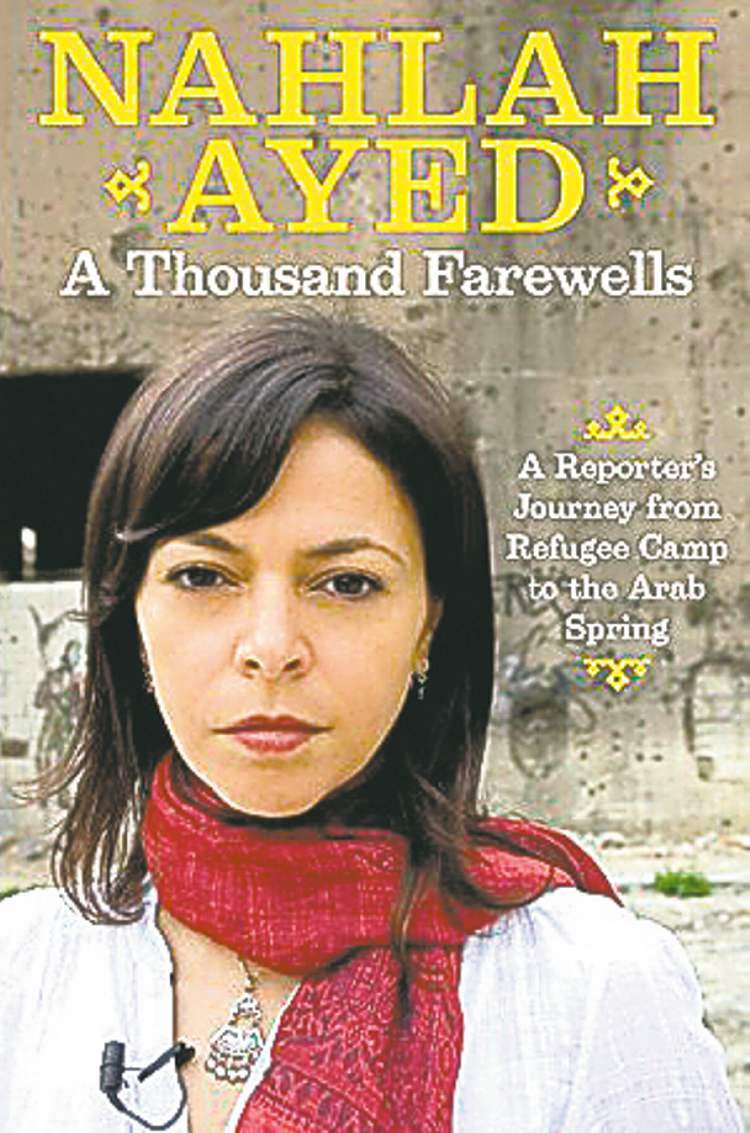
In the end, Ayed escapes the violent confrontation with the help of a passing stranger. But the incident, smeared with her own blood and seared into her brain, would become the stuff of nightmares that would last for years.
In her first book, the CBC-TV foreign correspondent seeks to lay that trauma, and a million others, to rest, putting it in the context of a career spent chasing crises and explosions of incredible suffering.
From the daunting mountains of Tora Bora in Afghanistan, to the turbulent streets of Cairo, Ayed, who is fluent in Arabic, documented regional dissolution into chaos, first for The Canadian Press and then as a television reporter for CBC.
A Thousand Farewells begins with the unusual circumstances that conspired to send Ayed seeking stories abroad.
Born in Winnipeg as the daughter of Palestinian refugees, Ayed was six when her parents decided to sell their St. Boniface home and move the family to a squalid refugee camp outside of Amman, Jordan, in 1976.
It was the reverse of the immigrant dream: her parents hoped to return their children to the Palestinian culture they had been forced to flee.
Ayed recalls the experience — which ended when the family returned to Winnipeg when she was 13 — as a “nightmare.”
Back here, Nahlah and her siblings threw themselves into re-assimilating, absorbing North American cartoons and helping their parents run an Osborne Village convenience store.
It was there, Ayed says, where she began to devour newspapers and magazines, setting the stage for her journalism career.
But even as Ayed settled in to Winnipeg, graduating from Churchill High School, before moving on to the University of Manitoba, then Carleton University in Ottawa, her early uprooting set the tone for a peripatetic life, one in which she became a perpetual “uneasy immigrant, someone in search of refuge.”
Perhaps never as much, though, as the people she met along the way. Despite A Thousand Farewells’ relatively slim page count, Ayed introduces us to enough people to justify the book’s name.
Some of them are only briefly sketched: a lone woman, for instance, wailing on the edge of a mass grave outside of Hillah, Iraq. Or the pub owner drinking the afternoon away as bombs fell on Beirut.
But she gives other people the time and space to come alive, neatly summarizing their lives and drawing us into the chaos that surrounds them. It doesn’t take long for readers to become as fond of Reem, an Iraqi poet and one of Ayed’s close friends, as Ayed herself is.
Indeed, we empathize with Reem when we meet her, as she cries out upon discovering her childhood home has been commandeered by the American occupation.
Outside these frames, though, the pictures grow stale. The final chapters of A Thousand Farewells march steadily to their close, but the end result is somehow unsatisfying.
Ayed, now based in Toronto, has laid out a compelling collection of stories and subjects, memories and snippets of well-chosen journalistic detail: to numb a “depressed” population in the wake of renewed violence in Beirut in 2006, Ayed notes, prescriptions for one anti-anxiety medication soared by almost 65 per cent.
But it’s never clear what all of these tips and tales are conspiring to say, what greater message — if any — Ayed hopes to convey.
In her narrative, the tableaux flash by; people emerge for a page or a paragraph and then disappear. When one of her Iraqi friends disappears in an road ambush, Ayed helps in the anguished search. But the episode is given only a fraction of space in the book.
Perhaps that’s a stylistic choice, a reflection on the many sudden losses of war, the abrupt cutting of threads. But it seems just as likely it’s more grounded in Ayed’s journalistic training: at times clearly self-conscious about revealing any bias, Ayed judiciously strays from sentiment and often keeps herself separate from the action.
That’s an admirable quality for a reporter though not, perhaps, for a memoirist. While Ayed’s war stories are compelling on their own, the cumulative whole feels more like a collection of anecdotes — with a solid primer on Middle Eastern sociopolitical history thrown in — than a cohesive reflection.

Still, when Ayed does step forward to bare her personal experience, the mundane details leap off the page and bring the experience home: her father’s fixation with asking about the weather in wartorn regions, for instance, or her litany of exhausted emails home, each one marking a bond with Canadian friends coming undone — but never, Ayed proudly declares, her bond with Canada.
“My being Canadian meant more than the mere possession of a passport,” she writes, in response to the repeated queries of Middle Eastern sources about her citizenship — a thing that, to them, was a “buoy that could solve all of life’s problems.”
“I tried to explain that it was a way of life, a way of thinking, of being, that began the day I was born.”
Melissa Martin is a Free Press reporter.
Melissa Martin
Reporter-at-large
Melissa Martin reports and opines for the Winnipeg Free Press.
Every piece of reporting Melissa produces is reviewed by an editing team before it is posted online or published in print — part of the Free Press‘s tradition, since 1872, of producing reliable independent journalism. Read more about Free Press’s history and mandate, and learn how our newsroom operates.
Our newsroom depends on a growing audience of readers to power our journalism. If you are not a paid reader, please consider becoming a subscriber.
Our newsroom depends on its audience of readers to power our journalism. Thank you for your support.
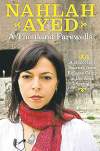
Book review
A Thousand Farewells
A Reporter’s Journey from Refugee Camp to the Arab Spring
- By Nahlah Ayed
- Viking, 341 pages, $32
Melissa Martin
Reporter-at-large
Melissa Martin reports and opines for the Winnipeg Free Press.
Every piece of reporting Melissa produces is reviewed by an editing team before it is posted online or published in print — part of the Free Press‘s tradition, since 1872, of producing reliable independent journalism. Read more about Free Press’s history and mandate, and learn how our newsroom operates.
Our newsroom depends on a growing audience of readers to power our journalism. If you are not a paid reader, please consider becoming a subscriber.
Our newsroom depends on its audience of readers to power our journalism. Thank you for your support.

Advertisement Advertise With Us
Advertisement Advertise With Us