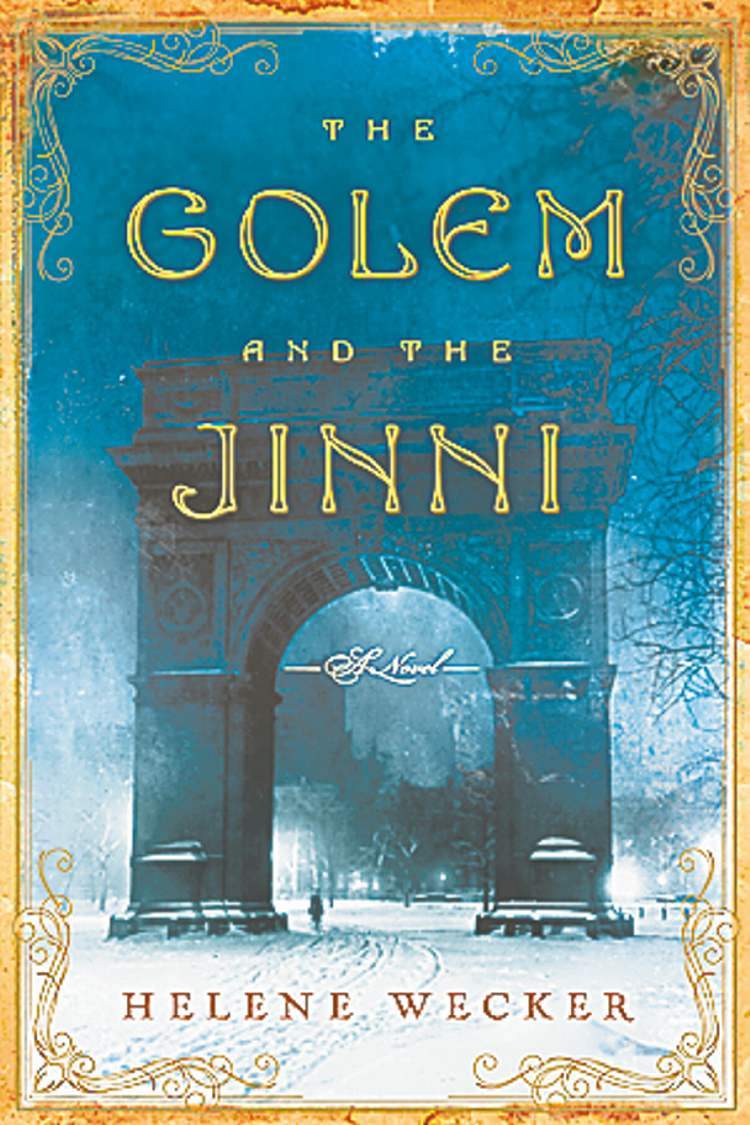
Strong fiction debut pairs immigrant Golem, Jinni
Advertisement
Read this article for free:
or
Already have an account? Log in here »
To continue reading, please subscribe:

Digital Subscription
One year of digital access for only $205*
- Enjoy unlimited reading on winnipegfreepress.com
- Read the E-Edition, our digital replica newspaper
- Access News Break, our award-winning app
- Play interactive puzzles
*First annual payment billed as $205.00 + GST for one year. This annual subscription will automatically renew at $233.00 + GST every 52 weeks (10% off the regular annual price of $259.35). Offer available to new and qualified returning subscribers only. Cancel any time.
To continue reading, please subscribe:
Add Free Press access to your Brandon Sun subscription for only an additional
$1 for the first 4 weeks*
- Enjoy unlimited reading on winnipegfreepress.com
- Read the E-Edition, our digital replica newspaper
- Access News Break, our award-winning app
- Play interactive puzzles
*Your next Brandon Sun subscription payment will increase by $1.00 and you will be charged $17.95 plus GST for four weeks. After four weeks, your payment will increase to $24.95 plus GST every four weeks.
Read unlimited articles for free today:
or
Already have an account? Log in here »
Hey there, time traveller!
This article was published 25/05/2013 (4864 days ago), so information in it may no longer be current.
New YORK, 1899. Another boatload of those teeming masses is about to arrive at Ellis Island, among them a solemn, statuesque woman from Danzig.
Caught without a ticket, she leaps off the ship and sinks like a stone, only to walk out onto the banks of the Lower East Side, hours later and miles away. Golem, of course, cannot swim.
Meanwhile, in Little Syria, a tinsmith is labouring over a dented antique oil lamp. Erasing a portion of the ancient script, he is nearly knocked out by the explosive release of an imprisoned desert spirit.

Trapped in human form, the fiery being, whose true name can only be spoken by the wind, is equally surprised by where he’s ended up.
These are the opening chapters of American Helene Wecker’s literary debut, and they’re doozies. Perhaps the most famous beast of Jewish folklore is paired with a creature right out of The Arabian Nights. And they’re re-imagined as developed, human-like characters.
It’s an unusual combination, to say the least. Even though the Jews were once a desert people, the best-known golem story is set in Prague, where a rabbi used the Kabbalistic arts to animate the clay defender in response to 16th-century Czech pogroms.
The intermixed mythos seems like it could clash. But it doesn’t. When the Golem and the Jinni eventually meet, their narratives merge fluidly.
And why not? Transplanted out of time and myth, swept along by forces beyond their control, theirs is the ultimate immigrant experience. What two poor creatures in this strange new land could have more in common?
Of course, this story could only ever take place in New York, that most iconic exemplar of the immigrant city. New York is the thread that knits so many disparate histories and peoples together, and Wecker, a one-time New Yorker herself, uses it as the tie between her protagonists until their fated meeting.
Both title characters take human names, but the narrative text only ever refers to them as the Golem and the Jinni. There seems something significant in this noun usage. Despite being unmoored from one’s country, or perhaps because of it, labels like Syrian, Polish or Chinese can be jealously guarded.
Perhaps part of being an immigrant means holding on to those things that define us.
The jacket copy cites another historical fantasy, Jonathan Strange & Mr Norrell, by British author Susanna Clarke. No surprise there. Clarke’s epic 2004 debut was rightfully hailed by critics, and Wecker’s narrative scope and meticulous research bear comparison. Yet Wecker’s work is actually the stronger of the two.

Where Wecker’s pacing is spot on, expertly switching between a half-dozen point-of-view characters without ever losing momentum, Clarke’s charming, Austen-like prose suffered from a fear of the editor’s knife. Her book, while excellent, should have been cut by a third.
In common with Clarke, Wecker has written rich and memorable characters, but it’s the story that is the great achievement here. The tale of the Jinni or Golem alone would be engaging enough, but all the major threads come together beautifully, and the result is something greater than the sum of its parts.
It’s difficult to write a plot this complex without compromising readability or clarity, and Wecker has achieved that.
For a celebrated veteran, this novel would be a great work — a near-flawless gem. As it stands, it’s one of the strongest debuts in years.
Joel Boyce is a Winnipeg writer and teacher.