Pro-aboriginal polemic a challenge to decipher

Advertisement

Advertise with us

This locally published left-wing history lesson outlines Canadian aboriginal difficulties over several generations from coast to coast to coast.

Read this article for free:


or

Already have an account? Log in here »

To continue reading, please subscribe:

Subscribe and receive a limited-edition Free Press branded hat or tote.

Digital Subscription

One year of digital access for only $205*

  • Enjoy unlimited reading on winnipegfreepress.com
  • Read the E-Edition, our digital replica newspaper
  • Access News Break, our award-winning app
  • Play interactive puzzles

*First annual payment billed as $205.00 + GST for one year. This annual subscription will automatically renew at $233.00 + GST every 52 weeks (10% off the regular annual price of $259.35). Offer available to new and qualified returning subscribers only. Cancel any time.

To continue reading, please subscribe:

Add Free Press access to your Brandon Sun subscription for only an additional

$1 for the first 4 weeks*

  • Enjoy unlimited reading on winnipegfreepress.com
  • Read the E-Edition, our digital replica newspaper
  • Access News Break, our award-winning app
  • Play interactive puzzles
Start now

*Your next Brandon Sun subscription payment will increase by $1.00 and you will be charged $17.95 plus GST for four weeks. After four weeks, your payment will increase to $24.95 plus GST every four weeks.

Hey there, time traveller!
This article was published 24/08/2013 (4768 days ago), so information in it may no longer be current.

This locally published left-wing history lesson outlines Canadian aboriginal difficulties over several generations from coast to coast to coast.

Author Peter Kulchyski, a University of Manitoba native studies professor, has long taken an aggressive stand on behalf of aboriginal rights in journals like Canadian Dimension, Briarpatch and the Journal of Canadian Studies.

Here he examines documents ranging from elements of Canada’s constitution to the United Nations Declaration on Human Rights.
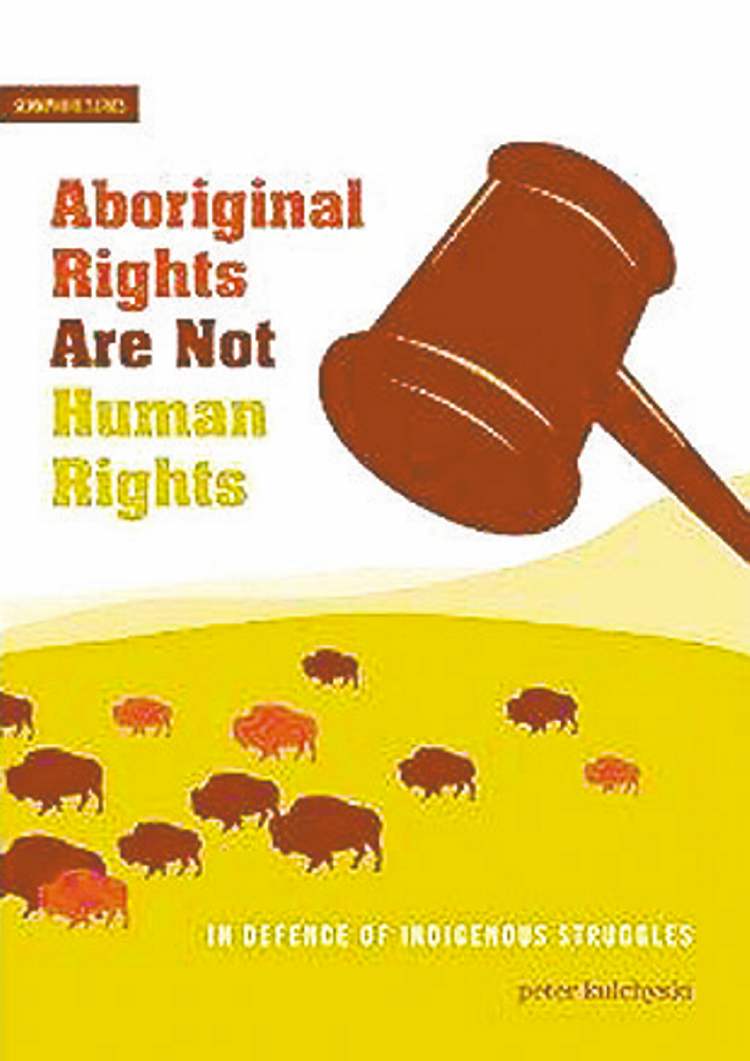
Alas, from its opening pages, Aboriginal Rights Are Not Human Rights is exasperating, largely because the material is a challenge to decipher.

Kulchyski’s decision to use limited capitalization and punctuation leaves the reader little choice but to work through the text with a pencil in hand to sort out sentences — and to separate lengthy chunks of material into paragraphs.

Does he think the conventions of English typography are to be disregarded as the tools of running-dog capitalists?

A further stylistic interference is his tendency to drop terms into his text without warning. For example, he refers to “undrip” (a term that turns out to be an acronym for United Nations Declaration on the Rights of Indigenous Peoples).

He is also inclined to sarcasm and bombast, especially when he is writing about some of his favourite bogeymen, like Manitoba Hydro.

Kulchyski has proved in the past, in books like The Sound of a Drum, that he can write forcefully. What is unfortunate about his style this time around is it diminishes the impact of his viewpoint and argument. The reader may find signs of an impressive perspective but will have difficulty untangling it.

He argues that indigenous cultures have developed uniquely, largely through struggle against domination by the state (for which he uses the term totalization).

As Kulchyski notes, when the Canadian Constitution was repatriated, aboriginal rights were included. He cites Section 35 as establishing the legal status of aboriginal rights and declaring that they cannot be overridden by human rights.

One of the most interesting sections is the one labelled “socialism and native americans.” Here Kulchyski observes the contrast between the strength of Canadian socialists’ support for solidarity around the world and the “less inspiring record of socialist support for indigenous struggles in their own backyard.”

Demonstrations against imperial ventures in Africa and Latin America seem to attract all kinds of activists. On the other hand, what he calls colonialism in Canada’s own Far North appears, at times, to have drawn rather tepid responses.

Kulchyski does give credit to some earlier activists, such as those who organized around issues involved with Haida Gwai, Grassy Narrows and the Lubicon Cree. He includes himself as one of those earlier campaigners.

He speculates the reason for the lack of “a mass outpouring of support,” such as has arisen in the past 10 years, has been the failure of the political left to appreciate the “particularity of oppression.” He insists “the left and aboriginal people in Canada have a lot to say to each other if they could really start talking.”

Kulchyski, however, should know he is more likely to find a receptive audience if he spoke in a language people understand.

Ron Kirbyson is a Winnipeg writer with a longtime interest in aboriginal issues.

Report Error Submit a Tip

More Stories

Tory health critic ‘disappointed’ after being rebuffed by health officials

Carol Sanders 4 minute read Preview

Tory health critic ‘disappointed’ after being rebuffed by health officials

Carol Sanders 4 minute read Yesterday at 11:53 AM CDT

The health critic for the Progressive Conservative party says her ability to get information about the accelerated reopening of Dauphin’s emergency department was stymied by Prairie Mountain Health officials because they refused to meet with her.

“I wanted to meet with PMH staff to discuss the status of the facility and the challenges they’re facing and getting services back online,” Kathleen Cook said Friday.

“I was very disappointed that Prairie Mountain Health declined me that opportunity.”

Cook said she asked for a meeting a few days after the Sept. 7 reopening of a temporary ER at the hospital, that was severely damaged by flooding.

Read
Yesterday at 11:53 AM CDT

Port of Churchill expansion could chase belugas away, U of M researcher says

Nicole Buffie 4 minute read Preview

Port of Churchill expansion could chase belugas away, U of M researcher says

Nicole Buffie 4 minute read 9:07 AM CDT

As plans to expand the Port of Churchill into a four-season trade corridor gathers momentum, a University of Manitoba researcher has published a report on what ship traffic could mean for the beluga whales that gather in the Churchill River estuary each summer.

Veronica Coppolaro said more vessels in the waterways bring a risk that belugas will stop using the estuary for migration, which would impact the ecological landscape, tourism and communities that rely on the animals for food and cultural purposes.

“There are studies showing that (noises) change the way they swim, they change the way (the whales) are vocalizing, they change their main activity, and so this (expansion) can have consequences at different levels,” she said.

The Churchill river estuary is a marine habitat where the Churchill River empties into Hudson Bay. During the summer months belugas gather in the area to feed and give birth.

Read
9:07 AM CDT

Downtown no place to be after dark, huge majority of Winnipeggers say in survey

Joyanne Pursaga 8 minute read Preview

Downtown no place to be after dark, huge majority of Winnipeggers say in survey

Joyanne Pursaga 8 minute read Friday, Sep. 11, 2026

Most Winnipeggers are afraid to walk alone downtown and believe the city needs more police officers, a new survey finds.

Winnipeg Police Service released its 2026 citizen survey Friday.

Downtown safety appears to remain a major concern, with just 44 per cent saying they feel very or reasonably safe walking alone in the area during the day. The number plummets to eight per cent overall at night, down from nine per cent in 2024, the last time the survey was conducted.

This year, 14 per cent of men felt very or reasonably safe walking alone downtown at night, compared to just three per cent of women.

Read
Friday, Sep. 11, 2026

News briefs for Sunday, September 13, 2026

1 minute read Updated: 9:47 AM CDT

A collection of breaking news briefs filed on Sunday, September 13, 2026

Suspect arrested two months after bear spray, air rifle incident at Henderson Hwy. hotel

9:47 AM

A man has been arrested and remains in police custody after being charged with spraying bear spray inside a Henderson Highway hotel in early July. The suspect is also accused of  pointing a gun, chasing people and making violent threats in the hotel's parking lot after a dispute over a VLT ticket at the licensed establishment in the 1000 block of Henderson Highway.

Bombers exact revenge in Banjo Bowl, lose Collaros to injury

Taylor Allen 6 minute read Preview

Bombers exact revenge in Banjo Bowl, lose Collaros to injury

Taylor Allen 6 minute read Yesterday at 9:20 PM CDT

Redha Kramdi downplayed the significance of his return for the Winnipeg Blue Bombers.

“I don’t think I have that big of an impact,” said Kramdi on Tuesday, who watched the club go 2-4 while he was sidelined with a cast on his left hand.

It sounded silly at the time, and it’s even sillier now considering how exceptional the 29-year-old safety from Montreal was in Saturday’s 22nd edition of the Banjo Bowl.

Kramdi caused two turnovers — a forced fumble and an interception — to lead the Bombers to a 19-6 victory over the Saskatchewan Roughriders in front of a sell-out crowd at Princess Auto Stadium.

Read
Yesterday at 9:20 PM CDT

Drug recovery centre opens office in ‘heart of the city’

Morgan Modjeski 4 minute read Preview

Drug recovery centre opens office in ‘heart of the city’

Morgan Modjeski 4 minute read Yesterday at 3:38 PM CDT

Richard Halverson found his freedom from addiction through Adult & Teen Challenge and, six years later, he hopes a new Winnipeg location will bring hope to the city.

Dozens gathered Saturday morning to mark the grand opening of the recovery centre’s community services office on Main Street.

Located inside the former Wojcik funeral home, the bright-white building — which was also formerly a liquor store — will serve as an access point for people fighting drug addiction. That includes connecting them to addictions support, housing and training.

“For me, I always start with: ‘What’s your story?’” said Halverson, who now works for the faith-based organization.

Read
Yesterday at 3:38 PM CDT