Mob boss preferred revenge over money
Advertisement
Read this article for free:
or
Already have an account? Log in here »
To continue reading, please subscribe:

Digital Subscription
One year of digital access for only $205*
- Enjoy unlimited reading on winnipegfreepress.com
- Read the E-Edition, our digital replica newspaper
- Access News Break, our award-winning app
- Play interactive puzzles
*First annual payment billed as $205.00 + GST for one year. This annual subscription will automatically renew at $233.00 + GST every 52 weeks (10% off the regular annual price of $259.35). Offer available to new and qualified returning subscribers only. Cancel any time.
To continue reading, please subscribe:
Add Free Press access to your Brandon Sun subscription for only an additional
$1 for the first 4 weeks*
- Enjoy unlimited reading on winnipegfreepress.com
- Read the E-Edition, our digital replica newspaper
- Access News Break, our award-winning app
- Play interactive puzzles
*Your next Brandon Sun subscription payment will increase by $1.00 and you will be charged $17.95 plus GST for four weeks. After four weeks, your payment will increase to $24.95 plus GST every four weeks.
Read unlimited articles for free today:
or
Already have an account? Log in here »
Hey there, time traveller!
This article was published 21/03/2015 (4172 days ago), so information in it may no longer be current.
Business or Blood: Mafia Boss Vito Rizzuto’s Last War chronicles the bloody underworld power struggle in Montreal that escalated when Vito Rizzuto, the undisputed leader of the Mob in Montreal, was in custody for eight years beginning in 2004 for his involvement in the mob-related “Three Captains” triple slaying in New York in 1981.
It was an escalation in violence Rizzuto predicted would happen when he was fighting extradition to the U.S., warning authorities it would occur if he were not present to exert his “calming influence” on Montreal’s underworld.
The book’s title refers to the two main reasons mobsters kill each other — to forward their business interests or for revenge.
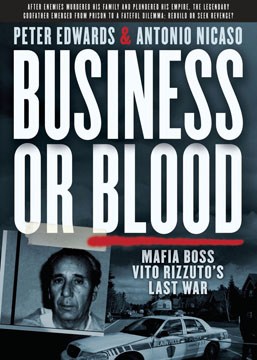
Rizzuto’s enemies made sure the leadership void created by his incarceration was not filled by either his son, Nick Jr., or his father, Nicolo, murdering both men less than a year apart in 2009-10.
In many cases, the line between blood and business is ambiguous. In the case of Vito Rizzuto, however, as portrayed by veteran crime writers and reporters Peter Edwards and Antonio Nicaso, it is clear business was secondary to his desire to avenge the deaths of not only his father and his eldest son, but his many friends and associates who were killed and injured during the bloodletting that took place while he was, ironically, safely incarcerated in the U.S.
A man such as Rizzuto doesn’t rise to the pinnacle of underworld power without making a few enemies. Those against whom he was exacting his revenge had their own reasons for wanting members of Rizzuto’s organization out of the picture.
Edwards and Nicaso do a fine job of connecting the dots of criminal enterprises spanning several decades in numerous countries and including various ethno-cultural groups. They are quick to point out this not just a story about Italian organized crime, but includes gangsters from a variety of backgrounds.
The authors have done exhaustive research to provide readers with the necessary background regarding organized crime in Quebec, eastern Ontario, Italy and the U.S. Their research includes information that could only be gleaned from those close to the action.

The book includes a timeline of events dating back to the 1800s, but concentrates mostly on the events taking place from the time Nicolo Rizzuto established himself as a mobster in the latter half of the 20th century until shortly after Vito’s death, apparently of natural causes, late in 2013.
Readers unfamiliar with the history of organized crime in eastern Canada and Italy will need a scorecard to keep track of the thugs, hit men and other assorted ne’er-do-wells that inevitably populate a story such as this. Fortunately, the book includes a cast of characters split into criminal associations and geographical designations, which is helpful for keeping straight who’s who in a world where loyalties can change overnight and yesterday’s street punk is tomorrow’s boss.
In Business or Blood, fans of the true-crime genre have a comprehensive telling of a recent, bloody chapter of Canadian organized-crime history. It explores the reasons mass bloodlettings take place and the repercussions for organized crime and society.
Gilbert Gregory is a Free Press copy editor.
History
Updated on Saturday, March 21, 2015 4:56 PM CDT: Alters paragraph four.