Coming to Canada: History of postwar English immigration detailed

Advertisement

Advertise with us

In the post-Second World War years, over half a million war-weary English citizens, like many immigrants before them, flocked to Canada in search of a better life.

Read this article for free:

or

Already have an account? Log in here »

To continue reading, please subscribe:

Subscribe and receive a limited-edition Free Press branded hat or tote.

Digital Subscription

One year of digital access for only $205*

  • Enjoy unlimited reading on winnipegfreepress.com
  • Read the E-Edition, our digital replica newspaper
  • Access News Break, our award-winning app
  • Play interactive puzzles

*First annual payment billed as $205.00 + GST for one year. This annual subscription will automatically renew at $233.00 + GST every 52 weeks (10% off the regular annual price of $259.35). Offer available to new and qualified returning subscribers only. Cancel any time.

To continue reading, please subscribe:

Add Free Press access to your Brandon Sun subscription for only an additional

$1 for the first 4 weeks*

  • Enjoy unlimited reading on winnipegfreepress.com
  • Read the E-Edition, our digital replica newspaper
  • Access News Break, our award-winning app
  • Play interactive puzzles
Start now

*Your next Brandon Sun subscription payment will increase by $1.00 and you will be charged $17.95 plus GST for four weeks. After four weeks, your payment will increase to $24.95 plus GST every four weeks.

Hey there, time traveller!
This article was published 09/05/2015 (4104 days ago), so information in it may no longer be current.

In the post-Second World War years, over half a million war-weary English citizens, like many immigrants before them, flocked to Canada in search of a better life.

But despite being the largest group of arriving immigrants to Canada during those years, the English have tended to be virtually invisible, say the authors of this scholarly, knowledgeable and informative historical work.

Because little has been written about this enormous group of immigrants who came from the late 1940s to the mid-1970s, Invisible Immigrants seeks to address this neglected area of our history.
Archives of Ontario
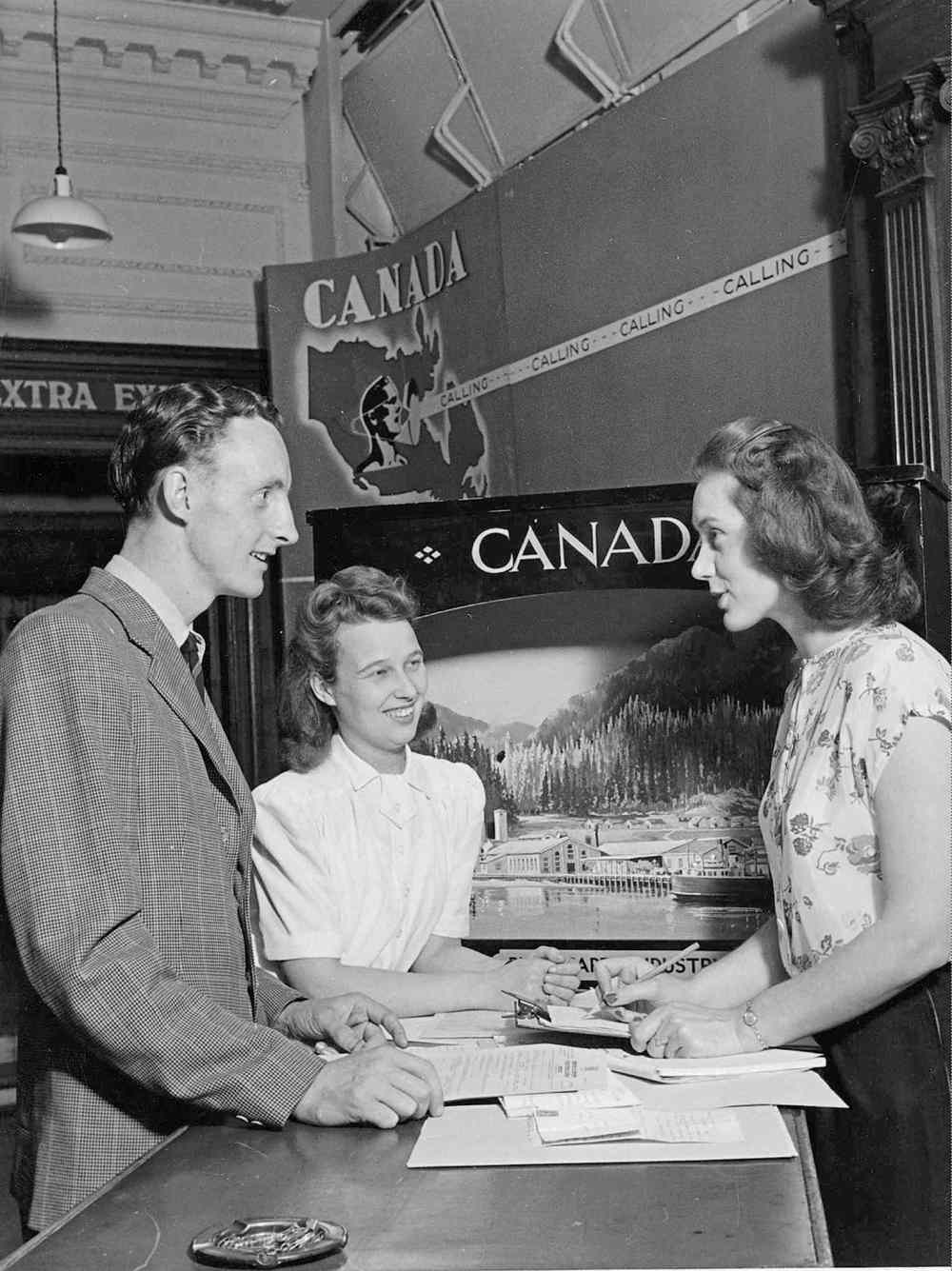
A young English couple contemplating emigration at Rainbow Corner in London.
Archives of Ontario A young English couple contemplating emigration at Rainbow Corner in London.

There is a wealth of information here, much of it garnered from interviews with English immigrants who came to Canada during that period and stayed.

Authors Marilyn Barber and Murray Watson share excerpts of the actual recorded interviews and written testimonies of more than 70 English migrants. They then analyze, explore and discuss the inevitable similarities and differences revealed in their testimonies.

Barber, a Canadian historian and research professor based at Carleton University, teamed up with U.K.-based oral historian Watson to produce a work moulded and fashioned by perspectives from both sides of the Atlantic. Barber has long been involved with the study of immigration and has written many academic articles on the subject. Watson worked in international marketing until embarking later in life on the study of English immigration. He is the author of Being English in Scotland.

While written in a style that is often academically inclined and so somewhat dry, the text is often enlivened by the inclusion of engaging stories of many of the English newcomers to Canada. Many of them were in their 20s and early 30s when they came and settled in mostly larger cities in Canada. Ontario was the most favoured destination followed by British Columbia and then Quebec.

Noticeably, the majority of those interviewed are also from Ontario and Quebec, with folks living in the Prairies largely absent – the authors do not claim to present a representative selection. The stories are often as individual and varied as the people themselves but the writers do attempt to sort out some of the confusion by pointing out similarities and summing things up at the end of each section.

They describe how emigration following the Second World War “took place on a massive scale.” So many set out for what they believed to be the “land of milk and honey” that in 1946, Winston Churchill labelled the emigrants “rats leaving a sinking ship.” (He changed his opinion during a visit to Canada in the early 1950s.)

Along with Australia and New Zealand, Canada was eager to attract new emigrants after the war and had advertised and extolled the country’s advantages, even recruiting potential emigrants to various fields of employment.

Barber and Watson describe the grim political, social and economic conditions of an England devastated by the war that led people to search elsewhere to improve their lives. They also examine why Canada was so often chosen over Australia or New Zealand.

The different ways in which immigrants coped with the journey across the Atlantic and how they adapted and began to build a new life are all detailed here. The final pages take the reader through an exploration of the immigrants’ family and community stories and their perspectives on national identity.

Invisible Immigrants.

Most interesting are the initial reactions of the English newcomers to the country they came to call home – their astonishment at the wide, open spaces, the extremes of the climate, the differences in the landscape, and the overwhelming variety and abundance of food, clothing and housing available to Canadians.

In comparison, England after the war was still subject to strict food rationing well into the 1950s and most things, including housing, were hard to come by.

Those who love history, those who hope to deepen their knowledge of Canadian immigration history and those who are postwar English immigrants will most appreciate this carefully researched and informative contribution to a part of our history that has received little attention.


Cheryl Girard is a Winnipeg writer who was brought as an infant from the middle of England to live in the middle of Canada and who loves this vast, spacious and beautiful country… well, winters, not so much.

History

Updated on Saturday, May 9, 2015 8:29 AM CDT: Formatting.
Report Error Submit a Tip

More Stories

Scholar, educator and author Karen Busby tirelessly fought for groundbreaking human rights and social justice changes

Melissa Martin 10 minute read Preview

Scholar, educator and author Karen Busby tirelessly fought for groundbreaking human rights and social justice changes

Melissa Martin 10 minute read Saturday, Aug. 1, 2026

Of all the remarkable achievements in Karen Busby’s life, one of the most incredible is how she found the time.

Time, as a trailblazing legal scholar and educator at the University of Manitoba, to help lead transformative fights for human rights. Her work would help secure same-sex marriage equality in Manitoba, strengthen Canada’s laws against gender-based violence and earn landmark Supreme Court decisions to better protect sexual assault victims in court.

Around this core mission, she also found time to write books that made a lasting impact on equality in education, to become one of Canada’s strongest public voices for Indigenous, gender and LGBTTQ+ rights and to build Winnipeg’s art community, including as a co-founder of Ace Art and serving a decade on the board of the Winnipeg Art Gallery-Qaumajuq.

But above all, Busby always had time for her family, both born and chosen.

Read
Saturday, Aug. 1, 2026

Brighter days ahead after Camp Arnes

Joshua Frey-Sam 5 minute read Preview

Brighter days ahead after Camp Arnes

Joshua Frey-Sam 5 minute read Saturday, Aug. 1, 2026

Keishna Abenstein remembers what it was like to be a teenager who was stuck in her shell.

She also recalls how much going to summer camp at Camp Arnes helped her spread her wings.

Abenstein has watched her middle child, Teagen, go through a similar roller-coaster as a teenager. Teagen, described as a social butterfly in his childhood, has become a bit more reserved in his adolescence after many of his closest elementary school friends went to a different middle school, forcing him to make new friends as he began the next chapter of his education.

Abenstein saw an opportunity for a similar experience at Camp Arnes that could impact her son the same way it did for her.

Read
Saturday, Aug. 1, 2026

Giant Tiger decision creates giant void for desperate population

Niigaan Sinclair 5 minute read Preview

Giant Tiger decision creates giant void for desperate population

Niigaan Sinclair 5 minute read Friday, Jul. 31, 2026

A lot of Winnipeggers may shrug, but the end of Giant Tiger’s downtown store is a giant problem for many of the people living in the centre of the city.

It would have been difficult for anyone going into or passing by the Canadian discount chain’s Donald Street and Ellice Avenue location Thursday to miss the red notices posted on the store’s windows advising it will close on Nov. 7.

According to a 2024 Downtown Winnipeg BIZ report, about 18,000 people live in Winnipeg’s downtown.

More than 60,000 people work there, and some days — when there’s a big concert or the Jets play at Canada Life Centre, for example — the number of people spending time in the area increases significantly.

Read
Friday, Jul. 31, 2026

‘Good deal of synergy’ brewing in South Osborne

Gabrielle Piché 5 minute read Preview

‘Good deal of synergy’ brewing in South Osborne

Gabrielle Piché 5 minute read Friday, Jul. 31, 2026

Pub crawls could become the next South Osborne draw.

At least, that’s the hope of entrepreneurs in the area as three breweries build out locations in the Winnipeg neighbourhood.

Nonsuch Brewing Co. and Good Neighbour Brewing Co. have opened storefronts along the strip in the past three months. Dastardly Villain is creating a taproom and nanobrewery.

“I’m really excited to have these pubs and taprooms,” said Ben Shantz, board chair of the South Osborne Business Improvement Zone.

Read
Friday, Jul. 31, 2026

Pimicikamak FN locked down, police hunt for suspect after fatal shooting

By Zoe Pierce 3 minute read Preview

Pimicikamak FN locked down, police hunt for suspect after fatal shooting

By Zoe Pierce 3 minute read Saturday, Aug. 1, 2026

Pimicikamak Cree First Nation, also known as Cross Lake, remains under lockdown as RCMP Major Crime Services investigate a shooting that left a 42-year-old man dead.

RCMP said officers were notified by local First Nation Safety Officers at about 9:30 p.m. Friday about a seriously injured person on Main Road in the community. Officers found two males at the scene, including one with a gunshot wound.

The 42-year-old man was pronounced dead at the scene by EMS. The second male was not injured and did not require medical attention, police said.

Manitoba RCMP Major Crime Services, along with Cross Lake RCMP and Forensic Identification Services, are investigating. Police said the suspect is believed to be known to the person shot and may still be in the community.

Read
Saturday, Aug. 1, 2026

240 WestJet flight attendants picket in Winnipeg

Malak Abas 6 minute read Preview

240 WestJet flight attendants picket in Winnipeg

Malak Abas 6 minute read Updated: Yesterday at 3:21 PM CDT

Winnipeg’s WestJet flight attendants took to the picket line outside of Richardson International Airport on the first day of nationwide strikes Sunday, while inside, frustrated flyers scrambled to re-route cancelled long-weekend flights.

The Canadian Union of Public Employees’ Ontario arm and the airline announced the strike would commence after the strike deadline was passed without a deal early Sunday morning. WestJet attendants have been without a contract since Dec. 31, 2025.

Hours later, the 240 WestJet flight attendants based in Winnipeg had walked off the job and were marching outside of the airport terminal, some carrying signs with slogans including “Tired with WestJet? So are We!” and “Unpaid Work Won’t Fly.”

Key issues causing the stalemate are wages and pay for work on the ground: the union says flight attendants are not being paid for some of that work, while the company says they pay for the work through a “credit hour” system rather than an hourly rate.

Read
Updated: Yesterday at 3:21 PM CDT