Soviet victory at Stalingrad bore a heavy cost

Advertisement

Advertise with us

The battle of Stalingrad in the Second World War was a titanic struggle between the armies of Nazi Germany and the Soviet Union.

Read this article for free:


or

Already have an account? Log in here »

To continue reading, please subscribe:

Subscribe and receive a limited-edition Free Press branded hat or tote.

Digital Subscription

One year of digital access for only $205*

  • Enjoy unlimited reading on winnipegfreepress.com
  • Read the E-Edition, our digital replica newspaper
  • Access News Break, our award-winning app
  • Play interactive puzzles

*First annual payment billed as $205.00 + GST for one year. This annual subscription will automatically renew at $233.00 + GST every 52 weeks (10% off the regular annual price of $259.35). Offer available to new and qualified returning subscribers only. Cancel any time.

To continue reading, please subscribe:

Add Free Press access to your Brandon Sun subscription for only an additional

$1 for the first 4 weeks*

  • Enjoy unlimited reading on winnipegfreepress.com
  • Read the E-Edition, our digital replica newspaper
  • Access News Break, our award-winning app
  • Play interactive puzzles
Start now

*Your next Brandon Sun subscription payment will increase by $1.00 and you will be charged $17.95 plus GST for four weeks. After four weeks, your payment will increase to $24.95 plus GST every four weeks.

Hey there, time traveller!
This article was published 30/05/2015 (4106 days ago), so information in it may no longer be current.

The battle of Stalingrad in the Second World War was a titanic struggle between the armies of Nazi Germany and the Soviet Union.

It lasted six months, from August 1942 to early February 1943, ending with the encirclement and surrender of the German forces.

The bitter, street-by-street and building-by-building combat cost an estimated one million lives.
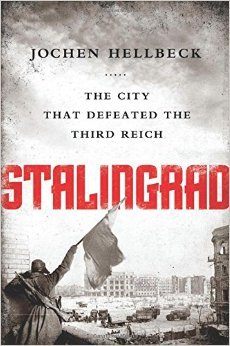
The Soviet victory represented a turning point in the Second World War; as Rutgers University historian Jochen Hellbeck observes, the battle “shifted the war’s momentum in favour of the Red Army; after Stalingrad, its divisions would push steadily westward, their sights set on Berlin.”

Hellbeck has selected excerpts from Soviet first-person accounts of the battle of Stalingrad in order to illuminate the motivations of the Soviet rank and file.

It is an intriguing and gripping yet off-putting collection.

The source of these first-person accounts was the work of the Commission on the History of the Great Patriotic War, a delegation of historians from Moscow who visited the Stalingrad front in January and February 1943.

Aware of the monumental significance of the battle, the historians wanted to record for posterity the experiences of participants.

Accordingly, they conducted interviews with a wide range of actors: “generals, staff officers, troop commanders, simple foot soldiers, commissars, agitators, sailors of the Volga Military Flotilla, nurses and a number of civilians.”

The commission’s historians ultimately collected 215 interviews that fill thousands of typed pages. They were unable to obtain permission to publish these documents, however; Hellbeck’s selection represents their first appearance in English.

The eyewitness accounts presented in Hellbeck’s volume reflect the brutality and futility of industrialized warfare, its carnage and destruction.

The courage, tenacity and self-sacrifice of the Soviet soldiers in defending Stalingrad against the Nazi invader can only excite the highest admiration. But there is a limit to which one can sympathize with the Soviet soldier: charging into battle, they would shout “For the socialist motherland!” and “For comrade Stalin!”

They really were indoctrinated — or perhaps the historians inserted these expressions of fidelity to communism and the Soviet state in order to make the interviews more acceptable to Soviet censors. Who knows?

The Soviets did emphasize indoctrination and constant monitoring of the “political-moral mood” of the troops. For this purpose, political officers were attached to each regiment.

As Hellbeck writes, “The cement that the Red Army command used to bind together diverse soldiers and motivate them to fight was ideology.”

Hellbeck’s selections vividly depict the battle of Stalingrad in all its horror and heroism.


Graeme Voyer is a Winnipeg writer.

History

Updated on Saturday, May 30, 2015 8:50 AM CDT: Formatting.

Report Error Submit a Tip

More Stories

Smart Suite lets families of children with disabilities learn how adaptive design, tech can improve their lives

Sheldon Birnie 4 minute read Preview

Smart Suite lets families of children with disabilities learn how adaptive design, tech can improve their lives

Sheldon Birnie 4 minute read 3:35 PM CDT

The first thing Zoe Versteeg did after rolling into the living room was to change the hue-lighting colour to match the shade of her lavender glasses. The smile that spread across her face was nearly as bright as the lights in the room.

“It’s just joy, immediate joy when she sees something happening. She’s like, ‘I control that, I got to do that,’” Elsien Versteeg, Zoe’s mother, said. “Her being able to make those decisions on her own, she can just do it herself now.”

Zoe, who is 13 and non-verbal, uses eye-gaze technology to communicate and control both her wheelchair and an array of smart devices. Versteeg and Zoe were at the official opening of the Rehabilitation Centre for Children’s new Smart Suite on Aug. 26, where the team behind the project was demonstrating the breadth of adaptive design and technologies available locally for families of children with disabilities to provide them with greater independence.

The Versteegs use many of the devices in their own home near New Bothwell.

Read
3:35 PM CDT

Woman dies in house fire on Fleet Avenue

Morgan Modjeski 4 minute read Preview

Woman dies in house fire on Fleet Avenue

Morgan Modjeski 4 minute read Updated: Yesterday at 9:37 AM CDT

A woman is dead after a fire destroyed part of a house in Winnipeg’s Rockwood community.

Neighbour Russ Kolisnyk said he watched as fire crews battled the blaze at about 10:30 a.m. at 1076 Fleet Ave. Monday.

“They went into the back of the house with hoses, all of the other equipment, they were in their full gear,” the 61-year-old said. “Then we heard a person coming out and they came out the front door with her.”

A couple, believed to be in their 60s, lived in the home, another neighbour said.

Read
Updated: Yesterday at 9:37 AM CDT

Soviet victory at Stalingrad bore a heavy cost

Reviewed by Graeme Voyer 3 minute read Preview

Soviet victory at Stalingrad bore a heavy cost

Reviewed by Graeme Voyer 3 minute read Saturday, May. 30, 2015

The battle of Stalingrad in the Second World War was a titanic struggle between the armies of Nazi Germany and the Soviet Union.

It lasted six months, from August 1942 to early February 1943, ending with the encirclement and surrender of the German forces.

The bitter, street-by-street and building-by-building combat cost an estimated one million lives.

The Soviet victory represented a turning point in the Second World War; as Rutgers University historian Jochen Hellbeck observes, the battle "shifted the war's momentum in favour of the Red Army; after Stalingrad, its divisions would push steadily westward, their sights set on Berlin."

Read
Saturday, May. 30, 2015

Waverley West council candidates say city services haven’t kept up with fastest-growing ward

Joyanne Pursaga 5 minute read Preview

Waverley West council candidates say city services haven’t kept up with fastest-growing ward

Joyanne Pursaga 5 minute read Updated: Yesterday at 7:50 PM CDT

A new city councillor will be elected this fall to lead Winnipeg’s fastest-growing ward that remains short on city services despite it being the most populated.

Read
Updated: Yesterday at 7:50 PM CDT

Bombers defence is in for its stiffest test of the season against Als

Ken Wiebe 6 minute read Preview

Bombers defence is in for its stiffest test of the season against Als

Ken Wiebe 6 minute read 2:58 PM CDT

Jordan Younger sees the growing pains, yet he still sees the potential through it all. This isn’t about watching film through rose-coloured glasses either, as the Winnipeg Blue Bombers defensive co-ordinator has no trouble acknowledging the issues that have occasionally plagued his unit during a 5-5 start.

Read
2:58 PM CDT

Police make two arrests in June theft of cross-country fundraising cyclists’ bikes

Zoe Pierce 4 minute read Preview

Police make two arrests in June theft of cross-country fundraising cyclists’ bikes

Zoe Pierce 4 minute read 4:53 PM CDT

On June 22, Thomas Clark and Valentin Duquenne set out to cycle across Canada to raise money for men’s mental health. Along the way, they lost four bikes to thieves in two cities — first in Winnipeg, then in Calgary.

Just over a month after their first bikes were stolen in Winnipeg, police have arrested two men for the theft.

The bicycles, valued at about $15,000, were stolen July 24 from a vehicle parked in the 400 block of Portage Avenue while Clark and Duquenne were inside CBC Manitoba for a media interview.

The Winnipeg Police Service said one of the bikes was recovered Aug. 7 after officers spotted a 60-year-old man riding it in the 1800 block of Bannatyne Avenue West. He was arrested and charged with possession of property obtained by crime over $5,000 before being released on an appearance notice. The bicycle was returned to its owner.

Read
4:53 PM CDT