Sci-fi series’ conclusion is classic Scalzi
Advertisement
Read this article for free:
or
Already have an account? Log in here »
To continue reading, please subscribe:

Digital Subscription
One year of digital access for only $205*
- Enjoy unlimited reading on winnipegfreepress.com
- Read the E-Edition, our digital replica newspaper
- Access News Break, our award-winning app
- Play interactive puzzles
*First annual payment billed as $205.00 + GST for one year. This annual subscription will automatically renew at $233.00 + GST every 52 weeks (10% off the regular annual price of $259.35). Offer available to new and qualified returning subscribers only. Cancel any time.
To continue reading, please subscribe:
Add Free Press access to your Brandon Sun subscription for only an additional
$1 for the first 4 weeks*
- Enjoy unlimited reading on winnipegfreepress.com
- Read the E-Edition, our digital replica newspaper
- Access News Break, our award-winning app
- Play interactive puzzles
*Your next Brandon Sun subscription payment will increase by $1.00 and you will be charged $17.95 plus GST for four weeks. After four weeks, your payment will increase to $24.95 plus GST every four weeks.
Read unlimited articles for free today:
or
Already have an account? Log in here »
Hey there, time traveller!
This article was published 26/09/2015 (3978 days ago), so information in it may no longer be current.
American science-fiction vet John Scalzi puts his Old Man’s War universe to bed for a time with his latest, a moderately satisfying conclusion to a fairly diverse series. The original novel for which the series is named acknowledged a debt to Robert Heinlein’s Starship Troopers, but made a number of innovative departures, including a left turn in terms of politics and a tempered but ever-present thread of humour.
That novel became the first in a trilogy, followed by what could be described as an interquel to the same trilogy, and then a duology of the most recent two books. Throughout these books Scalzi has posited a harsh, Darwinian universe, “red in tooth and claw,” as it were, with hundreds of alien civilizations in constant war over regions of space, planets, or simply mutual intolerance.
But even in the first book, Scalzi sowed the seeds of a contrarian political viewpoint. While the first three books explored the exploits of several of his Colonial Union soldiers as pawns in an ongoing succession of wars of survival, hints were dropped that the humans were doing more than simply defending their own existence. With last year’s The Human Division, the focus shifted to a new group of characters, most of them Colonial Union diplomats rather than soldiers, trying to clean up the inevitable mess of a decades-long shoot-first foreign policy.
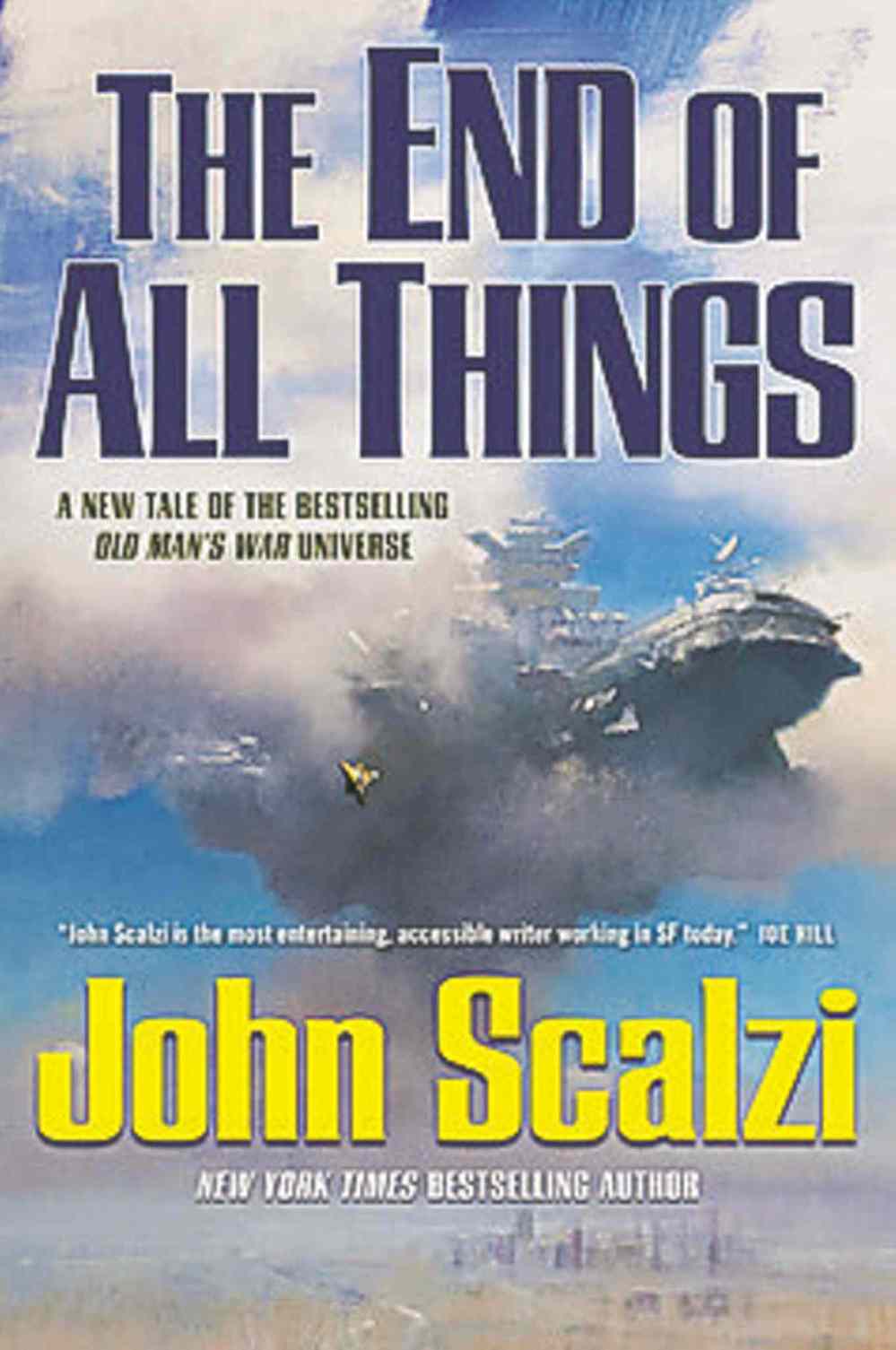
The End of All Things picks up that thread. For the second time, Scalzi structures his book as a series of short stories and novelettes intended to work individually but also simultaneously as chapters in a single novel. To reinforce that dual perspective, he published it both ways: as a series of individual stories released electronically and sold separately over a period of months, or as this single book, available now after the release of the final part. It’s something like a hybrid of short-fiction publishing with old-fashioned serial novels, both found in magazines from the 19th century onward.
Scalzi was more successful with this approach in The Human Division, perhaps because the characters and stories were new to the Old Man’s War universe and thus worked better as independent works of fiction. In The End of All Things, the constituent parts are less effective as individual stories, which is too bad, as the resulting shifts in character and point of view from story to story also make the novel feel less cohesive. The rotating cast of protagonists, while well-written, are likewise more difficult to connect with than a single main character in a typical novel-length work.
Overall structure aside, the writing is of Scalzi’s usual quality, balancing thoughtfulness with entertainment for a fairly readable result. Most of the major threads from the previous book (as well as earlier entries) are tied up, though room is left for additional entries down the road, and both author and publisher have announced that he is contracted for at least one more Old Man’s War book in the next decade.
This latest release serves as a reasonably solid followup to the previous book and equally good conclusion to the series. New readers should start with 2005’s Old Man’s War, or at the very least last year’s The Human Division. Returning readers are likely to be satisfied (if not blown away) by another decent entry in what has sometimes been an exemplary series.

Joel Boyce is a Winnipeg writer and teacher.
History
Updated on Saturday, September 26, 2015 7:50 AM CDT: Formatting.