In the eye of the storm All sports in the line of fire as summer weather heats up
Read this article for free:
or
Already have an account? Log in here »
To continue reading, please subscribe:

Digital Subscription
One year of digital access for only $205*
- Enjoy unlimited reading on winnipegfreepress.com
- Read the E-Edition, our digital replica newspaper
- Access News Break, our award-winning app
- Play interactive puzzles
*First annual payment billed as $205.00 + GST for one year. This annual subscription will automatically renew at $233.00 + GST every 52 weeks (10% off the regular annual price of $259.35). Offer available to new and qualified returning subscribers only. Cancel any time.
To continue reading, please subscribe:
Add Free Press access to your Brandon Sun subscription for only an additional
$1 for the first 4 weeks*
- Enjoy unlimited reading on winnipegfreepress.com
- Read the E-Edition, our digital replica newspaper
- Access News Break, our award-winning app
- Play interactive puzzles
*Your next Brandon Sun subscription payment will increase by $1.00 and you will be charged $17.95 plus GST for four weeks. After four weeks, your payment will increase to $24.95 plus GST every four weeks.
Read unlimited articles for free today:
or
Already have an account? Log in here »
With such freezing winters, warm weather is usually welcomed with open arms here in the Keystone province. But it’s hard to be grateful for rising temperatures when sunny days turn into torturous heat.
Internationally, athletes have been affected by the rising heat, smoke or storms that viciously blunder through. This year alone the weather has impacted everything from the Tour de France to the men’s FIFA World Cup.
CASSIDY DANKOCHIK / THE CARILLON FILES Team Manitoba’s game against Team Quebec at the U18 2026 Football Canada Cup in July was delayed until 10 p.m. because of a heat warning.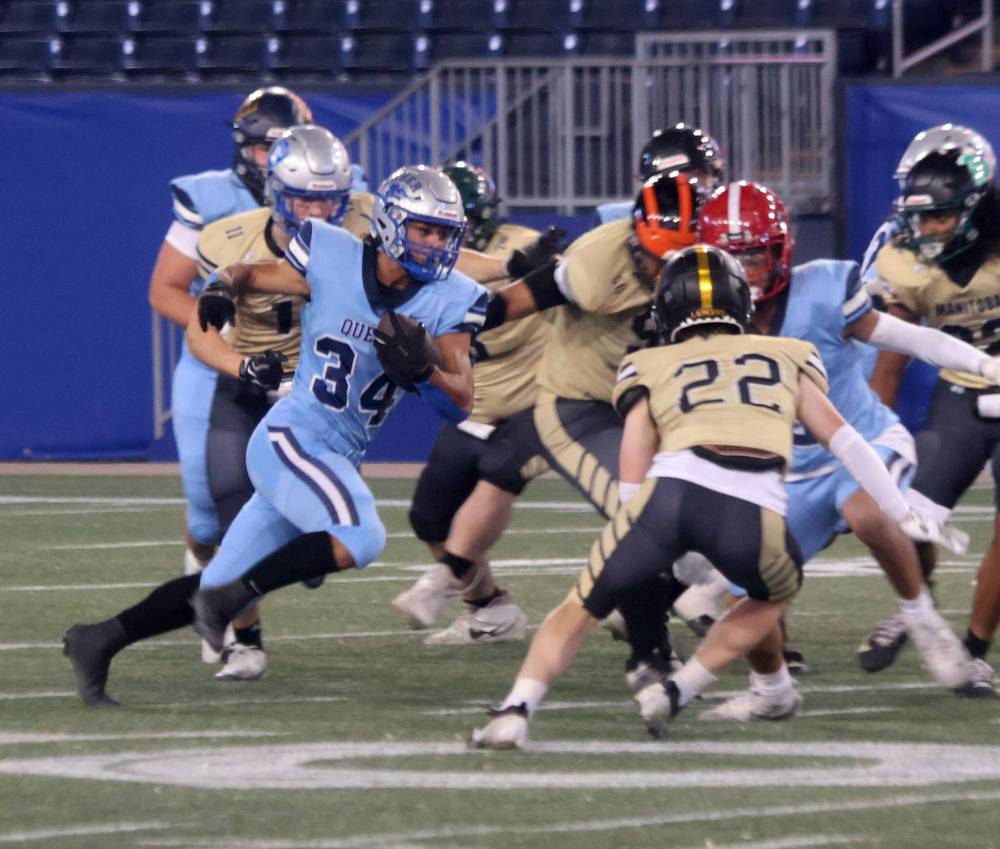
Locally, the U18 Football Canada Cup had to delay multiple games well into the night and there have been repetitive tarp deployments during Winnipeg Goldeyes games.
Jared Ladobruk, executive director of Golf Manitoba, has seen the impact over the last couple of years.
“We’re down in our metric keeping for rounds of golf played. Many other facilities are very close to that as well due to the fact that it’s been so wet this spring and summer,” Ladobruk shared.
The heat itself hasn’t been an issue as players self-manage their hydration and UV protection, but the rain has made the course unplayable.
“We had one event cancelled that was to be up in Gilbert Plains the first week of July due to flooding in the area. Unfortunately, we had to cancel that event in the community and had to pivot to three weeks later to a different community,” he explained.
“It certainly impacted us from a competition standpoint.”
Environment Canada Humidex Table:*
20-29 degrees = no discomfort
30-34 degrees = some discomfort
35-39 degrees = great discomfort; avoid exertion
40 degrees and over = dangerous; cancel activity
*all numbers in Celsius
With the season length already being on a short ladder, it’s even tougher to reschedule tournaments to ensure that the necessary matches are being held prior to championships games. Ladobruk brought up how it has affected the facilities involved with employees losing jobs due to the cancellations.
“Certainly, this weather is having a negative impact on what is already a very short golf season,” he said. “It’s something we will have to be on top of moving forward because the different weather patterns that we’re experiencing recently, we have to anticipate that the world will go through it again.”
Leaving the golf course for the pitch, provincial soccer teams are experiencing the opposite problem. They are able to play in the rain (with the exception of lightning) but the heat has been a health issue for the players.
“We’ve had some games where the temperature was above 34 degrees (Celsius). Definitely hard for the players to stay hydrated — they get tired easier and there’s a big risk of muscle injuries,” JB Pierazzi, Prairie Premier League Bonivital men’s head soccer coach, said.
Much like the designated hydration breaks held during the FIFA World Cup, Winnipeg team’s have also had to abide to the new rule — necessary two-minute water breaks scattered within the game.
SUPPLIED The Gilbert Plains Country Club officially closed for the season on Aug. 5 after extensive flooding that occurred in late June.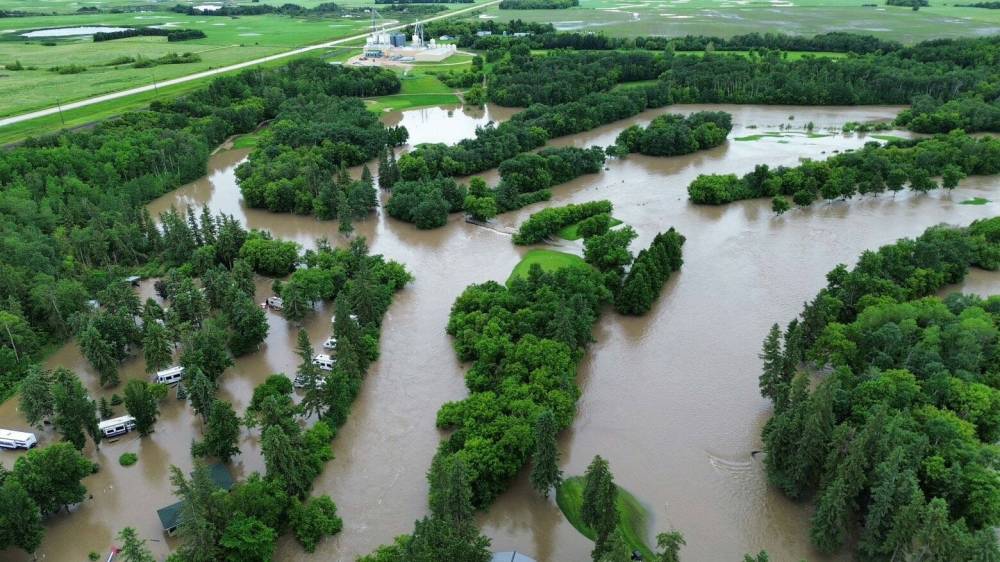
“It’s not easy especially because we’re playing on turf,” Pierazzi said, the turf being made of artificial grass and plastics. “There’s no (circulation) and the humidity gets stuck. It increases the temperature by four to five degrees.”
“(Due to) the lack of hydration, we had a player that felt dizzy. We had to take him out at half time because of a stomach ache. We’ve had some issues because of the heat. The players are not really used to that,” Pierazzi added.
“The players are not really used to that.”
Not only does it impact the players on the field, but also the ones on the bench who sit in the heat for over two hours. Pierazzi does his best to ensure they have proper shade and coverage.
For the Velodonnas Cycling Club, they’ve had their fair share of cancellations. Linda van de Laar, secretary of the all-female club, expressed that all the elements affect their rides, especially depending on what terrain they’re biking on that day.
“For road riding, wind gusts are dangerous because they can push cyclists into the road. Since we are sharing the road with vehicles, wind gusts can be quite dangerous when you’re riding in a pack,” she said.
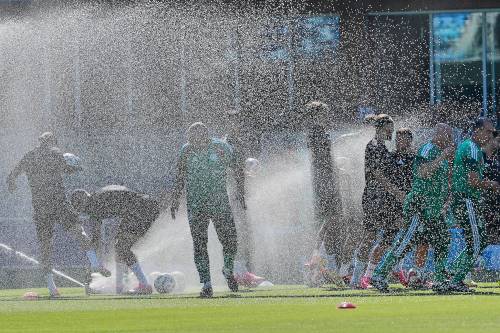
Eugene Hoshiko / THE ASSOCIATED PRESS FILES Algeria players are sprayed by sprinklers during a training session ahead of Group J action at this summer’s men’s World Cup.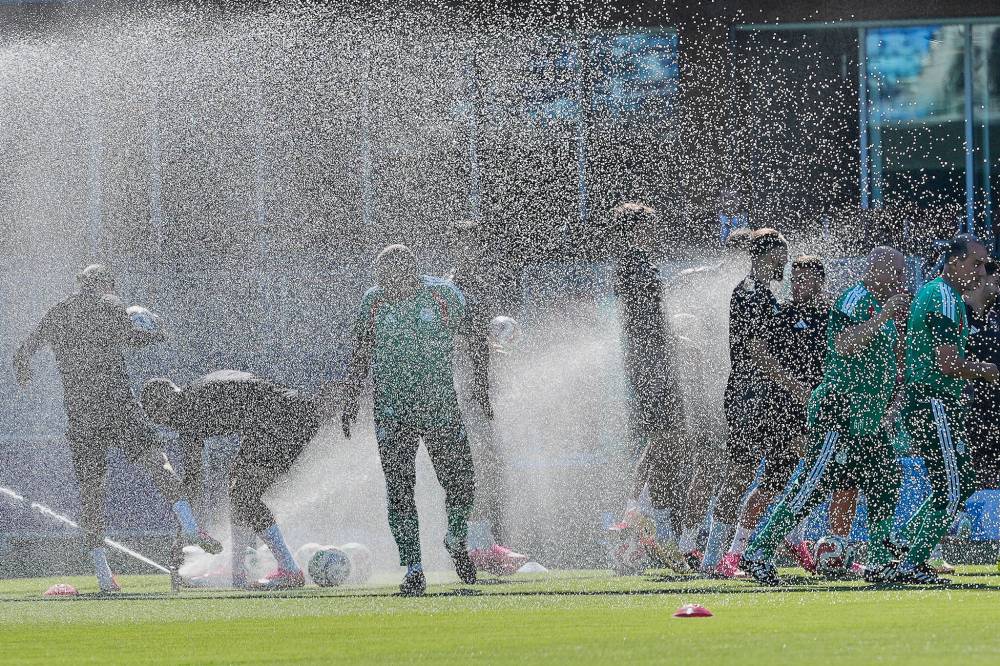
The club has rides on Monday, Tuesday and Wednesday evenings which vary from road, gravel and mountain bike trails. With tornado, heat and storm warnings, they’ve had to cancel many rides throughout the summer months.
“On July 20, our rides were cancelled because of a sudden downpour that came out of nowhere,” van de Laar explained.
Volunteer ride leaders are not able to carry extra supplies with them, with every rider responsible for their own hydration. Although the leaders do bring a small basic first aid kit with them, it is not a requirement for them to be certified in standard first aid or CPR.
After this year’s extreme weather, the club has put into consideration having their ride leaders carry these certifications as conditions such as heat exhaustion or stroke need to be properly identified.
And while the outdoor sports have surely been affected, so have some of the indoor ones, too. Matthew Berven, commissioner for Winnipeg Box Lacrosse, had a strenuous day on June 9 when multiple weather warnings were sent out.
Mosa’ab Elshamy / THE ASSOCIATED PRESS FILES There were wildfire disruptions to the Tour de France this summer, with dozens burning in the southwest of France. The final stage of the race had to be rerouted and shortened, fully taking place within Paris.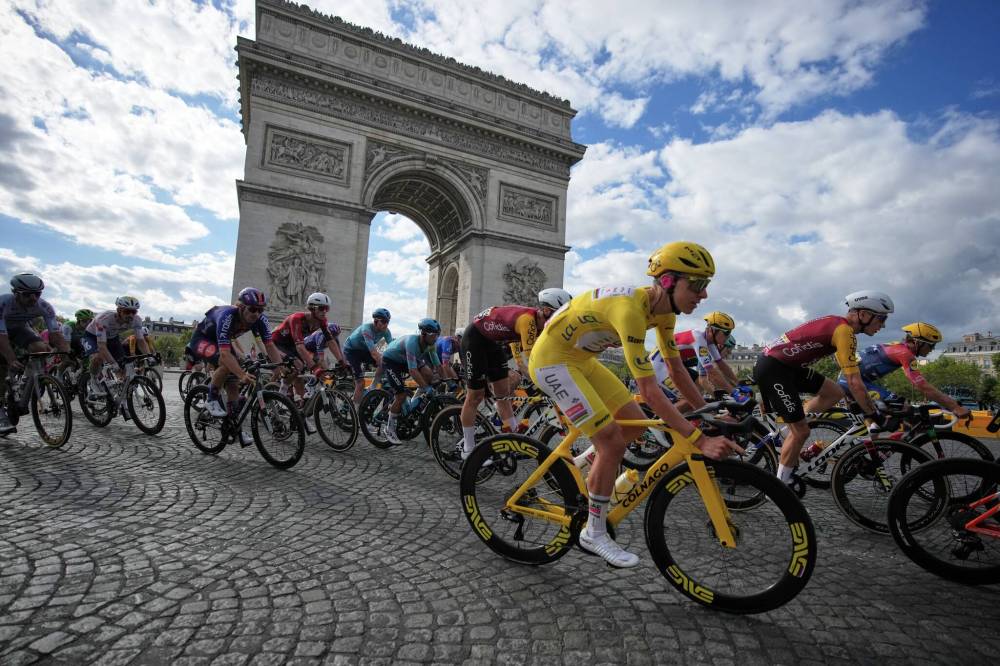
“On the big night we had all those tornado warnings, we had games scheduled — we have clubs that play in and around Winnipeg,” Berven said, with teams from Stonewall, Ste. Agathe, East St. Paul, Oakbank and Brandon.
Initially, the league didn’t foresee any issues with it being an indoor sport.
“But what ended up happening was the storm tracked right across Winnipeg, then there were emergency red warnings cropping up as the storm was passing over top of us,” he explained.
“All these people had to travel around the perimeter or through the city and there were certain areas that were getting a ‘Do not travel. Stay in place’ warning from the province,” Berven said, having to cancel and reschedule 12 games as well as draft a weather policy on safe travel conditions for the players.
And this type of weather — from storms to heat advisories to poor air quality — isn’t going away anytime soon, as Jay Johnson, a kinesiology professor at the University of Manitoba, shared.
“We’re seeing it now affect our leagues, organizations, community (and) school-based programming,” Johnson said.
SUPPLIED The indoor Winnipeg Box Lacrosse league now has a weather policy because of the June 9 storm that saw the cancellation and rescheduling of 12 games due to unsafe travel conditions for the players.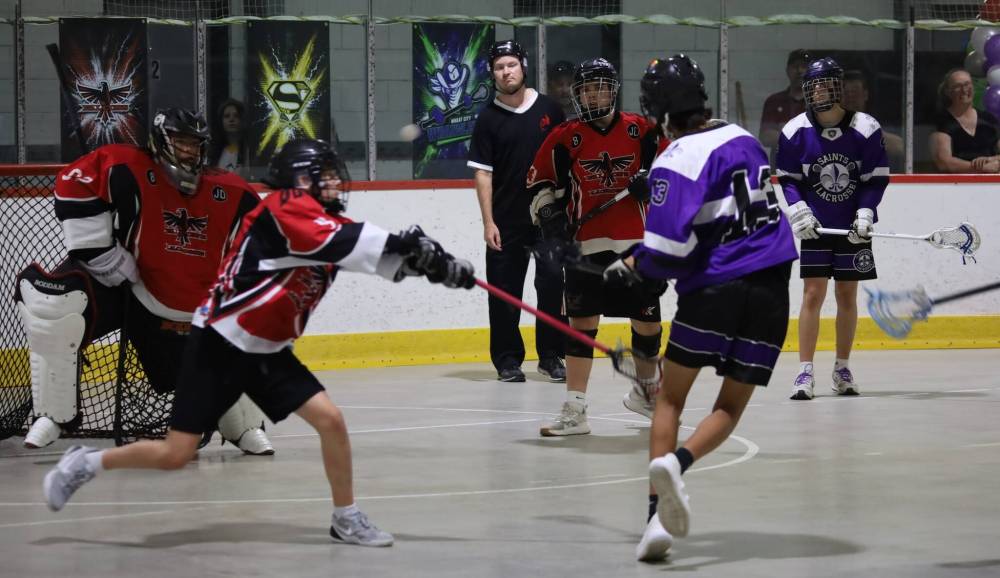
Johnson said that while physicians often prescribe physical activity to their patients, they are now being encouraged to stay indoors, ultimately resulting in lack of exercise. For those who do not have the financial means to book indoor facilities or summer camps, they are forced to stay inside for their health — a counter intuitive measure.
“People who are in lower socioeconomic situations, they’re reliant on public spaces and community programming for their physical activity, recreation and sport,” he explained.
“The indoor part is where inequity comes in. And have higher rates of health consequences too if you look at the social determinants of health. They’re also affected more health-wise because of climate change and environmental factors.”
Of course, the bigger picture is we need to stop burning and consuming fossil fuels — but that is not a short-term solution. Instead, we need to adapt to our ever-changing climate and prepare.

With him teaching an outdoor education class this summer, Johnson needed to make a plan A, B and C when it came to the curriculum and the health and safety of his students. For example, Johnson had taken his students to Spruce Woods for a biking trip but with a recent storm, the path was unrideable due to fallen trees and branches.
“It’s created different ways that we have to approach what we do, where we do it, and when we do it,” Johnson said.
“Be prepared for everything — a rapidly changing climate and a world that’s heating up.”
grace.penner@winnipegfreepress.com