Inuit oral histories pointed to Franklin wreckage — but no one listened

Advertisement

Advertise with us

If ego were a parade in Canada's Arctic, a white man would probably lead it.

Read this article for free:

or

Already have an account? Log in here »

To continue reading, please subscribe:

Subscribe and receive a limited-edition Free Press branded hat or tote.

Digital Subscription

One year of digital access for only $205*

  • Enjoy unlimited reading on winnipegfreepress.com
  • Read the E-Edition, our digital replica newspaper
  • Access News Break, our award-winning app
  • Play interactive puzzles

*First annual payment billed as $205.00 + GST for one year. This annual subscription will automatically renew at $233.00 + GST every 52 weeks (10% off the regular annual price of $259.35). Offer available to new and qualified returning subscribers only. Cancel any time.

To continue reading, please subscribe:

Add Free Press access to your Brandon Sun subscription for only an additional

$1 for the first 4 weeks*

  • Enjoy unlimited reading on winnipegfreepress.com
  • Read the E-Edition, our digital replica newspaper
  • Access News Break, our award-winning app
  • Play interactive puzzles
Start now

*Your next Brandon Sun subscription payment will increase by $1.00 and you will be charged $17.95 plus GST for four weeks. After four weeks, your payment will increase to $24.95 plus GST every four weeks.

Hey there, time traveller!
This article was published 30/01/2016 (3842 days ago), so information in it may no longer be current.

If ego were a parade in Canada’s Arctic, a white man would probably lead it.

For it could well be that the Inuit in Canada’s North got a raw deal and should get more credit for helping to locate the bones of one of the world’s most famous ships — Sir John Franklin’s Erebus — in her underwater grave in 2014.

Author David Pelly says information passed down by the Inuit in the late 1800s defined where the ship was (although searchers argue it was technology that pinpointed its exact location).

Either way, while Canada’s Inuit unquestionably helped solve one of the greatest exploratory mysteries of the Victorian Age, it was then-prime minister Stephen Harper who excitedly announced it to the world in 2014. While there was mention of the Inuit contribution, if any of their people were there with the beaming Harper, they were lost in a sea of white.

But what may make people such as Pelly fume more than anything is that the finding of the ship was characterized as a discovery. It wasn’t. Franklin’s sailing ship, trapped in the ice and abandoned, was discovered by the Inuit, as much as 169 years earlier.

The distinction isn’t moot because to sidestep, to mistake, to misrepresent, to ignore the history of a people who are the unquestionably respected masters and custodians of Canada’s Arctic is to inch toward cultural genocide. At the very least, it is insulting and demeaning.

Franklin’s sailing ship and everybody aboard it vanished around 1845 on a dangerous mission: to conquer the Northwest Passage sea corridor from the Atlantic to the Pacific in what was the most treacherous, ice-clogged body of water anywhere. It was then the biggest maritime prize in the world.

Although not the theme of his latest book, Pelly describes in Ukkusiksalik some of the information in Inuit oral histories that were like bread crumbs on the ice leading to what is left of HMS Erebus.

In a chapter on Franklin, Inuit elder Tuinnaq Kanayuk Bruce repeats information passed down to her orally about how Inuit helped a U.S. 3rd cavalry officer and his men hunt for the explorers from 1878-80.

The cavalry party was informed by an Inuk, Ikinilik, that he had visited a ship frozen in the ice but there was no sign of life, and when they got inside there was a corpse in a bunk as well as canned meat, forks, knives and spoons. Inuit also said they had to walk out five kilometres from the shore on smooth ice to reach the abandoned ship.

Another man, Puhtoorak, said he visited the ship multiple times at Ootgoolik. That name corresponds to the area in which Erebus was found. (The ship later sank.)

More importantly, a New York journalist with the cavalry searchers reported he had learned (obviously from Inuit) that the ship was near an island named Keeweewoo, a small island near O’Reilly Island, which, author Pelly says, “as far as we know, corresponds very closely with the location of the shipwreck found in 2014.”

Says a critical Pelly: “It is evident that this long-standing Inuit oral testimony pointed quite accurately to the ultimate modern ‘discovery’ of the Erebus shipwreck.”
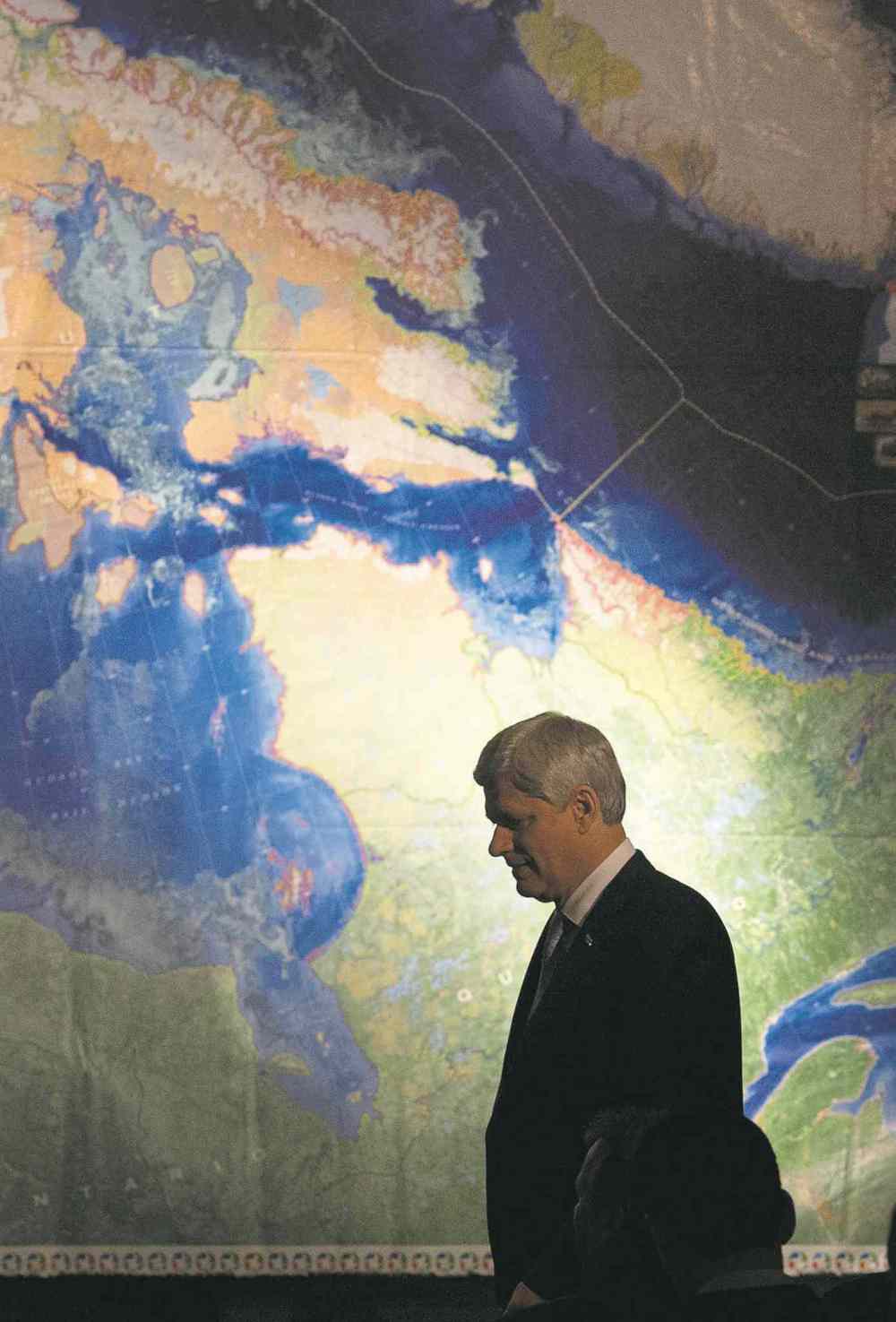
Darren Calabrese / THE CANADIAN PRESS files 
In 2014, then-prime minister Stephen Harper announced the discovery of the sunken Erebus.
Darren Calabrese / THE CANADIAN PRESS files In 2014, then-prime minister Stephen Harper announced the discovery of the sunken Erebus.

Franklin and his 129 men all died in the expedition; The Erebus’ sister ship, Terror, is still missing.

A sizeable portion of Pelly’s book is the oral histories of Inuit life and their experiences in the Ukkusiksalik area north-northwest of Hudson Bay, among rock 2.5 billion years old.

Inuit oral storytelling is arresting. There is no embellishment, no guile, no attempt to please or persuade, deceive or distort, somewhat like a good occurrence report by police: matter-of-fact, neutral, robotic.

It takes some getting used to, but it’s worth it.


In 1969, writer Barry Craig was aboard the icebreaker that helped the first commercial vessel conquer the Northwest Passage and fulfil the dream that Franklin and his men died trying to achieve.

Report Error Submit a Tip

More Stories

Gilbert Plains Country Club closes for remainder of season due to flood damage

Ken Wiebe 6 minute read Preview

Gilbert Plains Country Club closes for remainder of season due to flood damage

Ken Wiebe 6 minute read Yesterday at 5:50 PM CDT

Scott McCallum has made the trek to the Gilbert Plains Country Club clubhouse countless times.

But this was the first time the golf professional and general manager of the course required hip waders to get to his office.

Walking hand in hand with his wife Lindsay, McCallum didn’t need much time to see the devastation caused by the flash flooding in the Parkland region in late June.

“We’re on a river and it’s a beautiful golf course, but anytime you’re on a body of water you know that you’re taking a chance of events like this happening,” McCallum said in a telephone interview. “To this magnitude, we’ve never seen anything like it before. So, this is new to us.

Read
Yesterday at 5:50 PM CDT

Inuit oral histories pointed to Franklin wreckage — but no one listened

Reviewed by Barry Craig 4 minute read Preview

Inuit oral histories pointed to Franklin wreckage — but no one listened

Reviewed by Barry Craig 4 minute read Saturday, Jan. 30, 2016

If ego were a parade in Canada's Arctic, a white man would probably lead it.

For it could well be that the Inuit in Canada's North got a raw deal and should get more credit for helping to locate the bones of one of the world's most famous ships — Sir John Franklin's Erebus — in her underwater grave in 2014.

Author David Pelly says information passed down by the Inuit in the late 1800s defined where the ship was (although searchers argue it was technology that pinpointed its exact location).

Either way, while Canada's Inuit unquestionably helped solve one of the greatest exploratory mysteries of the Victorian Age, it was then-prime minister Stephen Harper who excitedly announced it to the world in 2014. While there was mention of the Inuit contribution, if any of their people were there with the beaming Harper, they were lost in a sea of white.

Read
Saturday, Jan. 30, 2016

Chrysler refines Pacifica and Grand Caravan as buyers return to practical family hauler

Kelly Taylor 5 minute read Preview

Chrysler refines Pacifica and Grand Caravan as buyers return to practical family hauler

Kelly Taylor 5 minute read 3:00 AM CDT

BURLINGTON, Ont. — The mighty minivan — relegated to the scrap heap by the rush to crossovers and SUVs — is making a comeback, and Chrysler hopes to lead the way with its top-selling, Canadian-made Grand Caravan and Pacifica models.

While many manufacturers — Mazda, Ford, GM, Hyundai and Nissan — abandoned the once-popular family hauler, Chrysler has continued to play in the segment since it was launched by Lee Iacocca in 1983.

For 2027, the Pacifica gets a cosmetic refresh and the Grand Caravan is a holdover, but new this year are price savings of up to $7,200, Chrysler product planner Mike Szymkiewicz told journalists assembled here for the launch of the two vehicles.

“It’s primarily that we’re taking less margin, but we’re also adding content,” he said. “So less margin but we hope more volume.”

Read
3:00 AM CDT

Today’s horoscope

Georgia Nicols 4 minute read Preview

Today’s horoscope

Georgia Nicols 4 minute read Yesterday at 2:00 AM CDT

MOON ALERT: Avoid shopping (except for food and gas) and important decisions after 6 p.m. After that, the moon moves from Taurus into Gemini.

ARIES (March 21-April 19)

Discussions about home repairs and family matters, especially with respect to project costs, might occur. It’s an excellent day to make plans about the education and care of your kids. Some however, will plan out a vacation — every detail.

TAURUS (April 20-May 20)

Read
Yesterday at 2:00 AM CDT

Letters, Aug. 7

7 minute read 2:01 AM CDT

Clarification

A letter to the editor in the Aug. 6 edition of the Free Press, headlined Defining context, indicated that the federal auditor-general criticized the Canadian Museum for Human Rights for having had deficiencies in managing its exhibitions, saying, “without rigorous systems and practices to ensure accuracy and balance … errors and bias could be introduced to exhibits which could adversely affect the corporation’s reputation and be costly to correct after the fact.” The report in question was done in 2017 and released publicly in 2018. At the time, the museum agreed with the findings and listed a series of steps it would take to address the issue.

ERs should be used as intended

Re: Steinbach ER under siege by frustrated Winnipeggers (Aug. 5)

Leon’s Getting Larger and their tours are getting longer

Tiago Resko 4 minute read Preview

Leon’s Getting Larger and their tours are getting longer

Tiago Resko 4 minute read 3:00 AM CDT

Emo music was never just a phase for Nikola Boticki.

“It was people just saying the things I was feeling,” says the 26-year-old vocalist and guitarist. “Growing up, it’s kind of like, ‘I feel that way but I’m not going to say that out loud,’ so it was nice to hear someone say it.”

Boticki got into the punk subgenre near the end of his angsty high school years and his appreciation only grew while in isolation during the COVID-19 pandemic.

The music inspired him to form his own emo band, Leon’s Getting Larger, with friends Luke Penner (vocals/drums) and Noah St Hilaire (bass).

Read
3:00 AM CDT