In conversation with… John Ralston Saul
Advertisement
Read this article for free:
or
Already have an account? Log in here »
To continue reading, please subscribe:

Digital Subscription
One year of digital access for only $205*
- Enjoy unlimited reading on winnipegfreepress.com
- Read the E-Edition, our digital replica newspaper
- Access News Break, our award-winning app
- Play interactive puzzles
*First annual payment billed as $205.00 + GST for one year. This annual subscription will automatically renew at $233.00 + GST every 52 weeks (10% off the regular annual price of $259.35). Offer available to new and qualified returning subscribers only. Cancel any time.
To continue reading, please subscribe:
Add Free Press access to your Brandon Sun subscription for only an additional
$1 for the first 4 weeks*
- Enjoy unlimited reading on winnipegfreepress.com
- Read the E-Edition, our digital replica newspaper
- Access News Break, our award-winning app
- Play interactive puzzles
*Your next Brandon Sun subscription payment will increase by $1.00 and you will be charged $17.95 plus GST for four weeks. After four weeks, your payment will increase to $24.95 plus GST every four weeks.
Read unlimited articles for free today:
or
Already have an account? Log in here »
Hey there, time traveller!
This article was published 14/05/2016 (3755 days ago), so information in it may no longer be current.
Award-winning author John Ralston Saul presided over an enhanced citizenship ceremony Monday at the Canadian Museum for Human Rights, part of a week-long focus at the CMHR on migrants and refugees. Saul co-founded the Institute for Canadian Citizenship with his wife, Adrienne Clarkson, the former governor general. Prior to the citizenship ceremony, participants had a chance to discuss their experiences in roundtable discussions organized by the ICC. Perspectives and politics editor Shannon Sampert spoke with Saul about citizenship and human rights and their connections, particularly to indigenous people.
Free Press: Your belief is that modern Canada, including its notions of citizenship, have been shaped by the ideas of indigenous people. Most of us, when we think about citizenship rights and new Canadians, we think of those as being two dichotomous groups. But you see there are lessons to be learned from indigeneity.
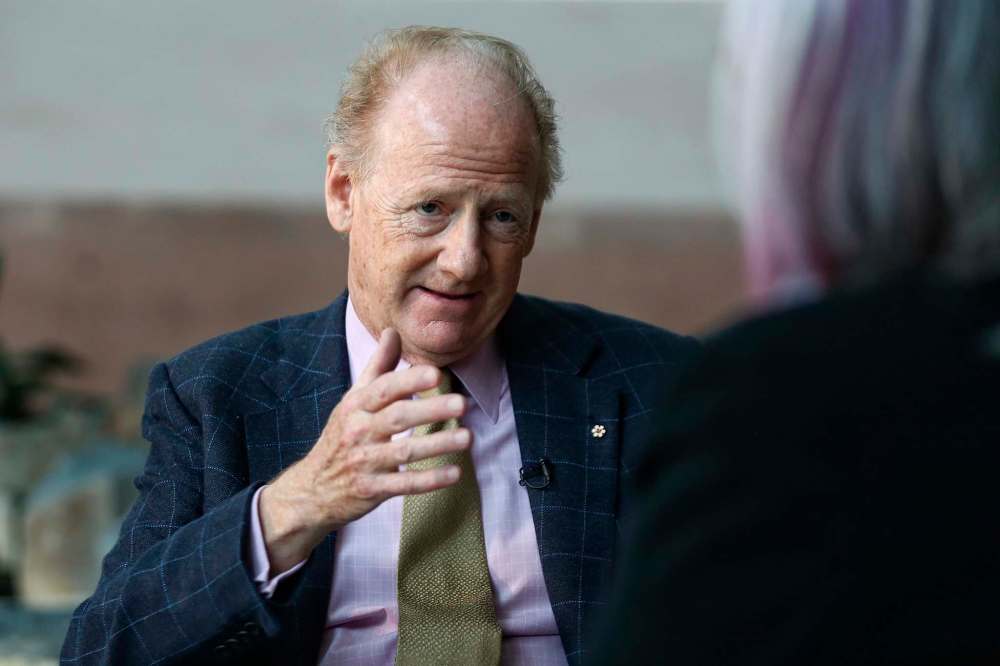
John Ralston Saul: Mythology is about truth, and we’ve had a lot of this mythology put in place by a lot of people who come from Britain and France to impose their mythology. If you look at their attitudes towards immigration and citizenship, they are not at all like us in Canada. So how can we possibly say the root of the Canadian approach to citizenship and immigration comes from Europe or the United States? I mean, we just don’t do the same things.
What I’ve said, very simply is that unlike other colonies, for the first 250 years approximately, indigenous people were either the dominant force or an equal force. And in that period of time, the poverty-stricken, lost, confused fur traders and farmers and immigrants learned how to live here. In the beginning, they survived only because of indigenous peoples. In essence, they learned a way of belonging, of welcoming people, of dealing with the “other,” which is not a European approach. And we’ve just kept on doing it.
FP: One of the things you write about is the idea of sympathy being a passive form of racism. In Canada, right now, I think a lot of people are sympathetic to what’s going on, particularly on northern reserves where suicide rates are so high and poverty is an ongoing issue, where no running water is available. How would you like Canadians to rethink the way we view this?
JRS: When we fall into sympathy, it’s really not terribly useful — although I suppose it’s better than outright hatred, which is what we used to do — but sympathy allows you to escape from actually dealing with what’s happening. Suicides on northern reserves are an outcome of a whole range of activities over 100 to 150 years, activities driven by Ottawa, Toronto, Montreal, Winnipeg with policies like the Indian Act. It is things like poor schooling. Your kids get $1, an indigenous kid gets 75 cents and they’re on an isolated reserve so they actually need $1.50 because of where they are. The absence of a health-care unit, the absence of a social centre. I’ve been up in the Arctic Circle where they have hockey rinks that don’t have any heating. So it’s – 40 C outside, it’s –55 inside. Or there’s a social centre but no budget for anybody to run any programs. Stuff we wouldn’t accept in Winnipeg but we let it go on and on and on.
So that produces a lack of hope, the confusion — nihilism is the outcome of all of that and nihilism leads to suicides.
FP: As a person living in Winnipeg, the problems are just so overwhelming about the level of care that needs to take place to get rid of poverty. The hangover from residential schools and decolonization is all so overwhelming. We’re not going to get rid of the problems in a generation.
JRS: Yes and no. As we all know, if there are problems in your family, indigenous or not, those problems reverberate for generations. That’s one thing and it takes a long time.
But the answers to the other issues is simple. We start spending the right amounts of money in things like education. There is no reason there should be dirty water. We don’t accept it in the south, why do we accept it in the North? You work with indigenous engineers, architects and so on and you solve this problem in five years. This is doable.
We see schools in shacks and polluted grounds — this a building problem, an architectural problem. These things can be dealt with really fast; this is not so overwhelming. Let’s get the really nuts-and-bolts, the practical things, done. It’s going to cost several billion dollars, and we’re going to have to spend it, but we spent it on ourselves and now we need to spend it properly in this area.
FP: It’s great to see young indigenous people graduating with degrees. They’re passionate, they’re organized, and they’re going back to their reserves and making demands on their reserves, too.
JRS: The fighting back by indigenous people started in 1900: OK, they’ve cornered us, our population is almost gone, they’ve defeated us. From there, the modern Indian rights movement started and it was a very hard fight, with a lot of stuff going against them. From 1960 on, they’ve been blasting the way forward. So, the difficulty is that there are a lot of people that concentrate only on what’s still going wrong but they’re not seeing what is actually happening.
So the endless newspaper headlines, every time the numbers come out saying aboriginals lag behind in education, that’s true. But look at this another way. In 1955 or 1960, there were less than 10 aboriginals in Canada in universities and now there are about 35,000. It was forbidden for an aboriginal to be a lawyer until about 1955, but today there are 2,000 aboriginal lawyers. There are doctors, there are these professors. We now have the first president of a university who is aboriginal (Mike DeGagné at Nipissing University). So this growth rate of the really great stuff is faster than in any other area in Canadian society.
This interview was condensed for clarity and length.