From Bad to worse

New Michael Jackson bio treads fawning, familiar ground

Advertisement

Advertise with us

In 1997, Michael Jackson released the album Blood on the Dance Floor which contained a track titled Morphine — the first and only of his songs to deal with his relationship to drugs. By the time Jackson died in 2009 at age 50, drugs would dominate his days and nights. And ultimately cause his death.

Read this article for free:


or

Already have an account? Log in here »

To continue reading, please subscribe:

Subscribe and receive a limited-edition Free Press branded hat or tote.

Digital Subscription

One year of digital access for only $205*

  • Enjoy unlimited reading on winnipegfreepress.com
  • Read the E-Edition, our digital replica newspaper
  • Access News Break, our award-winning app
  • Play interactive puzzles

*First annual payment billed as $205.00 + GST for one year. This annual subscription will automatically renew at $233.00 + GST every 52 weeks (10% off the regular annual price of $259.35). Offer available to new and qualified returning subscribers only. Cancel any time.

To continue reading, please subscribe:

Add Free Press access to your Brandon Sun subscription for only an additional

$1 for the first 4 weeks*

  • Enjoy unlimited reading on winnipegfreepress.com
  • Read the E-Edition, our digital replica newspaper
  • Access News Break, our award-winning app
  • Play interactive puzzles
Start now

*Your next Brandon Sun subscription payment will increase by $1.00 and you will be charged $17.95 plus GST for four weeks. After four weeks, your payment will increase to $24.95 plus GST every four weeks.

Hey there, time traveller!
This article was published 25/06/2016 (3721 days ago), so information in it may no longer be current.

In 1997, Michael Jackson released the album Blood on the Dance Floor which contained a track titled Morphine — the first and only of his songs to deal with his relationship to drugs. By the time Jackson died in 2009 at age 50, drugs would dominate his days and nights. And ultimately cause his death.

That is the singular take-away of any substance from Before You Judge Me: The Triumph and Tragedy of Michael Jackson’s Last Days. Author, TV and radio broadcaster Tavis Smiley and music bio author David Ritz chronicle the 16 weeks before Jackson’s death on June 25, 2009 — six years ago today. It was a period when the king of pop was ostensibly engaged in preparations for a massive 50-date concert stand in London, England, that was to be both his comeback and swan song.

The massive investigation undertaken by Smiley and Ritz indicates Jackson spent more of his time conducting impetuous dealings with myriad business advisers, avoiding his immediate family, conducting wild shopping sprees, watching movies and ingesting crazy cocktails of heavy prescription drugs than he did singing and dancing.

No XMP or IPTC Header Found

The authors are abundantly sympathetic to Jackson’s memory. They write with a mix of breathless National Enquirer-style of sensationalism/speculation and an over-awed Teen Beat style of fan magazine writing that has largely disappeared from music coverage (with the possible exception of People magazine).

Before completing the introduction, the authors have gushed, “To be close to Michael (Jackson) is to be close to immortality.” There are many references to his “artistic genius,” and he is dubbed a character of “mythic proportions.” His song lyrics are breathlessly dissected for pages at a time for clues about his early life, the trials and tribulations of stardom, and his philosophy of life as if they were serious literature rather than dance music.

Not to deny Michael Jackson was a universal entertainment superstar of the first rank. His musical achievements were extraordinary, from the earliest emergence as a singing, dancing child prodigy fronting the Jackson Five through to his solo dominance of rock, pop and soul music (and video) through the years — 1982’s Thriller remains the biggest-selling album of all time, claiming an incredible 65 million albums sold.

Jackson’s hits owned radio charts and his inventive singing and dancing videos dominated MTV, breaking down racial barriers and stereotypes proving, as Rolling Stone acknowledged, “the biggest pop star in the world could be young and black.” One source indicates an astounding 227 books about Jackson and his career have been published, with one or two new additions appearing every year.

Much of this biography is cobbled together from the usual sources: old interviews, newspaper and magazine articles, videos, the Internet and other books. Some sections jump out for the way they’re written in the third person, with the authors taking on the persona of Jackson as if they are telling the story in his words and thoughts.

Joel Ryan / The Associated Press files
In March 2009, Michael Jackson announced he would play 50 live concerts at the London O2 Arena that July. He died June 25 of that year.
Joel Ryan / The Associated Press files In March 2009, Michael Jackson announced he would play 50 live concerts at the London O2 Arena that July. He died June 25 of that year.

In the afterword, Smiley describes this device as a “novelistic narrative,” “imbuing the text” with “all the excitement and fast-paced rhythm of a novel.” It’s an interesting concept and good reading, but the authenticity and the accuracy of these passages can’t be verified. The technique is simply conjecture masquerading as fact.

In seeking to understand why Jackson died at 50, Ritz and Smiley tend to play down the weirdness of his childhood, the Disney-esque Neverland estate he moved to at age 30, the numerous plastic surgeries that altered his appearance from an average African-American visage to a fun-house, male version of a young Diana Ross. There’s little serious investigation of the child molestation rumours from 1993 and even less reporting on the facts of the seven counts of committing lewd acts with a minor that were tried in 2004 that more or less ended Jackson’s reign as king of pop. The not-guilty verdict in the case is accepted as the ultimate proof of Jackson’s innocence.

Jackson’s prescription drug use, on the other hand, is unavoidable: clonazepam to treat anxiety, the anti-depressant trazodone to promote sleep, Demerol to ease the pain of his weekly Botox injections and propofol, the milky intravenous anesthetic Jackson had administered by his “private doctor” on an almost nightly basis to treat chronic insomnia.

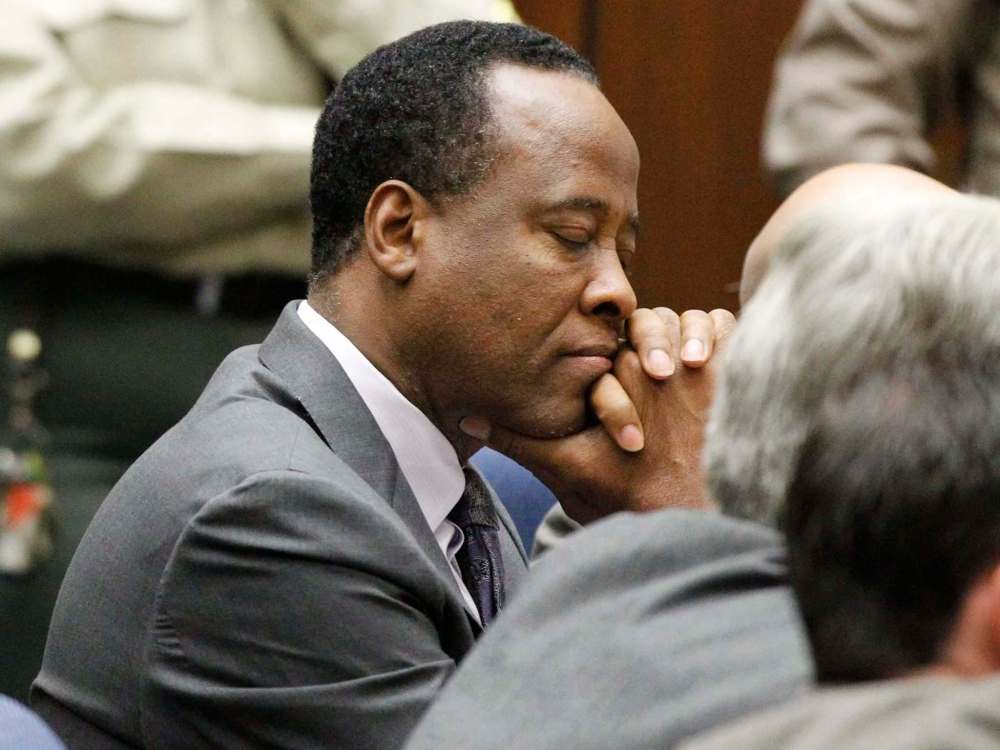
Jackson died of acute propofol and benzodiazepine intoxication; his personal physician, Conrad Murray, was later convicted of involuntary manslaughter in the sad death.

Overall, the authors succeed in proving, largely by default, that Jackson was a prescription medication junkie and that his death, while an accidental overdose, was close to predictable given the lethal potency of the medications he chose to abuse.

Danny Moloshok / The Associated Press files
A fan of Michael Jackson (top) holds up a licence plate proclaiming his love for the pop singer while waiting for the verdict in the involuntary manslaughter trial of Conrad Murray (above), Jackson’s personal physician. In November 2011, Murray was convicted and sentenced to four years in county jail his role in Jackson’s 2009 death.
Danny Moloshok / The Associated Press files A fan of Michael Jackson (top) holds up a licence plate proclaiming his love for the pop singer while waiting for the verdict in the involuntary manslaughter trial of Conrad Murray (above), Jackson’s personal physician. In November 2011, Murray was convicted and sentenced to four years in county jail his role in Jackson’s 2009 death.

Jim Millican is a Winnipeg writer and music journalist.
Mario Anzuoni / The Associated Press files
Report Error Submit a Tip

More Stories

Rare and tough to notice, sarcomas may lurk in the body

Jen Zoratti 12 minute read Preview

Rare and tough to notice, sarcomas may lurk in the body

Jen Zoratti 12 minute read Monday, Aug. 31, 2026

Last summer, Michelle Finley was going about a normal day.

She had just dropped her car off at a garage and was walking back to her office building downtown when, suddenly, she was stopped in her tracks by a searing cramp on the bottom of her right foot.

“It was so painful it took my breath away,” says Finley, now 52. “I stopped and held on to the side of a building for a second — like, it was bringing tears to my eyes.”

Finley thought she had a really bad case of plantar fasciitis. Nine months later she would lose her foot to sarcoma.

Read
Monday, Aug. 31, 2026

Mayoral rematch between Gillingham, Klein gets ugly on Day 1

Joyanne Pursaga 6 minute read Preview

Mayoral rematch between Gillingham, Klein gets ugly on Day 1

Joyanne Pursaga 6 minute read Updated: Yesterday at 6:25 PM CDT

Former city councillor and provincial cabinet minister Kevin Klein says he will soon enter the race to become Winnipeg’s next mayor — prompting an immediate war of words with incumbent Scott Gillingham.

Gillingham quickly responded to the announcement by calling Klein “toxic” and a “fixer” for Peter Nygard.

Klein said Tuesday he had decided not to enter the mayoral race weeks ago due to an unspecified health scare that required surgery. After recovering, he decided to run.

“The future of the city means a lot to me. I believe that we have so much untapped potential that I felt I should do something about it,” said Klein, noting he felt compelled to run because key city issues, such as perceptions of public safety in the downtown, have grown worse over the past four years.

Read
Updated: Yesterday at 6:25 PM CDT

Klein’s entrance adds spark to ho-hum mayoral race

Tom Brodbeck 5 minute read Preview

Klein’s entrance adds spark to ho-hum mayoral race

Tom Brodbeck 5 minute read Yesterday at 2:46 PM CDT

Until this week, Winnipeg’s mayoral race looked less like a democratic contest and more like a coronation.

Read
Yesterday at 2:46 PM CDT

Renewed spirit and life: Indigenous treatment centre expands with $21-M revamp

Scott Billeck 5 minute read Preview

Renewed spirit and life: Indigenous treatment centre expands with $21-M revamp

Scott Billeck 5 minute read Yesterday at 3:44 PM CDT

Don Robinson knows first-hand that many people don’t get sober by themselves.

In late June 1984, Robinson downed his last drink. His recovery began at Pritchard House in Winnipeg’s North End, a 22-bed treatment facility run by the Native Addictions Council of Manitoba.

“I didn’t get sober by myself,” said Robinson, a member of Bunibonibee Cree Nation who now works in grief and trauma counselling and traditional knowledge as an elder at Ka Ni Kanichihk Inc.

More than four decades later, Robinson was back at the council on Monday, crowded into a room at its newly renovated treatment centre at 160 Salter St. — a place he once turned to for help and where he helps others now.

Read
Yesterday at 3:44 PM CDT

New Michael Jackson bio treads fawning, familiar ground

Reviewed by Jim Millican 5 minute read Preview

New Michael Jackson bio treads fawning, familiar ground

Reviewed by Jim Millican 5 minute read Saturday, Jun. 25, 2016

In 1997, Michael Jackson released the album Blood on the Dance Floor which contained a track titled Morphine — the first and only of his songs to deal with his relationship to drugs. By the time Jackson died in 2009 at age 50, drugs would dominate his days and nights. And ultimately cause his death.

That is the singular take-away of any substance from Before You Judge Me: The Triumph and Tragedy of Michael Jackson’s Last Days. Author, TV and radio broadcaster Tavis Smiley and music bio author David Ritz chronicle the 16 weeks before Jackson’s death on June 25, 2009 — six years ago today. It was a period when the king of pop was ostensibly engaged in preparations for a massive 50-date concert stand in London, England, that was to be both his comeback and swan song.

The massive investigation undertaken by Smiley and Ritz indicates Jackson spent more of his time conducting impetuous dealings with myriad business advisers, avoiding his immediate family, conducting wild shopping sprees, watching movies and ingesting crazy cocktails of heavy prescription drugs than he did singing and dancing.

The authors are abundantly sympathetic to Jackson’s memory. They write with a mix of breathless National Enquirer-style of sensationalism/speculation and an over-awed Teen Beat style of fan magazine writing that has largely disappeared from music coverage (with the possible exception of People magazine).

Read
Saturday, Jun. 25, 2016

Construction Clock management platform rebranded as Supercrew

Aaron Epp 4 minute read Preview

Construction Clock management platform rebranded as Supercrew

Aaron Epp 4 minute read Yesterday at 8:45 PM CDT

David Peters is off the clock.

The Winnipeg-based construction worker turned tech entrepreneur announced on Tuesday his company, Construction Clock, has rebranded as Supercrew.

The new name reflects the evolution from a time tracking app for the construction industry to an all-in-one crew management platform that helps contractors plan work, track labour and pay employees, Peters said.

It’s the platform he envisioned when he started the company in 2022.

Read
Yesterday at 8:45 PM CDT