Greek theory explains China-U.S. rift
Advertisement
Read this article for free:
or
Already have an account? Log in here »
To continue reading, please subscribe:

Digital Subscription
One year of digital access for only $205*
- Enjoy unlimited reading on winnipegfreepress.com
- Read the E-Edition, our digital replica newspaper
- Access News Break, our award-winning app
- Play interactive puzzles
*First annual payment billed as $205.00 + GST for one year. This annual subscription will automatically renew at $233.00 + GST every 52 weeks (10% off the regular annual price of $259.35). Offer available to new and qualified returning subscribers only. Cancel any time.
To continue reading, please subscribe:
Add Free Press access to your Brandon Sun subscription for only an additional
$1 for the first 4 weeks*
- Enjoy unlimited reading on winnipegfreepress.com
- Read the E-Edition, our digital replica newspaper
- Access News Break, our award-winning app
- Play interactive puzzles
*Your next Brandon Sun subscription payment will increase by $1.00 and you will be charged $17.95 plus GST for four weeks. After four weeks, your payment will increase to $24.95 plus GST every four weeks.
Read unlimited articles for free today:
or
Already have an account? Log in here »
Hey there, time traveller!
This article was published 29/07/2017 (3327 days ago), so information in it may no longer be current.
A war that devastated ancient Greece 21/2 millennia ago can illuminate current international relations.
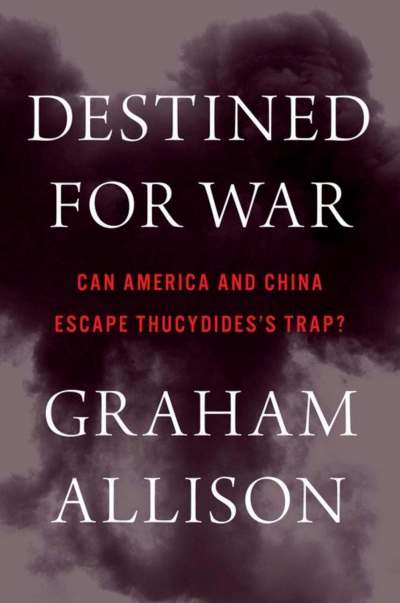
That is the contention of Graham Allison, a Harvard scholar and U.S. government advisor, in this insightful work of “applied history” which scans the historical record for precedents to contemporary problems.
The Peloponnesian War was a cataclysm of antiquity. It was fought between the classical Greek city states of Athens and Sparta.

The causes of the war were delineated by the ancient Greek historian Thucydides. In particular, Thucydides wrote, “It was the rise of Athens and the fear that this instilled in Sparta that made war inevitable.”
Athens was an emerging power; Sparta was the established power of the Greek world. Athens wanted the respect that would reflect its new status; Sparta was fearful of this challenge and sought to maintain the status quo. These structural conditions led to war.
Allison thus calls the confrontation between a rising and ruling power “Thucydides’s Trap.” During the past 500 years, these conditions have occurred 16 times; in 12 of these instances, war has been the result.
Ominously, in the contemporary world, the rivalry between China and the United States fits the pattern of Thucydides’s Trap. China is the rising power whose spectacular economic growth in recent decades has put it in a position to challenge American dominance.
Allison suggests war between China and the U.S. is possible, perhaps likely, but certainly not inevitable. Allison looks closely at the historical examples of Thucydides’s Trap which did not culminate in war in order to glean lessons about the management of relations between ascendant and established powers.
In its confrontation with the U.S., China enjoys certain advantages. For example, it recognizes no binding moral norms that would constrain its pursuit of self-interest.
While Americans — both officials and the general public — are increasingly averse to combat deaths, Chinese leaders “have been known to quip that they have several million surplus single males ready to die for their country.”
A stylistic criticism: Allison’s formidable education (Oxford and Harvard) does not prevent him from writing a sentence with a dangling participle.
More significantly, Allison says that China has “a supremacist world view bound up in Chinese identity.” That sounds like a polite way of calling it racist. If Chinese society is racist, then why doesn’t Allison describe it as such?
He has no compunctions over labelling western opposition to globalization as rooted in “xenophobia.”
Apparently, ugly words such as racism and xenophobia are to be applied only to western societies.
Winston Churchill, Allison tells us, observed that “the longer you can look back, the farther you can look forward.” Allison uses history to elucidate the dynamics of contemporary international relations; he emphasizes that events are not predetermined, but shaped by human agency.
With an understanding of history, American and Chinese leaders can respond to circumstances creatively, and take steps to avoid Thucydides’s Trap.
Graeme Voyer is a Winnipeg writer.