The right stuff
U.S. space-station commander's bio in solid orbit
Advertisement
Read this article for free:
or
Already have an account? Log in here »
To continue reading, please subscribe:

Digital Subscription
One year of digital access for only $205*
- Enjoy unlimited reading on winnipegfreepress.com
- Read the E-Edition, our digital replica newspaper
- Access News Break, our award-winning app
- Play interactive puzzles
*First annual payment billed as $205.00 + GST for one year. This annual subscription will automatically renew at $233.00 + GST every 52 weeks (10% off the regular annual price of $259.35). Offer available to new and qualified returning subscribers only. Cancel any time.
To continue reading, please subscribe:
Add Free Press access to your Brandon Sun subscription for only an additional
$1 for the first 4 weeks*
- Enjoy unlimited reading on winnipegfreepress.com
- Read the E-Edition, our digital replica newspaper
- Access News Break, our award-winning app
- Play interactive puzzles
*Your next Brandon Sun subscription payment will increase by $1.00 and you will be charged $17.95 plus GST for four weeks. After four weeks, your payment will increase to $24.95 plus GST every four weeks.
Read unlimited articles for free today:
or
Already have an account? Log in here »
Hey there, time traveller!
This article was published 09/12/2017 (3202 days ago), so information in it may no longer be current.
When he returned to Earth from his historic “year in space” mission to the International Space Station (ISS) on March 1, 2016, astronaut Scott Kelly set a record for the most accumulated days spent in space by an American — 520 over a career spanning two space-shuttle flights and two extended stays at the ISS.
In Endurance, Kelly recounts that 340-day “year” (over precisely 365 pages of text) and also tells the compelling and inspiring story of how he got there — his journey from a directionless, mediocre student to becoming one of America’s most accomplished astronauts.
Kelly is fortunate to have as his co-author Margaret Lazarus Dean, who wrote two previous books related to the space program: The Time it Takes to Fall (2007), a novel set in the aftermath of the 1986 Challenger space shuttle disaster, and most recently, Leaving Orbit: Notes from the Last Days of American Spaceflight (2015), which recounts the end of the space-shuttle program.
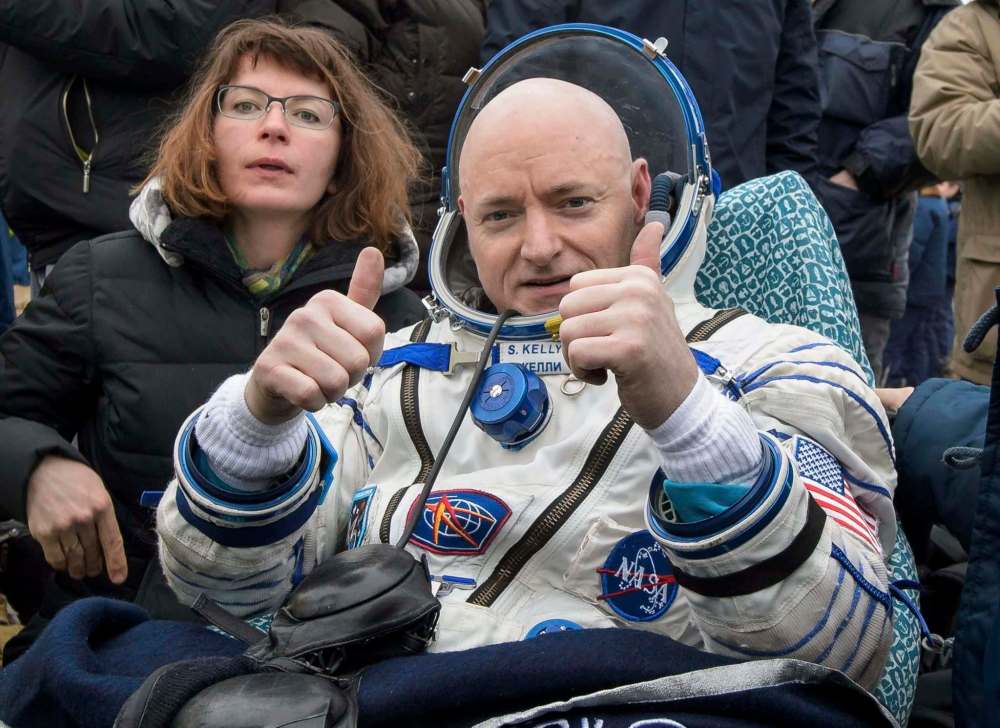
Together, Kelly and Dean have crafted a highly engaging book that is at once a celebration of humanity’s great accomplishment in the form of the ISS and a story of individual perseverance, equally at home in explaining the technological complexities of human spaceflight as it is the psychological, interpersonal and emotional ones.
Kelly makes the science and engineering behind the ISS quite accessible, while also on occasion offering surprisingly frank assessments of certain problematic NASA procedures or behaviours on the part of colleagues.
Even more fascinating are Kelly’s many observations about the cultural differences and intercultural relations aboard the ISS, particularly as they relate to the Russians, on whom the U.S. has had to depend for transport to and from the ISS since its shuttle fleet was retired.
When faced with the possibility of a collision with a large piece of space debris, for example, the American astronauts are immediately ordered to engage in numerous time-consuming safety precautions, while the Russians reason fatalistically that the station would be destroyed in such an event, so do nothing.
Fans of Chris Hadfield’s 2013 book An Astronaut’s Guide to Life on Earth will quickly recognize certain similarities between that book and Endurance.
Both authors — both commanders of missions on the ISS — recall how their years of training prepared them for their months on the station, where they gained huge followings on social media while coping with loneliness and mourning the impacts their careers have had on their families and romantic relationships.
Both men even struggle to overcome major surgeries that threatened to ground them.
Remarkably, however, neither appears to have crossed paths with the other, at least not in the pages of their respective books (although Kelly does give a couple of nice nods to Canadian astronaut Julie Payette, our freshly minted Governor General).
Kelly’s memoir is told in two alternating narratives; his year in space is told in the present tense, while his youth and career trajectory are recalled the past tense.
For the most part, this structure serves his purpose quite well, emphasizing the incredible amount of study, dedication and sacrifice it took to get him into space, and the personal resilience required to keep him focused and sane once he arrives.
It does, however, result in one jarring discontinuity: he mentions early in the book that his sister-in-law, Democratic congresswoman Gabrielle Giffords, had been shot five years previously while he was on an earlier ISS mission, a reference to the 2011 mass shooting in Tuscon, Ariz., that is only explained 165 pages later when his flashbacks finally catch up to that event.
Kelly’s fondness for two books looms large throughout: The Right Stuff — Tom Wolfe’s classic 1979 history of the Mercury program — and Alfred Lansing’s 1986 account of Sir Ernest Shackleton’s ill-fated Antarctic expedition of 1914-17, also entitled Endurance.
The first gave a young Scott Kelly an epiphany that forever transformed his young aimless life into one of purpose and discipline, while the second he turns to for inspiration while in space to learn from Shackleton’s fortitude.
With his Endurance, Scott Kelly leaves his own literary legacy, surely inspiring as-yet-unknown young men and women to become the next generation of space travellers.
Michael Dudley once dreamed of becoming an astronaut, but is quite happy to be a librarian at the University of Winnipeg.

Endurance: A Year in Space, a Lifetime of Discovery
By Scott Kelly with Margaret Lazarus Dean
Viking, 400 pages, $34
Related Articles
Antarctic explorer Shackleton’s ship found after a century
Advertisement Advertise With Us
Advertisement Advertise With Us